

Key Points and Summary – Canada’s Defence Ministry will finish its review of the 88-jet F-35 purchase by late September 2025, then hand Prime Minister Mark Carney a go/no-go decision.
-U.S. Ambassador Pete Hoekstra warns ditching the deal could strain NORAD interoperability, while domestic skeptics cite tariffs, cost growth, and doubts about Washington’s NATO reliability.

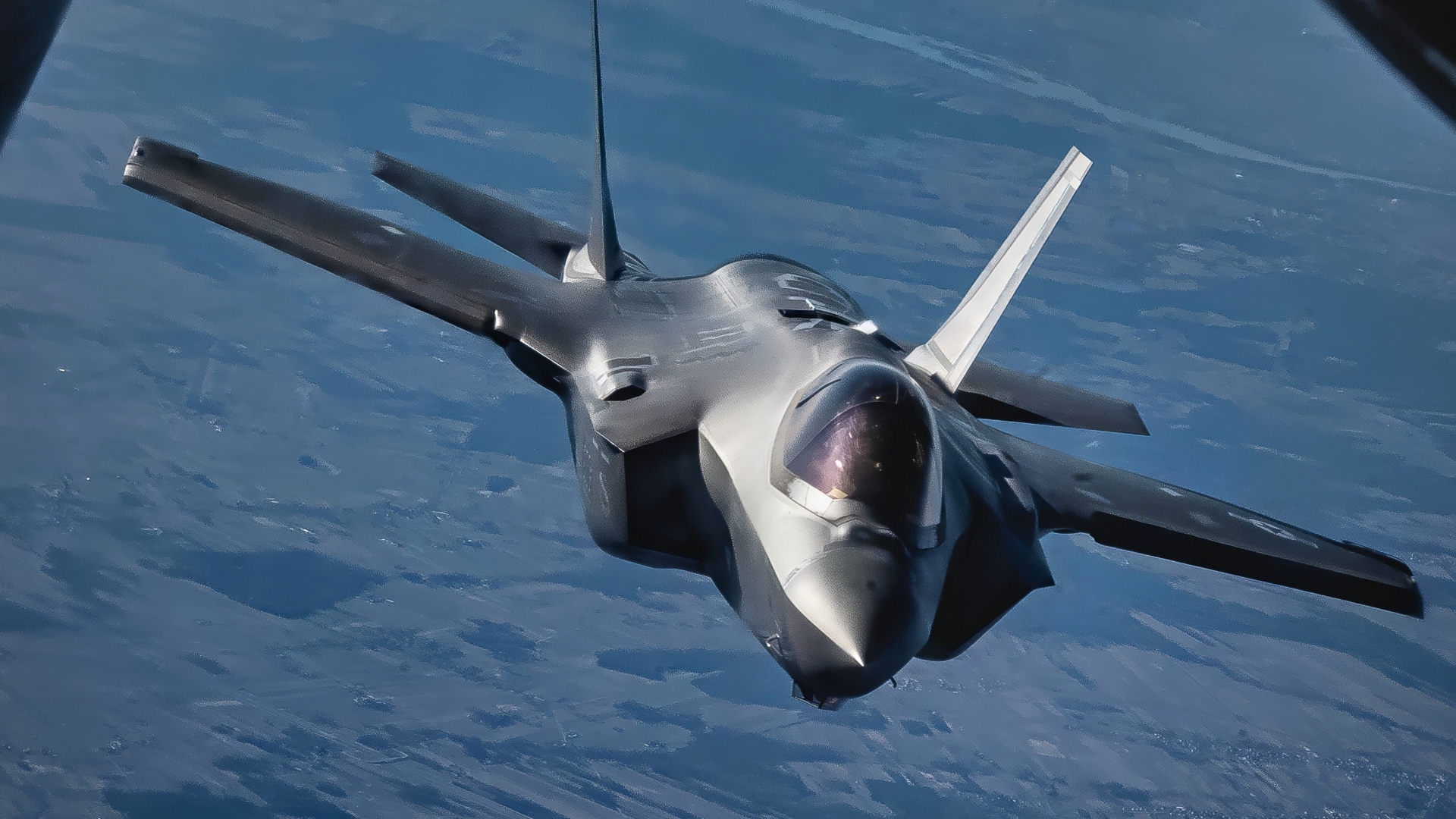
U.S. Air Force Maj. Melanie “Mach” Kluesner performs aerial maneuvers during a demonstration at the Oshkosh AirVenture Airshow in Wisconsin, on July 25, 2025. The demonstration highlights the team’s mission to showcase the precision, agility, and combat-relevant capabilities of the F‑35A Lightning II and the professionalism of its Airmen. (U.S. Air Force photo by Senior Airman Nicholas Rupiper)
-The path here included a multi-year FFCP competition that narrowed to F-35 vs. Saab’s Gripen, with Dassault and Airbus exiting over security and terms.
-Saab still pitches Canadian assembly and Arctic suitability. With aging CF-18s and rising threats, Ottawa’s choice now carries outsized consequences for alliance cohesion and Canada’s Arctic posture.
WARSAW, POLAND – Canada’s Department of National Defence (DND) is in the process of reviewing its planned F-35 purchase and has said that the whole effort will be completed by the end of September 2025. The consensus in some quarters is that the standing commitment to acquire the F-35 will be a hard sell to a Canadian population that has experienced growing resentment against the US over the tariff wars initiated by United States President Donald Trump since starting his second term in office.
However, reports in the Ottawa Citizen, one of the nation’s leading newspapers, are that Washington has already warned that America’s neighbor to the north could suffer “serious consequences” if Canada should abandon the deal.

U.S. Air Force Maj. Kristin “BEO” Wolfe, F-35A Lightning II Demonstration Team commander, flies over Kennewick, Washington, during the Tri-Cities Water Follies Airshow Over the River, July 30, 2023. The F-35 Demonstration Team participated in the 2023 Tri-Cities Water Follies airshow and various other events in support of their mission to recruit, retain and inspire new and old generations of Airmen. (U.S. Air Force photo by Staff Sgt. Kaitlyn Ergish)
Speaking to the Canadian Daily, Alex Tétreault, a DND spokesman, confirmed that reviews of the F-35 offer would be completed by “the end of the calendar summer.” Once the final report has been issued, it will be forwarded to Prime Minister Mark Carney for his final decision.
Four months ago, in May, the US Ambassador to Canada, Pete Hoekstra, had warned that Canada pulling out of the F-35 deal could cause serious problems for the US-Canada North American Aerospace Defense Command (NORAD) alliance. The US Ambassador explained that in the current air power technology generation, both nations should operate the same fighter jet model for mission profiles to be “interchangeable” with one another.
The Royal Canadian Air Force (RCAF) currently operates a fleet of older-model CF-18A/B aircraft, built by McDonnell-Douglas in the early 1980s. The aircraft are some of the oldest F/A-18 model aircraft still in service. Due to wear and tear on the Canadian airframes, Canada purchased 18 F/A-18 surplus aircraft from the Royal Australian Air Force (RAAF) in 2017.
A Long-Running Procurement
Then-Prime Minister Stephen Harper’s Conservative government announced in July 2010 that it would purchase 65 F-35As for CAD $9 billion. Ottawa justified the decision, saying the aircraft was essential for Canada’s defense and Arctic sovereignty.
But during the 2015 federal election campaign, the Canadian Liberal Party leader, Justin Trudeau, canceled the sole-source procurement, one of his high-profile campaign promises. Trudeau charged that the Conservative Party had bypassed conducting a competitive tender and, by making a directed procurement, had committed to an “unnecessary and expensive fighter.”
After he assumed office in November 2015, the Trudeau government confirmed Canada would seek other options. Then in 2017, Canada began the Future Fighter Capability Project (FFCP) to replace the combined fleet of aging CF-18 and used RAAF Hornets.
One of the first bidders was the Boeing Company, which now owned the McDonnell-Douglas plant in St. Louis, Missouri, and was bidding on the latest model F/A-18E/F Super Hornet. Other hopefuls were France’s Dassault Aviation with the Rafale, Sweden’s Saab JAS-39E/F Gripen, and Airbus Military aircraft offering the Eurofighter Typhoon.
Dassault bowed out of the bidding in 2018 due to the security restrictions associated with Canada’s membership in the Five Eyes intelligence alliance. Airbus withdrew in 2019 due to favoritism extended to Lockheed Martin, the manufacturer of the F-35, and the Super Hornet was later disqualified.
Final Round and F-35 Wins?
As of March 2022, this left F-35 and Saab’s JAS-39E/F as the only competitors. Canada ended up selecting the F-35 due to their NATO obligations, NORAD interoperability, and Ottawa’s concerns over increased threats by Russia and others to the nation’s Arctic sovereignty.
The proposed deal was now a procurement for $19 billion to acquire 88 F-35s. Initial deliveries were supposed to take place in 2025. At this point, Saab accused the DND of having conducted an unfair competition. Saab’s Canada subsidiary declared Ottawa had violated tender regulations by having renegotiated costs, delivery timelines, and industrial offset arrangements with Lockheed Martin after final bids had been submitted.
Saab has kept its bid alive with a series of proposed incentives, including an offer that would allow RVAF to assemble, produce, and maintain the Gripens in Canada. The argument was also made that the Swedish aircraft was a better choice for an extreme Arctic climate and has a better availability rate over the F-35.
Retired Canadian Lieutenant General Yvan Blondin had at one time been an advocate for the F-35, but later stated that the procurement should be reconsidered due to the uncertainty of Washington’s commitment to the NATO alliance under the Trump administration.
“US F-35 support has to be considered in the same light as the security of Article 5 of the North Atlantic Treaty: it may or may not be there when needed, it is not under our control,” Blondin said.
Canada’s review will conclude in as early as 10 days. The decision will not only have a significant impact on the RCAF’s future operations, but it will also determine the future of the US with what was once its closest ally.
About the Author: Reuben F. Johnson
Reuben F. Johnson has thirty-six years of experience analyzing and reporting on foreign weapons systems, defense technologies, and international arms export policy. Johnson is the Director of Research at the Casimir Pulaski Foundation. He is also a survivor of the Russian invasion of Ukraine in February 2022. He worked for years in the American defense industry as a foreign technology analyst and later as a consultant for the U.S. Department of Defense, the Departments of the Navy and Air Force, and the governments of the United Kingdom and Australia. In 2022-2023, he won two awards in a row for his defense reporting. He holds a bachelor’s degree from DePauw University and a master’s degree from Miami University in Ohio, specializing in Soviet and Russian studies. He lives in Warsaw.
More Military
SR-72 Mach 6 Mistake the Air Force Needs to End
The U.S. Navy’s Ohio-Class Missile Submarine Nightmare
America Has Mini-Aircraft Carriers
Russia’s Su-57 Felon Stealth Fighter: Made in India?
F-22 Raptor vs. J-20 Stealth Fighter: Hope This Never Happens




Marc LaPlante
September 19, 2025 at 7:03 am
Canada would be foolish to spend another dollar on American hardware.
The current American government has broken the strong bond between the two neighbours that has existed for 150 years.
Canada now has to tie itself with the world’s remaining democracies in Europe and Pacific rim.
Ceding to American bullying only invites more bullying.
Complete the purchase of the 16 F35s required by the 2021 contract, keep them for NORAD commitments, and fill the rest of the fleet with cheaper, more dependable, and practical Gripens.
Then plan for all future procurement to be in collaboration with allies that share Canadian values.
Ramon Dilkie
September 19, 2025 at 7:58 am
It is interesting to note and the author did not point this out but Canada’s last major purchase of the F-18 Hornet did not align with what the US Air Force was flying either . Only the US Navy was flying Hornets . The considerations of interoperability with NORAD should not depend solely on that statement. At the time we were considering replacing the CF 101 Voodoo , we really only had a choice of the F-15 or the F-18 . Frankly the F-16 would have been a better choice but we had a dual engine requirement for operation in the North .
George M Flegel
September 19, 2025 at 10:35 am
I think it is ill advised to be doing any serious business with the United States considering the current administration and the continuing on again, off again trade war with the United States. The F-35s operating cost is astronomical compared to the Saab Gripen and the Saab is more suited to Canada’s needs, most importantly the ability to operate in our colder climate and to operate from smaller airstrips. The F-35 is very capable and is undoubtedly one of the best fighters in the world, but I do not think that Canada needs an overpriced super high tech fighter. I also do not trust the Trump administration to not interfere with the deal by trying to add additional costs, mess with deliveries or jack tariffs if we do something to annoy them. Canada is better off doing business with Saab as it is a much more responsible use of our tax dollars and makes us less dependant on an unpredictable trading partner like the United States. It is basically the question of buying an overpriced top of the line super car or settling on a more practical and less expensive sports car, which will be just as good and cost so much less to maintain.
Joe
September 19, 2025 at 1:31 pm
To consider a fighter fleet with 2 totally different airframes would be very costly and foolish.Not just for aircrew. The required training for maintenance and support personnel would severly strain military budgets. And let’s face reality. The average Canadian does not give a hoot about airforce costs and training.
Even successive governments stayed with the F35-A choice.
James Perreault
September 19, 2025 at 8:18 pm
Why Saab wins in Canada. 1. We can build the Gripen-E in Canada. That offers Saab a second major safe location to build off European shores, access to cheaper resources, access to skilled labour forces and better integration into NATO. 2. Every dollar spent on replacement aircraft stays in Canada, as opposed to the dollar suck of the F-35. The Gripen-E offers cheaper operational costs, faster turn around time between sorties. Cheaper purchase costs, in respect to more planes per dollars budgeted. Is Already integrated with NATO. 3. Designed for Arctic weather conditions. The Gripen-E is designed for operations in less than ideal condition. It can take off and land on highways, unlike the garage queen F-35, which requires heated reenforced runways, which do not exist in northern Canada. 4. It can be served by a small crew four technician, as opposed to the small army required for the F-35. 5. Superior speed, the Gripen-E currently has a speed reported as Mach 2+. The F-35 is a maximum of Mach 1.66. 6. Although the Gripen-E has limited stealth composites giving it a larger radar cross section, it does possess BAE Meteor missiles giving it superior stand off capability. It also incorporates advances Multi target radar which can pass the target onto another Gripen-E aircraft. Meaning the plane that shoots the missile doesn’t need to be the plane acquiring the target. 7. Most North Americans fail to realize northern Canada and it’s Arctic territories is approximately 2.7 times larger than the Continental USA. So in the end 16 expanding up to 88 aircraft would be inadequate to cover such a vast land mass. Assuming the furthest air base is Cold Lake Alberta, it would take the F-35 in full afterburner would take approximately 119 minutes to intercept assuming traveling over the Arctic circle on a southern Ontario destination. This is the maximum range of the F-35 with no allowance for maneuvering or loiter time. Vs the Gripen-E at max speed in 60 minutes. That’s almost an hour difference to intercept. And the the Meteor it wouldn’t have to go the whole distance. 8. Political interference and sovereignty, the Saab is open source. This means Canada can make innovative upgrades without having to pander to the addled whims of a potential adversarial government. Open source would allow faster more rapid development and unlike the f-35 which is a closed loop system, we don’t need permission to repair or modify the aircraft. Currently, Canada would have to ship the planes down to the USA for maintenance and repairs if necessary. As a nation, do we really trust that the US would be willing to honor any agreements. Clearly they have already been openly hostile towards us. So putting all of our defense dollars into a government that keeps threatening to annex us makes no sense for Canadian sovereignty.
Stephan Larose
September 20, 2025 at 3:04 am
A completely useless and inappropriate fighter for Canada, which needs dual-engine, long-range patrol craft. F35s are notorious for their enormous maintenance requirements and for falling well short of availability standards in the US Air Force with a large percentage of the fleet routinely grounded an unavailable due to a host of issues. These are short-range, first-strike weapons. Is Canada planning a first-strike invasion somewhere? Additionally, these “stealth” aircraft are only stealthy to older x-band radars. Modern air-defense radars scan across a broader spectrum and light the F35 up from very long ranges. The Chinese can see these from space. A massive, massive waste of money that also continues to make us dependent on and vulnerable to the USA—the only conceivable world power that might invade Canada. If Canada wants sovereignty, it must build its own arms, then it can create jobs from these weapons which, in the unlikely scenario of a US invasion, would only manage to delay the inevitable. Again, a pointless and misdirected expenditure the Canadian economy cannot even afford.
David C
September 20, 2025 at 11:26 am
The only way Trump and the US people will learn a lesson of humility is to turn the tap from the US off,
Trump may have a few good points he is implementing,
But his arrogance has gone too far and needs to be stopped,
A big mouth without control always loses in the long run,
Just as a boat without a rudder does not reach it’s point of destination,
Many years back Canada built a jet farther advanced then that of all other countries, and the foolishness of government scrapped it
So expect a foolish decision from the loud mouth Carney
Ben
September 20, 2025 at 12:13 pm
Canada don’t have any enemies close by, we do not need any fighter jets.
Per Vangli
September 22, 2025 at 12:32 am
Denmark and Sweden newly did a “theatre play” in the Kattegat seabed. Sweden with Gripen planes and Denmark with F-35.
(Check with “Gripen F35 Kattegat” on Google). The result: Very good Interoperability !!!
Kelly
September 23, 2025 at 11:12 pm
Buy the 16 f35 we payed for already, then buy the gripes it’s cheaper to fly and maintain and has a availability rate of 90%, having 2 aircraft ft is not expensive, the gripes is way way much more cheaper to fly and maintain compared to the f35 in every way, and the gripen doesn’t require special support or equipment and can handle the cold artic unlike the f35, and the gripes is just as advanced as the f35 if not better, and the gripes just beat the f35 and f22 in war games, if canada buys both aircraft ft the f35 will be the. More expensive aircraft compared to the f35.
Tom Hooper
September 24, 2025 at 1:52 am
Forget about Americans they have forgotten about us. Fill the rest of our requirements with Gripens. And build long and short range super sonic drones here in Canada completely under Canadian control linked to our over the horizon radar. Bases throughout the North, protected by Gripens that can land on highways.