


The Russian Navy does not currently have a new aircraft carrier under construction. Still, it has been designing potential new carriers, most notably the nuclear-powered Project Shtorm and a more recent design for a light carrier, with possible construction timelines stretching into the late 2020s or even beyond, dependent on funding and shipyard capabilities.
However, Russia’s only operational carrier, the Admiral Kuznetsov, has been undergoing extensive repairs since 2017. The carrier is also shorthanded after the Russians converted a sizable portion of the Admiral Kuznetsov’s crew into ground troops to fight in Ukraine due to personnel shortages. Some 1,500 sailors were redeployed to form a “frigate” battalion under the 1st Guards Tank Army, with reported combat activity near Kharkiv and Pokrovsk.

Admiral Kuznetsov Russia Aircraft Carrier. Image Credit: Creative Commons.
Experts express skepticism about Russia’s financial and logistical ability to build a new carrier in the near future.
Shtorm-Class Aircraft Carrier, Real Or Pipe Dream?
Russia’s Project 23000 aircraft carrier, also known as the Shtorm-class, has been touted several times as a potential future project of the Russian Navy. But, the likelihood of that aircraft carrier ever being built appears slim at best due to the state of the Russian economy, compounded by the Western sanctions against Russia as part of the country’s ongoing war in Ukraine.
Global Security wrote that in 2018, the Russian Navy was considering options for a new aircraft carrier. One option focused on a conventionally powered vessel with a displacement of around 70,000 tons. This vessel would be slightly larger than the 58,600-67,500 tons of the full load Project 1143.5 Admiral Kuznetsov.
The other option, one that is nuclear-powered, might have a somewhat larger displacement. This vessel would be larger than the 42,000-ton Charles de Gaulle, but not as large as the 100,000-ton American supercarriers.
The new “Shtorm” aircraft carrier, Project 23000E, will be included in Russia’s next armament program for the 2019 to 2025 period. The aircraft carrier will go into service in the Navy by 2030, and experts say that its potential base will be Severomorsk (1,880 km north of Moscow).
The area of the take-off deck will be equivalent to three football fields. The deck will feature four lanes of varying lengths, along with a mixed launching system that includes both springboard and springboard-catapulting options.
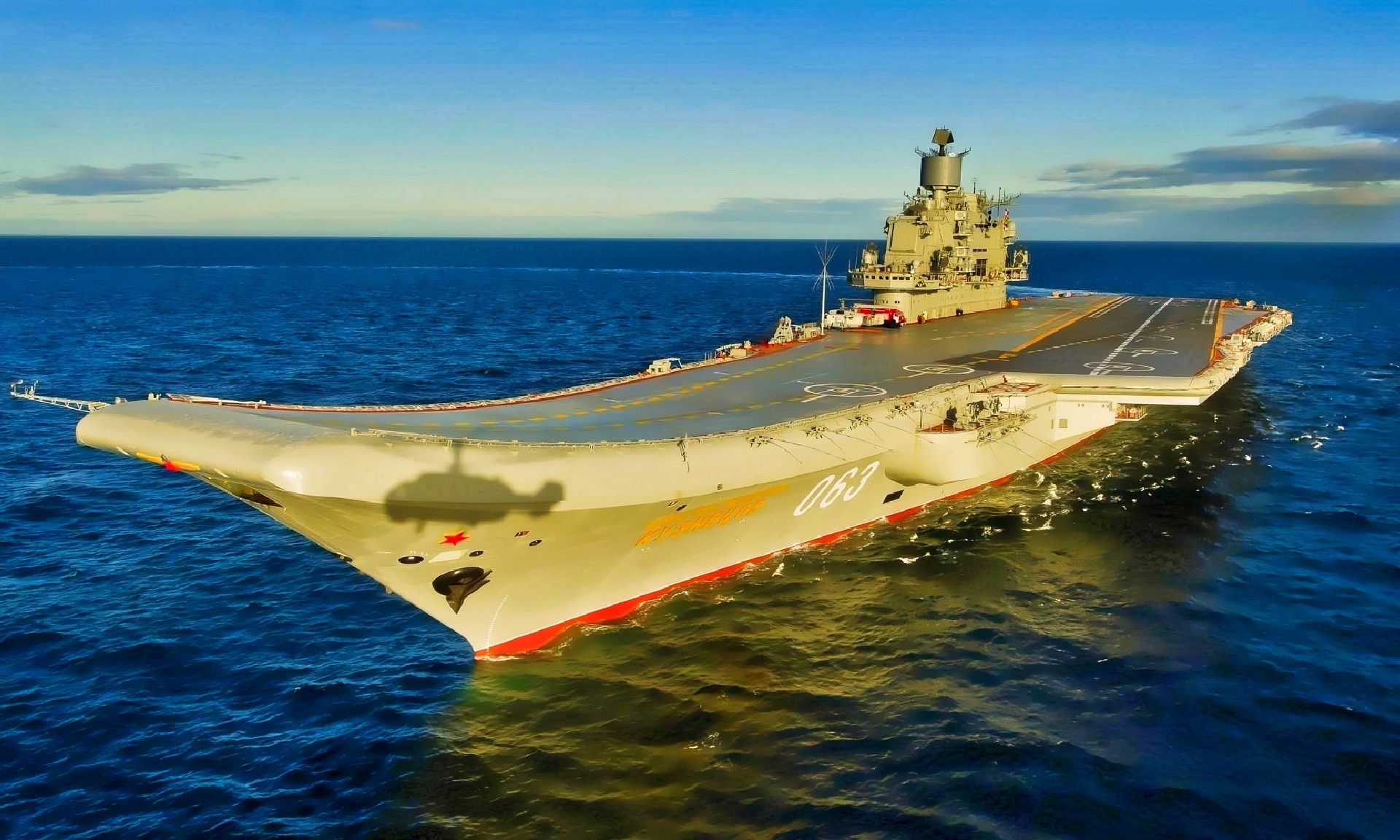
Admiral Kuznetsov Aircraft Carrier. Image Credit: Creative Commons.
Another article posted that the Shtorm would be even bigger. In terms of size and displacement, the “Shtorm” is projected to have a full displacement of 95,000 tons, putting it in the same class as the US Navy’s Nimitz-class carriers, which displace between 90,000 and 100,000 tons.
The Nimitz-class, which has been the backbone of US naval air power for decades, measures 330 meters (1,083 feet) in length, almost identical to the projected length of the “Shtorm” carrier. This scale will allow both ships to operate large air wings, with the Nimitz-class able to carry up to 90 aircraft, while the “Shtorm” will be able to deploy up to 100 aircraft, offering a slight edge in air group capacity.
The chances of Russia building this in the next few decades are minuscule, at best.
Light Carrier Design
The Nevskoye Design Bureau has unveiled a design for a lighter carrier, estimated to displace around 45,000 tons, which could be nuclear or gas turbine-powered and incorporate a ski jump and electromagnetic catapults. This design is in its early stages of development.
Challenges & Skepticism About Russia’s Shipbuilding
Limited Infrastructure is a significant issue. Russia lacks a single shipyard large enough to construct a vessel the size of a supercarrier, posing a significant logistical hurdle.
Financial constraints due to the war sanctions and the sad state of the Russian economy are not going to be fixed in at least the next decade. The ambitious nature and enormous cost of building a new aircraft carrier, particularly a nuclear one, make it a significant financial challenge that will be too much for Russia.
The poor state of Russia’s shipyards is highlighted by the sorry condition of the Admiral Kuznetsov, which has been in dry dock since 2017, with no discernible work having been done. It now appears that the Russian government has given up the ghost and is contemplating selling it for scrap.
The ongoing war in Ukraine and resulting international sanctions have stretched Russia’s defense industry and financial resources, further complicating the prospects for large naval projects like a new aircraft carrier.
Russia’s Issues On Land Are More Pressing Than Building A Carrier
The war, errrr, special military operation in Ukraine, which was supposed to be over in a couple of weeks, is nearing its fourth year and has been a meat grinder for its military.
Building an aircraft carrier, a power projection platform, makes no sense when Russia’s own coast borders are threatened. Ukraine didn’t even have a Navy to speak of, yet it sank or chased away all of Russia’s Black Sea Fleet with Harpoon missiles.
If Russia were to attempt to build a new carrier, it too would become a target for Ukraine, long before it was ever ready to set sail, if ever.
About the Author: Steve Balestrieri
Steve Balestrieri is a National Security Columnist. He served as a US Army Special Forces NCO and Warrant Officer. In addition to writing on defense, he covers the NFL for PatsFans.com and is a member of the Pro Football Writers of America (PFWA). His work was regularly featured in many military publications.
More Military
The B-1B Lancer: She Almost Never ‘Flew’
The South China Sea War of 2025: Who Wins?
F/A-XX: The Fighter Jet the U.S. Navy Might Be Desperate for