

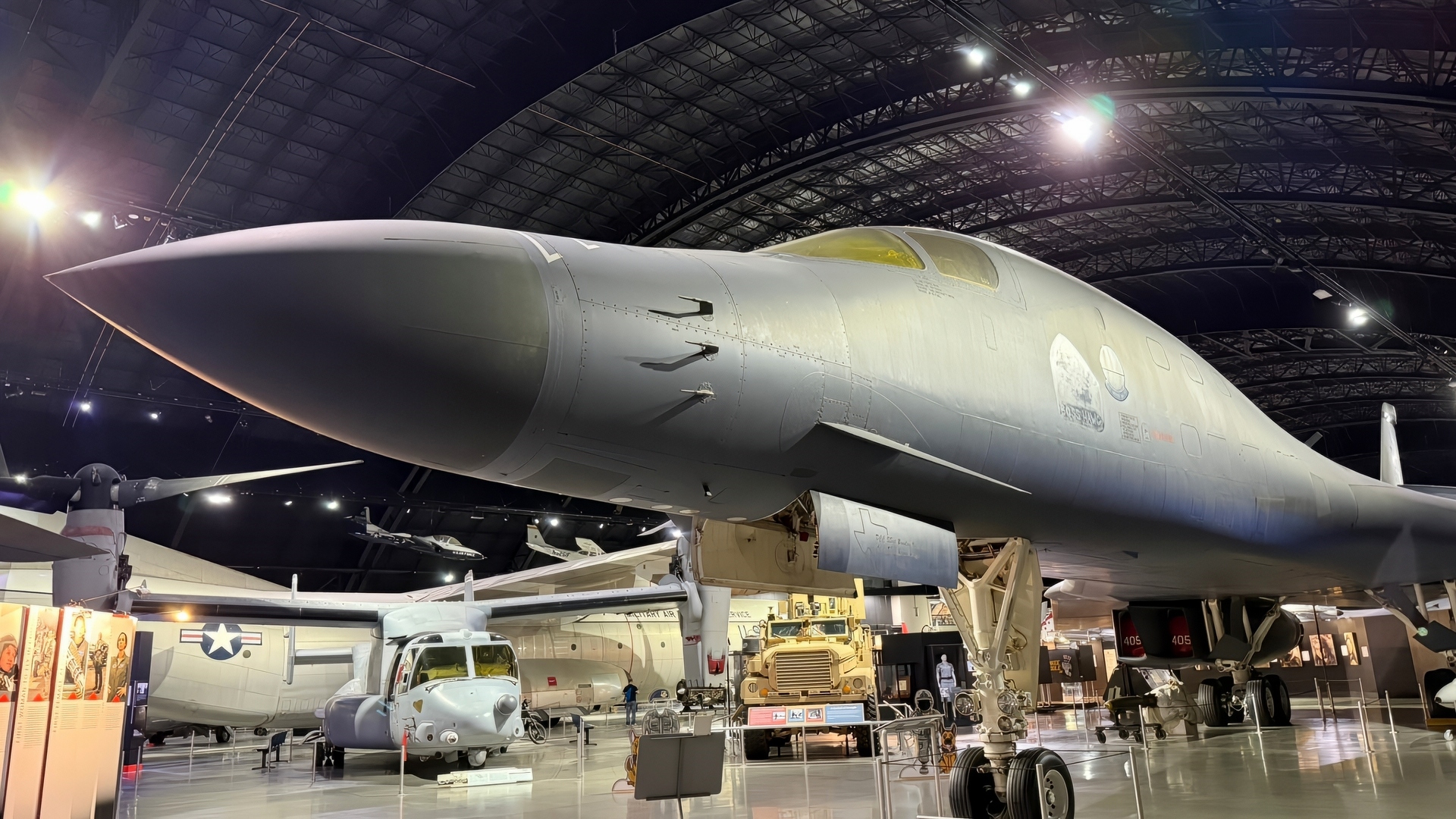
Key Points and Summary – The B-1B Lancer’s arc is uniquely American: canceled as the B-1A by Carter, resurrected by Reagan as the B-1B, sidelined for Desert Storm, then reborn as a conventional strike workhorse from Desert Fox through the post-9/11 wars.
-Non-stealth but fast and flexible with variable-sweep wings, “The Bone” hauls a class-leading 75,000-lb payload of JDAMs, JASSMs, and JSOWs.
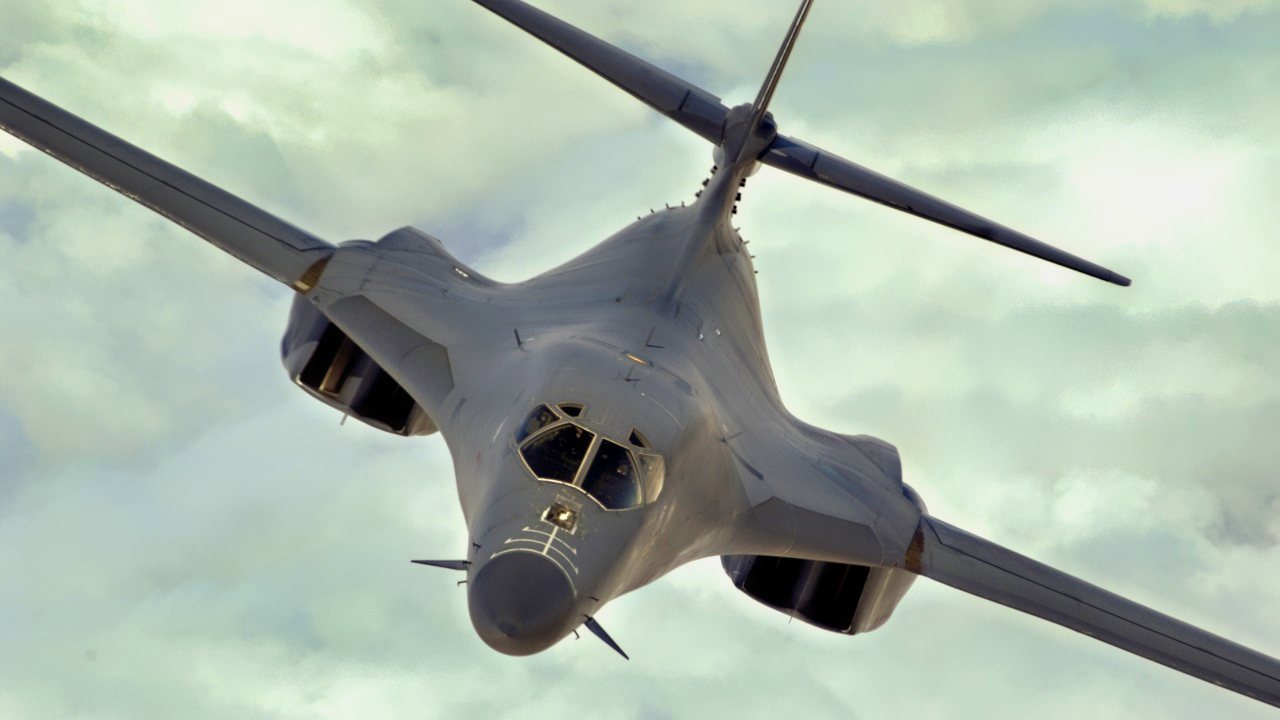
OVER NEVADA — A B-1B Lancer from the 37th Bomb Squadron, Ellsworth Air Force Base, S.D., streaks through the sky. Carrying the largest payload of both guided and unguided weapons in the Air Force inventory, the multi-mission Lancer is the backbone of America’s long-range bomber force. It can rapidly deliver massive quantities of precision and non-precision weapons against any adversary, anywhere in the world, at any time.
(U.S. Air Force photo by Master Sgt. Lance Cheung)
-Aging airframes and high upkeep now push the Air Force toward the B-21 Raider, yet bomber-force floors and operational demand keep ~45 B-1Bs on the line—sometimes via “regeneration” from the Arizona boneyard.
-Expect retirements in the early–mid 2030s, pace and budget of the B-21 permitting.
The B-1B Lancer Bomber Has Been on the Chopping Block Before
The B-1B Lancer bomber is one curious airplane. The US Air Force cancelled it under the Carter Administration, and revived it during the Reagan era. While it remains in service, the Air Force is starting to think about retirement for the old bird.
Although it is non-stealth, it has enjoyed a great combat history. It is supposed to be replaced by the B-21 Raider stealth bomber, but the Raider is far from deploying to full-time active duty. The B-1B Lancer still has a significant amount of life left in service.
The Bone Is the Heavyweight Champion
Nicknamed the “Bone,” due to its B-1 or “B-one” name, the Lancer has effective variable sweep wings that make it surprisingly maneuverable for such a large airplane. The B-1B can fly adeptly at supersonic and subsonic speeds. The Lancer has the biggest payload of any operational bomber with 75,000 pounds of ordnance. The Bone can be filled with conventional Joint Direct Attack Munitions (JDAMs), Joint Air-to-Surface Standoff Missiles (JASSMs), or Joint Standoff Weapons (JSOWs).

A B-1B Lancer prepares to return to Dyess Air Force Base, Texas, during Bomber Task Force 25-2 at Misawa Air Base, Japan, May 15, 2025. BTF missions provide opportunities to train and work with our allies and partners in joint and combined operations and exercises. (U.S. Air Force photo by Airman 1st Class Mattison Cole)
While the Lancer no longer carries nuclear weapons due to strategic arms limitation agreements with Russia, the conventional strike capability is awe-inspiring. The US Air Force would not have been as successful post-9/11 without the Lancer.
B-1B’s Design Is Its Saving Grace
The Air Force took full advantage of the variable sweep wings. This gave it the type of performance that prepared it for ample combat service.
“Forward wing settings are used for takeoff, landings, air refueling and in some high-altitude weapons employment scenarios. Aft wing sweep settings—the main combat configuration—are typically used during high subsonic and supersonic flight, enhancing the B-1B’s maneuverability in the low- and high-altitude regimes. The B-1B’s speed and handling characteristics allow it to integrate into mixed force packages seamlessly. These capabilities, when combined with its substantial payload, excellent radar targeting system, long loiter time and survivability, make the B-1B a key element of any joint/composite strike force,” according to Military.com.
History of the B-1 Program
Rockwell developed the Lancer to replace the B-52 in the 1970s. After the Vietnam War, the Air Force was looking for a conventional and strategic bomber that could be faster, more maneuverable, and survivable than the B-52. The B-52 was known for its carpet bombing campaign during Operation Linebacker that targeted civilian and military targets over North Vietnam. This was supposed to tip the war into the United States’ favor, but even though the B-52 was instrumental in destroying a multitude of targets, it did not break the enemy’s will to fight.

9th Expeditionary Bomb Squadron aircrew step out to the B-1B Lancer during Bomber Task Force 25-2 at Misawa Air Base, Japan, May 9, 2025. BTF 25-2 demonstrates Allied strength by forging strong alliances, showcasing our resolve, and deterring aggression, while also supporting global stability and security and strengthening military capabilities. (U.S. Air Force photo by Airman 1st Class Mattison Cole)
During the Cold War, the Air Force wanted a bomber that could fly low under Soviet radar to avoid the kind of surface-to-air missiles that were so destructive to Air Force airplanes during Vietnam. The B-1B’s swept wings were going to transform the way that bombers would streak toward targets and destroy them with conventional or strategic munitions.
When the Cold War ended, the Air Force needed the B-1B to take on the conventional mission after nuclear-equipped airplanes were limited by arms control. The service branch designed the B-1B to carry many forms of conventional munitions so it could remain relevant in 21st-century combat.
It Did Not See Combat Until 1998
The B-1B made its first combat appearance in 1998 in support of Operation Desert Fox. Iraq’s Saddam Hussein was not cooperating with weapons inspectors, and President Bill Clinton decided to take action with B-1B strikes that would eliminate Iraq’s weapons of mass destruction. B-1Bs dropped an incredible 94,000 pounds of munitions. The B-1B was then active after 9/11 in the war in Afghanistan and the second Gulf War.
Jimmy Carter Tried to Extinguish the Program
The B-1 program has endured cancellation efforts at different times during its history. The first B-1A was stopped by President Jimmy Carter. Even though the B-1A could fly at more than MACH 2 at high altitudes, it was facing schedule slips and cost overruns. Carter did not think the investment and time wasted were worth it, and he stopped the B-1 program in 1977, thinking that it would be better to pursue more advanced cruise missiles.
B-1B Lancer Finds a Friend in Ronald Reagan
But President Ronald Reagan had different ideas. Reagan and his national security team believed that the B-1B would be effective against the Soviet Union during a nuclear war because of its excellent potential performance and survivability against Russian air defenses. In 1982, the Air Force ordered 100 Lancers from Rockwell.
But throughout the 1980s and into the early 1990s, many years before it engaged in combat, the B-1B program had its enemies in Congress because the airplane lacked a large number of spare parts and components. Maintainers began cannibalizing the bomber to keep it in the air regularly. Training flights were cancelled, and most disappointingly, the B-1B did not fly missions during Operation Desert Storm.

B-1B Lancer Bomber U.S. Air Force Display. Image Credit: National Security Journal.
Now the B-1B will be replaced by the B-21 Raider despite the Lancer’s excellent combat performance after 9/11 during the Global War on Terror. Full retirement will probably happen in the early to mid-2030s. The B-1B is becoming increasingly expensive to maintain, and while its speed is an advantage, the airplane is not stealthy.
Now the Air Force is trying to keep 45 B-1Bs on active duty, but sometimes one is sent to the Boneyard at Davis-Monthan Air Force Base in Arizona, and then it is brought out of retirement to enter active duty again. The Air Force calls this “regeneration.” Congress requires 45 to be in service at all times.
For example, the Air Force brought back a Lancer nicknamed “Lancelot” in 2024 after it spent three years at the Boneyard because another B-1B had succumbed to an engine fire. In 2021, the service branch had retired 17 Lancers, including Lancelot. Four Lancers were in the best preserved condition, and Lancelot was selected to return to the starting lineup.
This will probably happen more in the coming years as the B-1B becomes older and requires more intense maintenance efforts. The B-1B had done an excellent job since 1998 in combat in conjunction with the B-2 Spirit and B-52 Stratofortress.
It’s a shame the Lancer will have to be benched for good. The Air Force will likely need to activate more B-1Bs from the Boneyard to give the fleet a boost. The Lancer is not done yet, and its service life will depend on how much the B-21 Raider program remains on time and under budget.
About the Author: Brent M. Eastwood
Brent M. Eastwood, PhD is the author of Don’t Turn Your Back On the World: a Conservative Foreign Policy and Humans, Machines, and Data: Future Trends in Warfare plus two other books. Brent was the founder and CEO of a tech firm that predicted world events using artificial intelligence. He served as a legislative fellow for US Senator Tim Scott and advised the senator on defense and foreign policy issues. He has taught at American University, George Washington University, and George Mason University. Brent is a former US Army Infantry officer. He can be followed on X @BMEastwood.
More Military
The South China Sea War of 2025: Who Wins?
F/A-XX: The Fighter Jet the U.S. Navy Might Be Desperate for
SEPv4: The M1 Abrams ‘Super’ Tank The Army Didn’t Need