


Key Points and Summary – A July visit to the B-2A Spirit at the U.S. Air Force Museum in Dayton is a reminder: this bomber was built to slip past the toughest air defenses on earth.
-The Spirit came from a Cold War need to penetrate the USSR’s shield, but post-1991 budgets slashed the buy from 132 to a tiny fleet.
-Even so, the B-2 has shaped wars from Kosovo to Libya, and most recently executed the bunker-buster strikes on Iran’s nuclear sites.
-Now the question is the future—how long the Spirit deter sprints by Russia and China, and how the coming B-21 Raider will assume the mantle of America’s deep-strike stealth.
The B-2A Stealth Bomber: Is It the U.S. Air Force’s Most Powerful Weapon?
If you’ve stood near the B-2 in Dayton, Ohio—black, silent, almost otherworldly—you feel why this airplane exists. It was a boyhood dream of mine to visit this bomber back on July 19-20 of this year, to say the least. Most of the photos and video clips in this article come from that visit.
The U.S. Air Force museum example is a non-flying test article, but the shape is the same: a radar-slippery flying wing the size of a house that seems to drain sound from the room. That quiet is the point.
The Spirit’s purpose, then and now, is to show adversaries that distance and air defenses don’t guarantee safety.
For Moscow and Beijing, that message still carries.
Why The Air Force Needed A Stealth Bomber
By the late 1970s, U.S. planners were staring at ever denser, smarter Soviet air defenses—large phased-array radars tied to long-range surface-to-air missiles, backed by interceptors and command-and-control that grew tougher every year.
Legacy bombers could lob cruise missiles from outside the threat ring, but certain targets—deeply buried command sites, air defense nodes, and nuclear infrastructure—demanded a penetrating platform that could slip inside, strike precisely, and get out.

A U.S. Air Force B-2 Spirit is prepared for operations ahead of Operation MIDNIGHT HAMMER at Whiteman Air Force Base, Missouri, June 2025.
That need birthed the Advanced Technology Bomber (ATB). The concept combined shaping, materials, and tightly managed emissions to produce a truly low-observable aircraft with the range, payload, and reliability to matter.
Politics ricocheted around it—the B-1A was canceled and later reborn as the B-1B even as ATB moved forward—but the requirement never changed: a stealth bomber that could punch through the best Soviet air defenses on night one, in any weather, with conventional or nuclear weapons.
The B-2 Spirit is that answer.
B-2A Spirit: How The Program Took Shape
Northrop (later Northrop Grumman) won the ATB competition in the early 1980s. The prototype rolled out publicly in 1988; the first aircraft arrived at Whiteman Air Force Base in 1993; the fleet reached initial operational capability in 1997.

B-2A Spirit On Display. Image by Editor Harry J. Kazianis/National Security Journal.
Along the way, costs rose and secrets seeped—stealth at this scale was hard, heavy on software, and maintenance-intensive. Yet the payoff was real: a bomber that can carry a large, flexible set of precision weapons behind a radar-evading airframe, controlled by a combat system designed from the outset to be silent, precise, and global.
The Dayton exhibit underscores that engineering grind, at least for me. The museum’s B-2 airframe endured brutal structural testing before it came to rest under those hangar lights. Everything about the Spirit—including how it’s serviced, fueled, and even towed—is different because its primary weapon is invisibility.
Why 132 Became Just A Handful
The Air Force planned to buy 132 Spirits. Then the world changed. As the Cold War ended and budgets tightened, skeptics in Congress questioned whether such an expensive bomber still fit the moment—and whether the support tail could be sustained. The program was cut in stages: first sharply reduced at the start of the 1990s, then capped at 20 operational aircraft (a test airframe was later converted, bringing the total built to 21). Unit costs, sustainment complexity, and the peace-dividend politics of the era sealed the decision.
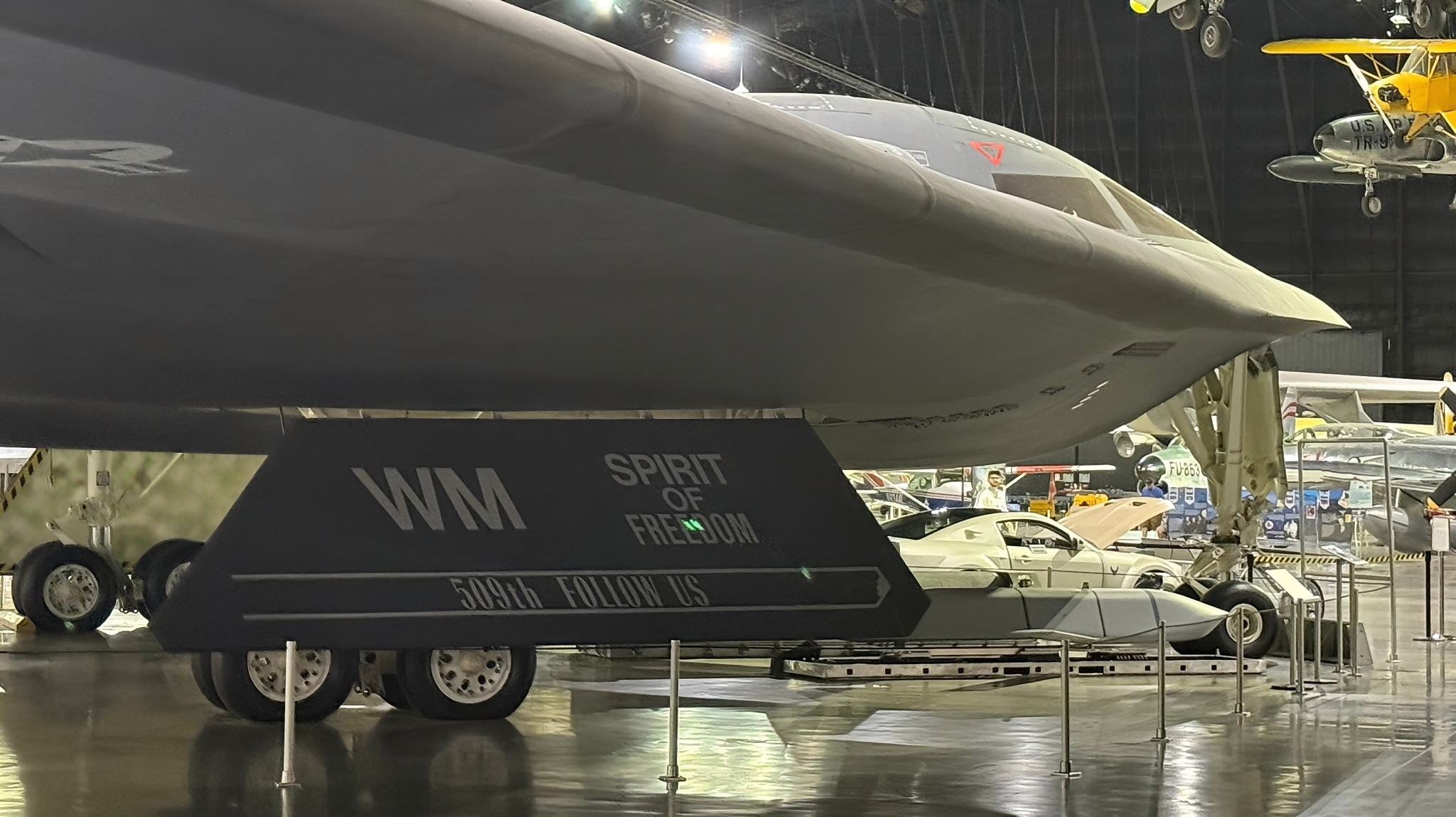
B-2 Bomber at USAF Museum National Security Journal Image. All Rights Reserved.
Two later events further thinned the line. In 2008, a Spirit crashed at Andersen AFB, Guam; both pilots ejected, but the jet was destroyed. In 2022, another B-2 suffered a serious ground mishap at Whiteman; by 2024 the Air Force decided it was uneconomical to repair, reducing the future force to 19.
For a platform designed to do the hardest missions, scarcity has always been the trade.
Combat Debut And A Wartime Résumé
The B-2’s first combat use came over Serbia in 1999. Spirits launched from Missouri, refueled multiple times, and dropped satellite-guided munitions with a degree of precision and survivability that changed expectations for strategic airpower. Two years later, as the United States struck Afghanistan, B-2s flew marathon missions—more than 40 hours in the air—hitting fixed targets and key nodes in the opening waves before landing forward to turn, reload, and head home.
In Iraq (2003), the B-2 did the same: opening salvos from extreme range, then quick turns to press the pressure on command and air defense systems. In Libya (2011), three B-2s punched open hardened shelters in the first hours of the no-fly campaign; in 2017, Spirits hit ISIS camps in Libya with massed precision weapons in a single, decisive raid. Across these conflicts, a pattern emerged: when a President wants surprise, precision, and shock without warning, the call often goes to Whiteman.
The Iran Strikes: What The B-2A Spirit Just Proved
The most recent demonstration came in June 2025, when U.S. forces executed coordinated strikes on Iran’s nuclear complex.
Spirits launched from the United States, penetrated Iranian airspace, and dropped bunker-busting munitions on fortified sites. The mission blended classic B-2 strengths—global reach, stealth, and precision—with old-school deception: decoy movements suggested one vector while the real bombers slipped in along another.

B-2 Bomber from U.S. Air Force Display. Image Credit: Harry J. Kazianis/National Security Journal.
Operationally, the raid reaffirmed three things. First, distance is optional when a stealth bomber can ride an aerial refueling web and arrive undetected. Second, the B-2’s ability to carry very heavy, specialized weapons against hard and deeply buried targets is not theoretical. Third, a handful of aircraft, properly planned and supported, can reset an adversary’s risk calculus in hours. The raid was a message aimed well beyond Tehran.
What The B-2 Signals To Russia And China
Deterrence is partly arithmetic—how many launchers, how many missiles—and partly psychology. The B-2 touches both. To Russia, whose air defense networks have proliferated and modernized in layers from the Arctic to Kaliningrad, the Spirit says: the most protected targets can be reached first, not last. To China, which has stacked overlapping radars, SAMs, and fighters across the mainland and the Western Pacific, the message is similar but broader: range plus stealth plus precision creates openings for the joint force. Strike the right nodes—the command backbones, the key air defense emitters, the repave points for runway denial—and the rest of the force flows more freely.
There’s also a diplomatic angle. When Spirits forward-deploy or even just become visible in the news cycle, adversaries take notice. The aircraft is recognizable, its history is public, and its tasking is tightly controlled. Even without releasing weapons, a photographed B-2 taxiing on an Indian Ocean atoll or rolling out of a Midwestern hangar is strategic communication that says: we can reach out.
What Makes The Spirit Different
A few attributes explain why the B-2 still matters despite its age and small fleet:
True Penetration Stealth: Shaping, materials, and emissions control optimized for getting through modern integrated air defenses—quiet by design, not just electronically clever.
Payload Flexibility: Everything from large numbers of smaller precision bombs to a handful of specialized penetrators—plus nuclear carriage under the triad.

B-2 Bomber Really Close Up National Security Journal Photo
Global Reach: Unrefueled, the jet already goes continents; with tankers, its radius is limited by crew duty cycles, not by fuel.
On-Axis Surprise: Cruise missiles are valuable, but they advertise their launch and may take long, predictable routes. A stealth bomber lets the United States choose when and where to appear.
Those strengths require tradeoffs. Low-observable maintenance is exacting; hangar space and specialized coatings matter; mission-capable rates can be unforgiving when crews are preserving signature management. The Air Force has poured time and money into sustainment, software, and defensive management system upgrades to keep the jet tactically sharp while a successor matures.
Present-Day Reality: A Small Fleet, A Heavy Lift
Today, the B-2 community carries a paradox. It’s a tiny fleet tasked with outsized missions. After the 2022 mishap and subsequent stand-down, the line returned to flight with renewed emphasis on safety and readiness. Deployed Spirits have trained from the continental United States, the Pacific, and the Indian Ocean, integrating with tankers, fighters, and ISR to practice long-range penetrating strike against complex defenses. The aircraft’s calling card remains the same: first night, hard target.
That small number shapes employment. When a handful of jets can change an adversary’s next-week planning, commanders will husband the fleet, using it sparingly to signal, to deter, and to break open the hardest locks. It is not a “daily sortie” asset; it is the tool you reach for when you need to do something decisive with little warning.
The Bridge To Tomorrow: Enter The B-21 Raider
The B-2 is not the end of the stealth-bomber story; it is the bridge to the B-21 Raider.
The Raider is designed to be smaller in crew, larger in fleet size, and cheaper to build and sustain, with open-system architecture and stealth optimized for the sensing environment of the 2030s. Flight testing has accelerated, with multiple test aircraft now flying and the program publicly described as the backbone of the future bomber force alongside modernized B-52s.
What does that mean for the Spirit? A managed hand-off. The Air Force will keep the B-2 credible—with stealth maintenance improvements, communications upgrades, and mission-system refreshes—until enough Raiders are on the ramp.

Really Close Up of B-2 Bomber in Dayton, Ohio Museum. Image Credit: National Security Journal Image.
As that happens, the B-2’s role will narrow, then sunset. But the design ideas it proved—global stealth, precision at scale, survivability through signature discipline—live on directly in its successor.
Why The Museum Visit Matters
It’s tempting to think of the B-2 as a relic because you can walk under one now. That’s the wrong lesson to take from Dayton. What you see there is proof of concept, not retirement. The engineering heart of the B-2—stealth wrapped around range and payload—remains exactly what deters the two hardest problems in American strategy: a Russia with the world’s densest air defenses protecting strategic targets, and a China with a continent-sized A2/AD umbrella. When the United States needs to touch something inside those umbrellas, quietly and with authority, a Spirit still moves.
Bottom Line on B-2A Spirit Bomber
The B-2A Spirit was built to do one job better than any aircraft before it: go where others can’t and make the first night count. The program’s path—ambitious start, political cuts, a tiny fleet carrying big missions—explains why the aircraft is iconic and rare.
Its combat history, culminating in the 2025 strikes on Iranian nuclear infrastructure, shows that the capability is not museum glass—it’s a living deterrent. And the B-21 Raider on the horizon means the central message to Russia and China will endure: America can reach the targets you most want to keep safe, and it can do so on its own timeline.
About the Author: Harry J. Kazianis
Harry J. Kazianis (@Grecianformula) is Editor-In-Chief and President of National Security Journal. He was the former Senior Director of National Security Affairs at the Center for the National Interest (CFTNI), a foreign policy think tank founded by Richard Nixon based in Washington, DC. Harry has over a decade of experience in think tanks and national security publishing. His ideas have been published in the NY Times, The Washington Post, The Wall Street Journal, CNN, and many other outlets worldwide. He has held positions at CSIS, the Heritage Foundation, the University of Nottingham, and several other institutions related to national security research and studies. He is the former Executive Editor of the National Interest and the Diplomat. He holds a Master’s degree focusing on international affairs from Harvard University.
More Military
China Has a Masterplan to Make the B-21 Raider Bomber Obsolete
The New B-21 Raider Is Far More Than Just A ‘Stealth Bomber’
The ‘New’ Arleigh Burke–Class Flight III Destroyer Has a Message for the U.S. Navy
France’s Mirage 2000: The Best Fighter You Never Heard of Fighting Putin in Ukraine