


Key Points and Summary – For decades, naval enthusiasts and a few planners floated “battlecarrier” schemes to graft flight decks and large missile batteries onto Iowa-class battleships.
-The pitch: keep 16-inch guns, add STOVL jets and helicopters, and create a one-ship strike monster.
-The reality: immense cost, severe air-ops limits, old hulls, huge crews, and poor survivability in a missile era.
-The 1980s reactivations proved the Iowas could take modern missiles and sensors, not aviation wings.
-Converting them would have displaced better investments in carriers, submarines, and escorts.
-The result is fitting: the Iowas remain museum ships—icons to learn from, not platforms to resurrect as hybrids.
The Iowa-Class “Battlecarrier”: A Big Idea That Belonged on Paper
The Iowa-class battleships are irresistible to the imagination. I know, I was just on the USS Iowa out in Los Angeles for a day back in August, and to be frank, it still gives me the chills, as it was always a bucket-list experience I will always treasure.
They have presence, margin, and a history of being updated successfully—from World War II gunships to 1980s missile-armed flagships.
That upgrade pedigree fueled recurring proposals to push one step further: turn an Iowa into a “battlecarrier,” a hybrid that married big guns with a flight deck for STOVL jets and helicopters plus a deep magazine of modern missiles. On napkins and in briefing slides, the concept seemed to promise the best of both worlds: a ship that could smash shore targets, launch aircraft, and hurl salvos at sea or inland—all from the same armored hull.
But a shipyard is where physics and budgets answer marketing. There, the battlecarrier ran out of both. And thank god for that.
The Upgrade Trail That Fed the Dream
The Iowas earned their second (and third) acts by absorbing modern systems without losing their core strengths. In the 1980s, each battleship gained Tomahawk and Harpoon missile launchers, point-defense weapons, new radars and EW, and a comprehensive overhaul. In fact, the launchers minus the missiles are still on the USS Iowa, and I saw them with my own eyes.
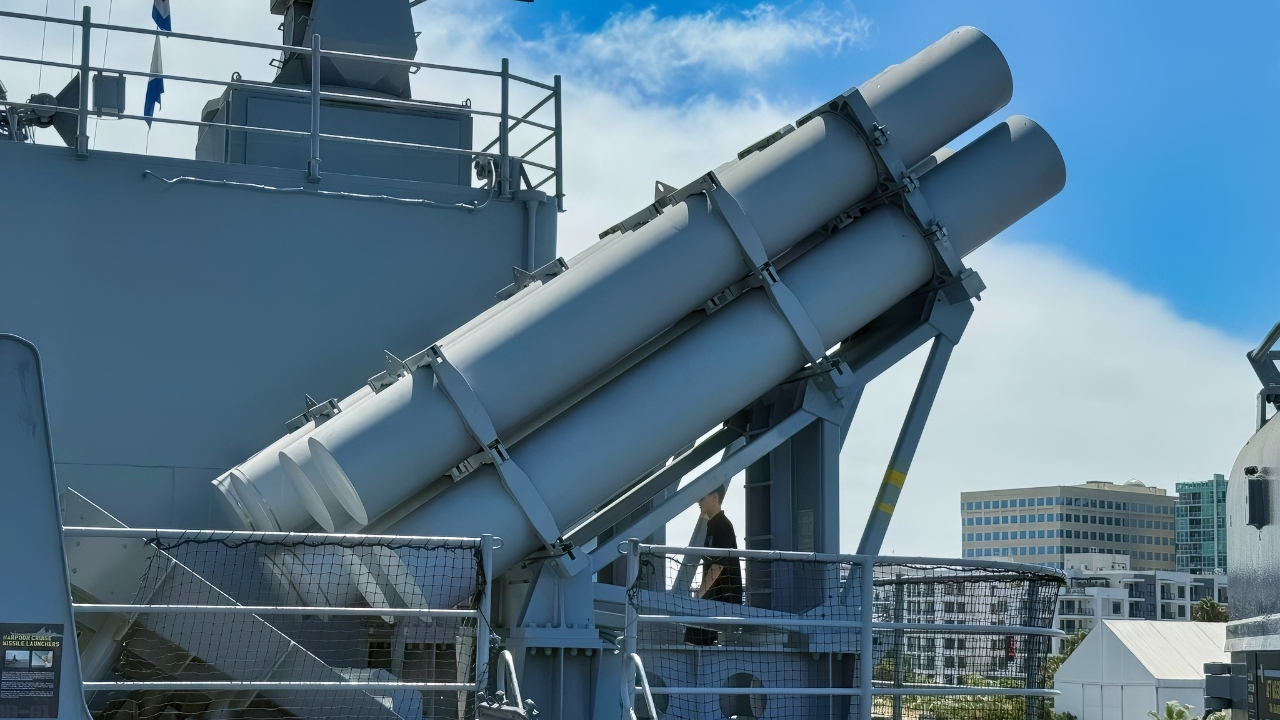
USS Iowa Harpoon Canister. Image Credit: Harry J. Kazianis/National Security Journal.

Harpoon Missile Onboard USS Iowa. Image Credit: National Security Journal.
Crews also operated drones and helicopters from austere pads. That record—proven growth headroom—convinced some designers that still more was possible: remove the aft 16-inch turret, build a hangar, add a ramped or canted flight deck for AV-8B Harriers and helicopters, and fill the freed-up volume with a very large vertical-launch battery. In some variants, the ship would also carry Marines and landing craft, operating as a partial assault ship.
Conceptually coherent? Yes. Operationally sound and affordable? No.
What a Real “Battlecarrier” Would Have Required
Strip the romance away and the conversion list becomes sobering:
Air Operations Architecture. A workable flight deck, heat-hardened surfaces for STOVL jets, elevators, a hangar, aviation fuel systems, magazines for aircraft weapons, and proper maintenance spaces.
Weapons and Sensors Integration. A new combat system to manage a massive VLS battery, aviation operations, and legacy guns—without creating fatal bottlenecks in power, cooling, or data.
Survivability Re-Engineering. Topside changes that alter weight and balance, blast paths, and damage-control lanes; protection for sensitive electronics from the concussion of 16-inch gunfire; and hardening against modern anti-ship missiles.
Crew and Training Pipelines. A hybrid crew—battleship sailors, aviation maintainers, flight deck crews, and Marine detachment—plus the schoolhouses and spares to sustain them.
That is not a refurbishment. It is a major new-construction program inside an old hull.
Air Ops Meets Steel Reality
Fixed-wing aviation is unforgiving. A short ramp on a narrow beam yields anemic sortie rates compared with true carriers. Jet exhaust would bake nearby structures; blast and foreign-object-damage risks multiply on a cluttered deck. Crucially, the hybrid’s flight deck would live in the blast shadow of 16-inch guns. Even if you limit gun arcs or flight ops to avoid mutual interference, you’ve handcuffed one half of the ship to employ the other. And because the Iowas lack catapults and arresting gear, the hybrid would be stuck with STOVL jets and helicopters—useful, but nowhere near a carrier air wing’s striking power or flexibility.
Bottom line: you’d pay carrier-scale money to get decades-old STOVL math—not a decisive return.
Survivability in the Missile Age
Armor defeated shells. It does not defeat modern kill chains. Large hulls are easy to find and classify via radar, infrared, electronic, and space-based cues. Adversaries now plan saturation attacks from multiple axes (sea-skimming, high-diver, ballistic, and from below with submarines). A hybrid ship with large radar signature and a modest escort would be a high-value target that can’t hide and can’t out-maneuver salvos. Converting an Iowa wouldn’t change that geometry; it would concentrate more eggs in a single, very visible basket.
And survivability is not just “float or sink.” One or two well-placed hits can mission-kill aviation facilities, fire-control, or power—turning a “do-everything” ship into a very expensive liability.
Dollars, Schedules, and Sailors
Even conservative conversion studies landed in the multi-billion-dollar range per ship, with multi-year yard periods and significant technical risk. Then comes the bill you pay every day: people. Battleships are manpower-hungry even before you add aviation.
A hybrid would demand hundreds more sailors and maintainers than a cruiser or destroyer, and you’d still need carrier-grade logistics (aviation fuel, munitions, spare parts) to keep the deck meaningful. In an era where the Navy competes for both funding and sailors, that math fails the opportunity-cost test.
Every dollar and billet spent on a battlecarrier is a dollar and billet not spent on submarines, escorts with deep VLS magazines, or the unmanned systems that actually complicate an opponent’s targeting.
Would It Have Added Unique Value? Not Really
What would a battlecarrier do that the fleet can’t do better with existing specialized ships?
Strike at Range. True carriers do this with high-sortie air wings.
Sea Control and Air Defense. Aegis destroyers and cruisers with big VLS farms do this with depth and flexibility.
Submarine Hunting. Frigates, destroyers, P-8 patrol aircraft, and MH-60R helicopters do this as an integrated team.
Amphibious Operations. Amphibs and big-deck assault ships carry far more vertical lift and Marines.
A hybrid might do some of each, but never as well—and always at the expense of something else the fleet needs more.
Why the Navy Stopped at Missiles—and Was Right To
The 1980s proved the Iowas could take modern missiles, sensors, and self-defense systems without betraying their hull form. They became missile-and-gun strike ships with presence, not ersatz carriers. As studies matured, Navy leadership consistently reached the same conclusion: aviation conversions were too costly, too risky, and too marginal in payoff. The Navy chose to buy capacity where it scales—carriers, Aegis escorts, and later submarines—rather than pour treasure into aging one-offs.
History vindicated that choice. The Iowas gave one last great service as missile battleships, then bowed out gracefully.
As one retired U.S. Navy Captain put it to me: “The battlecarriers are something for a video game, not for the U.S. Navy.”
The Age of Hybrid Big-Decks Came—Just Not on Battleships
Ironically, the logic behind the battlecarrier—mixing aviation and missiles for flexible power—did flourish, just not on battleships.
Modern carrier strike groups combine Ford/Nimitz-class carriers with escorts whose VLS cells far outnumber any plausible battleship retrofit. Amphibious assault ships routinely fly STOVL jets and large helicopter groups. The Navy is also moving toward “arsenal” concepts and unmanned adjuncts that add missile mass without putting more humans in harm’s way. The fleet achieved the hybrid’s operational effect—without surgically grafting wings onto a 1940s hull.
Why the Idea Keeps Returning—and Why It Shouldn’t
Big steel breeds big nostalgia. When budgets tighten or threats rise, the battlecarrier resurfaces in op-eds and online renders. The pitch is seductive: “We already own the hulls; just add modern kit.” But “just” hides the re-engineering, manning, and opportunity costs—and ignores the missile-saturated reality of today’s seas. If the United States wants more sea-based airpower, the answer is more carriers and faster air-wing evolution, not a boutique hybrid that dilutes focus. If it wants more missile mass, the answer is more VLS on more hulls and distributed launchers, not a single billboard target.
The Right Ending: Living History, Not Living on Borrowed Time
The Iowas now serve as museums—open classrooms where the public can touch the machinery of a different era and where sailors tell hard-won safety and leadership lessons. That is not a consolation prize. It is the proper use of icons whose greatest gift may be what they teach: build for growth, adapt without sentimentality, and retire platforms when the environment outgrows their strengths.
They were the right ships, updated the right way, and retired at the right time. Turning them into battlecarriers would have been an expensive way to learn that lesson all over again.
Bottom Line on the Battlecarrier
A battlecarrier made for a compelling drawing and a terrible ship. The Iowas’ record shows how far smart upgrades can push a good design—but also where prudence should stop. In an age of precision missiles, networked sensors, and unmanned wingmen, the hybrid’s costs and risks would dwarf its contribution. The fleet’s future lies in specialized ships that team well, not hybrids that promise everything and deliver compromise. The Iowas have already done their duty—now they do it again, by reminding us to invest in the fleet we need, not the silhouette we miss.
About the Author: Harry J. Kazianis
Harry J. Kazianis (@Grecianformula) is Editor-In-Chief and President of National Security Journal. He was the former Senior Director of National Security Affairs at the Center for the National Interest (CFTNI), a foreign policy think tank founded by Richard Nixon based in Washington, DC. Harry has over a decade of experience in think tanks and national security publishing. His ideas have been published in the NY Times, The Washington Post, The Wall Street Journal, CNN, and many other outlets worldwide. He has held positions at CSIS, the Heritage Foundation, the University of Nottingham, and several other institutions related to national security research and studies. He is the former Executive Editor of the National Interest and the Diplomat. He holds a Master’s degree focusing on international affairs from Harvard University.
More Military
Su-57 Felon vs. Eurofighter Typhoon: Who Wins?
The P-8A Poseidon Might Be the Ultimate Submarine Hunter
The S-3 Viking: The Best Submarine Killer Retired?