


Key Points and Summary – USS Iowa (BB-61) was built as a fast battleship to screen aircraft carriers, duel surface threats, and bombard ashore.
-After Atlantic duty—including carrying President Roosevelt—it fought across the Pacific, then rejoined the fleet for Korea before retiring.
-In the 1980s, Iowa returned as a cruise-missile platform: 32 Tomahawks, 16 Harpoons, Phalanx CIWS, upgraded radars, EW, data links, and drones for gunfire spotting.
-A 1989 turret explosion and the Cold War’s end hastened decommissioning.
-Today, amid analog systems and steam plants, a comeback would demand billions for propulsion, power, sensors, and weapons—an opportunity cost that makes the battleship’s best role a museum and classroom, not a combatant.
USS Iowa: I Spent An Entire Day on a Real U.S. Navy Battleship (It Was Glorious)
On August 15, I spent hours roaming the battleship USS Iowa at the harbor outside Los Angeles—steel decks humming with tourists, cool compartments that still smell faintly of oil and paint, placards that try to compress eight decades into just one visit.
To be frank, this was on my bucket list of life events I needed to complete. And man, it didn’t disappoint.
Up close, Iowa doesn’t feel like a relic. She feels like a thesis about American sea power—speed, reach, redundancy—written in armor plate. But she also reads like a time capsule: analog dials, steam-era engineering, cable runs that predate integrated anything. That contrast is the story of Iowa: a ship built to outrun and outgun, reinvented for cruise and anti-ship missiles in the 1980s, and now preserved as a museum because the kind of war she was built to fight no longer exists.

Iowa-Class 5-Inch Guns. Image by Harry J. Kazianis/National Security Journal.
Origin Story: Why The Navy Wanted A “Fast” Battleship
The Iowa-class was a product of urgent arithmetic in the late 1930s: the United States needed battleships that could keep pace with aircraft carriers, fight other capital ships, and throw heavy bombardment ashore—all under the limits and lessons of interwar treaties.
The design team fused long, fine lines for speed (33 knots-class), a deep magazine for nine 16-inch/50-caliber guns, a powerful 5-inch/38 dual-purpose secondary battery, and an armor scheme meant to shrug off the kinds of shells the ship herself would fire. The result was a hull that was longer and leaner than earlier classes, with enough fuel and reliability to sprint across the Pacific and still arrive ready to fight.

Iowa-Class 16-Inch Shell Menu. Image Credit: National Security Journal.
Laid down in 1940 and commissioned in 1943, USS Iowa (BB-61) became the namesake of four sisters (New Jersey, Missouri, Wisconsin). They were “fast battleships” not only in speed but in operational tempo—able to range with fast carrier task forces, screen them against surface threat, and step forward for shore bombardment when air planners needed the big guns.
Early Deployments for USS Iowa: Atlantic Duties And A Presidential Passenger
Before her Pacific war, Iowa drew a high-profile Atlantic mission: transporting President Franklin D. Roosevelt part of the way to the 1943 conference in the Middle East. The trip produced lore—a torpedo accidentally launched by an escort that forced Iowa to maneuver hard and survive her own side’s mishap—and proof of what the ship’s speed bought: choice. A fast battleship could be where the government needed it, when it needed it, carrying VIPs one week and screening carriers the next.

Those Iowa-Class Guns. Image Credit: Harry J. Kazianis/National Security Journal.
After that assignment, Iowa headed for the Pacific and the fight she was built for.
Battle Experience: Pacific War Workhorse
In 1944–45, Iowa spent most of her time at the sharp end—screening fast carriers, dueling aircraft, and blasting hardened targets ashore as U.S. forces leapfrogged westward. She escorted carrier groups in the Marshalls and Marianas, guarded the fleet during the Philippine Sea and Leyte Gulf operations, and later turned her 16-inch rifles against targets in Okinawa and the Japanese home islands. The big guns were both psychological and practical weapons: when a crisis ashore demanded immediate, heavy fire at long range, battleship shells arrived with a timetable and a certainty that air-delivered ordnance sometimes couldn’t match in bad weather.

16-Inch Iowa-Class Guns. Image Credit: National Security Journal.
The irony is that Iowa’s main battery fired relatively few ship-to-ship salvos; the most valuable thing she provided to the carrier age was presence and protection. Her gunnery had to be precise, her radar and fire-control steady, and her machinery tireless—an economy-of-force weapon that let carriers do their work.
Korea And The First Retirement
After the war, the fleet shrank, and Iowa went in and out of commission with the rest of her class. When Korea erupted, she returned to fire support, hurling 16-inch shells into hardened positions and rail yards, then retiring again as the armistice and budgets cooled the demand for big-gun ships. By the late 1950s, guided missiles and nuclear submarines were the darlings of planners, and the Iowas stood pier-side more than they sailed.
The 1980s Modernization: How A 1940s Hull Became A Cruise-Missile Platform
Fast-forward to the 1980s and a new strategic mood. The Reagan administration’s 600-ship Navy needed hulls quickly to restore presence and deterrence across multiple theaters. The big battleships offered something unique: volume, power, and deck space—perfect substrates for modern weapons, sensors, and communications. The Iowas came back to life with a very different punch. I was able to see a lot of this firsthand when I toured USS Iowa, and it was pretty amazing.
Tomahawk Land-Attack Cruise Missiles (TLAM). Each ship received eight Armored Box Launchers that are still onboard in a display mode, good for 32 Tomahawks. This turned a World War II bombardment platform into a deep-strike magazine, able to hit high-value land targets hundreds of miles inland without exposing carrier aviation to the densest air defenses. It also widened the ships’ strategic value: a single battleship could park off a hostile coast and influence events well ashore.

USS Iowa Tomahawk Box. National Security Journal Photo.
Harpoon Anti-Ship Missiles. With 16 canister-launched Harpoons (also there, in display mode), the Iowas regained a long-range anti-ship bite useful for sea control in crowded littorals. That mattered in an era when Soviet surface groups, armed with their own long-range missiles, formed real threats.
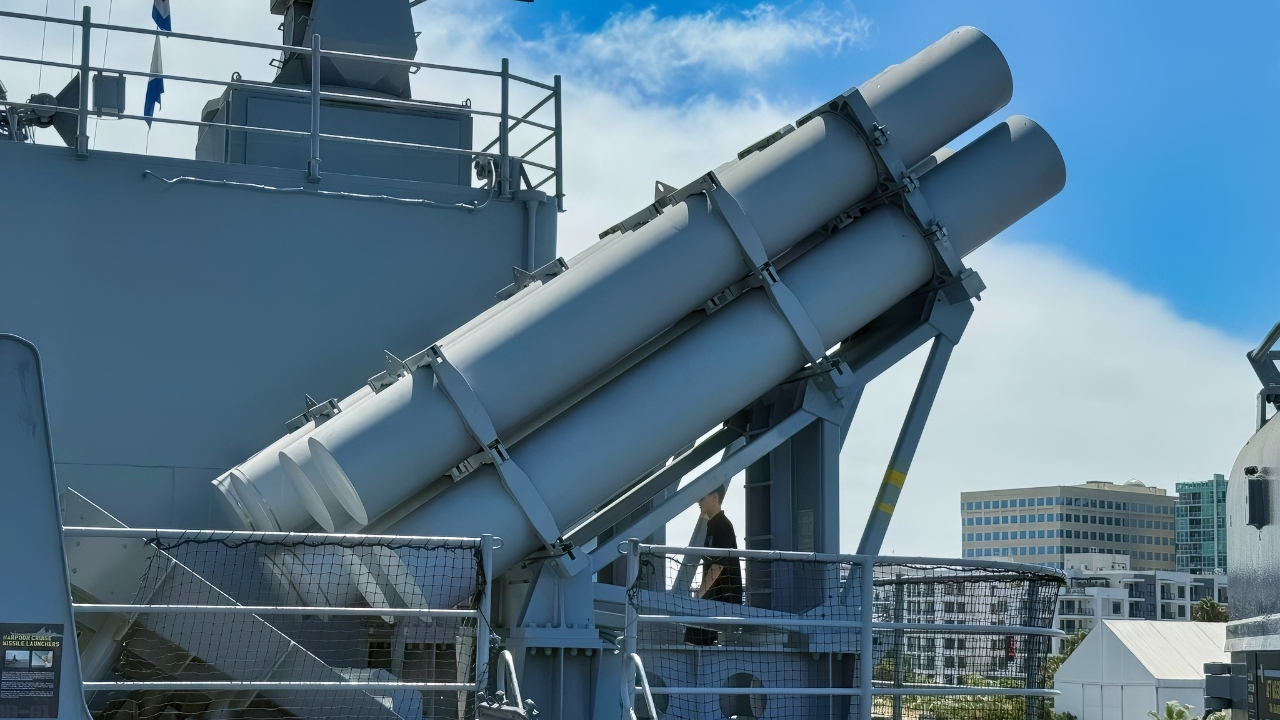
USS Iowa Harpoon Canister. Image Credit: Harry J. Kazianis/National Security Journal.
Phalanx CIWS And Electronic Warfare. The refits added Phalanx close-in weapon systems to swat sea-skimming threats at the last moment and modern EW suites for detection, deception, and decoying. Together with chaff and flares, the ships gained a layered, if imperfect, defense against the missile age.
Radars, Data Links, And Satcom. Analog displays proliferated alongside new surface and air search radars, encrypted communications, and satellite antennas that let the battleships plug into the modern battle network. A 1940s hull became a node in a 1980s command-and-control grid.
Retained Big Guns And New Spotters. The nine 16-inch/50 guns stayed, of course—still the heaviest conventional naval artillery the United States has ever fielded. What changed was spotting. The class adopted small unmanned aerial vehicles (pioneered on the sisters) to cue and correct gunfire at ranges where human observers couldn’t survive. The blend—15th-century physics with 20th-century sensors—was the point: mass plus precision without risking pilots.

Long View of USS Iowa Guns. Image Credit: National Security Journal.
Aviation And Boats. The ships lacked hangars but gained a small flight deck aft for helicopters and drones to operate and recover. They also carried fast boats for boarding and liaison in constrained waters.
The upshot: a 45,000–57,000-ton hull that could strike deep, fight at sea, defend itself modestly against missiles, and still deliver the instant, repeatable shock of 16-inch salvos when land commanders needed it.

Harpoon Missile Onboard USS Iowa. Image Credit: National Security Journal.
The Tragedy That Shaped Perception of USS Iowa
On April 19, 1989, an explosion in Iowa’s Turret Two killed 47 sailors during gunnery exercises. The blast and the investigation that followed became a national story, clouding the public view of the class at the very moment the Cold War was ending. In a world suddenly chasing a “peace dividend,” the accident fed a broader argument: these ships were complex, manpower-intensive, and perhaps too old to justify further investment. It wasn’t the only reason Iowa decommissioned again in 1990, but it was a powerful one.
What The Modernization Bought—And Didn’t
The 1980s upgrades delivered real capability. The class served as visible deterrents, surged to crises, and, in the case of Missouri and Wisconsin, fired Tomahawks and big guns in the Gulf War—using drones to spot impact and adjust fire in real time. In shore bombardment, nothing matched the shock-and-awe ratio of a 16-inch shell arriving on call.

Missile Box on USS Iowa. Image Credit: National Security Journal.
But the refits also revealed limits. Without vertical-launch cells, Tomahawks had to ride in armored boxes that were heavy, maintenance-intensive, and couldn’t flex to newer missile families without major rework. Without organic fixed-wing airborne early warning and with only modest point defenses, the ships relied on escorting cruisers and destroyers for layered air and missile defense. And with a crew measured in well over a thousand, each battleship represented a manpower bill at odds with a Navy trimming end strength.
The lesson wasn’t that the modernization failed. It’s that it was a time-bound solution—brilliant for the late Cold War, harder to justify once the threat and the budget changed.
Second Retirement And A New Life As A Museum
By the early 1990s, the Navy focused on multi-mission Aegis ships with vertical-launch magazines and smaller crews. The Iowas were decommissioned again and eventually opened to the public as museum ships. USS Iowa’s current home near Los Angeles turns steel and brass into living curriculum—for engineering students tracing steam lines, for veterans telling sea stories, for kids discovering what “shipshape” means by running a hand along a perfectly faired weld.
Could A Battleship Come Back? The Case For—And The Reality Check
Every few years, someone asks if the Iowas could return to service. And, to be frank, as an Editor for several different publications that work on defense issues and also a DC-based think tank expert who has also worked on military affairs, I have been doing my best to see this debate thrive, no matter which way it goes.

USS Iowa Logo National Security Journal Photo. Taken August 15, 2025.
As I see it, the argument ‘for’ goes like this:
Unmatched Naval Gunfire Support. A 16-inch battery can deliver explosive weight per minute that no modern gun can touch, at costs per shot far below missiles. In a future littoral fight where shore fires are constant, that looks tempting.
Hull Strength And Deck Space. The platforms are sturdy and spacious. In theory, you could replace the box launchers with vertical-launch cells, add modern sensors, and field a fearsome strike magazine.
Psychological And Political Value. When a battleship appears offshore, allies smile and adversaries notice. That kind of visible presence isn’t imaginary; it’s a real tool of statecraft.
Now the reality check, informed by what I saw:
Analog To Digital Isn’t A Retrofit—It’s A Rebirth. The ship is a cathedral of analog engineering: steam-driven auxiliaries, legacy wiring looms, electro-mechanical computing, manual linkages. To integrate a modern Aegis-class combat system, you’d be ripping out miles of cabling, rebuilding compartments, adding cooling and power trunks, and redesigning the human-machine layer. It’s not “upgrade”; it’s open-heart surgery on a national landmark.

Inside USS Iowa Image by Harry J. Kazianis.
Propulsion And Power. The battleship’s high-pressure steam plants are masterpieces of their era, not the basis for a 21st-century combat system that craves clean, conditioned electrical power. Converting to integrated electric drive or even modernizing steam to feed today’s loads would be a multi-billion-dollar, multi-year engineering marathon—risk on top of expense.
Weapons Reality. The 16-inch shell line is dead. Restarting it—or designing a new guided round—would be expensive and slow. Converting the ship to a vertical-launch magazine would mean carving out major structures, managing weight and stability, and then manning a system for which other hulls already exist in numbers. The Navy already fields destroyers and submarines that can launch hundreds of precision weapons with smaller crews and survivable signatures.
Survivability In The Missile/Submarine Age. The silhouette that made Iowa majestic also makes her easy to find. Modern anti-ship missiles, quiet submarines, and long-range sensing punish big, non-stealthy hulls. Yes, you could add better point defenses, new decoys, and improved EW. You would still be fighting physics: radar cross-section, infrared signature, acoustic noise, and the cost of escorts to keep her safe.
Manpower And Lifecycle Costs. A modern destroyer might sail with ~300 sailors; a battleship swallows four to five times that, even if you automate aggressively. Payroll, training pipelines, medical support, spares, pier infrastructure—multiply everything. The Navy’s persistent challenge is people, not just steel.
Opportunity Cost. Every dollar carved into an Iowa is a dollar not spent on submarines, air defenses, unmanned systems, and the networks that define current maritime warfare. Could the warship make a comeback? Sure, it’s possible.
But we need to be honest. The question is no longer, “Can you make it work?” It’s, “What do you give up to make it work?” The answer is: a lot of things commanders need more.

USS Iowa and Old Systems. Image by Harry J. Kazianis/National Security Journal.
Could you, in theory, design a one-off demonstration ship—new sensors, VLS, point defenses, and a token big-gun battery for naval gunfire support? Yes—at a staggering price. Would it be competitive with a pair of modern destroyers, a submarine, and a handful of unmanned surface and aerial systems for the same money? No. That’s why the “bring back the battleship” idea surfaces in op-eds and goes no further in budgets.
And when you see this warship in person, at least, for me, it was clear: the age of the battleships is over. And I was pretty bummed.
What USS Iowa Still Teaches
The ship’s value now is less about metal and more about memory and method. You can trace how the Navy handled redundancy—duplicated pumps, parallel circuits, and manual fallbacks that kept fighting even when half the ship was hurt. You can see how human factors were baked into a 1940s design—where the crew slept, how ammunition moved, how damage control teams reached valves quickly. You can stand under the muzzles of a 16-inch turret and understand what “deterrence” felt like to a generation who saw those guns fire. And you can walk aft and see the 1980s graft—missile launchers, radars, satcom domes—and grasp how a navy adapts old bones to new wars.

USS Iowa 16-Inch Guns National Security Journal Photo. Taken August 15, 2025 By Harry J. Kazianis.
The USS Iowa Needs a Page or Three in U.S. Navy History
USS Iowa is a masterpiece of another era that proved adaptable in the 1980s and remains invaluable today—as a museum, a classroom, a living reminder that warships are systems of people as much as systems of steel. The reasons some argue for a comeback are understandable: big guns, big presence, big deck space. But the reasons to say no are stronger: astronomical cost, analog innards, crew burden, and a threat environment that punishes large, non-stealthy ships.
From my tour in August, the ship feels both eternal and, honestly, old. The analog dials and steam lines are beautiful—but they’re also a truth: to turn Iowa into a modern combatant, you’d have to destroy the very thing you’re trying to save. Better to keep her as she is: a place to learn, to remember, and to understand why navies change—and what it costs when they don’t.
About the Author: Harry J. Kazianis
Harry J. Kazianis (@Grecianformula) is Editor-In-Chief and President of National Security Journal. He was the former Senior Director of National Security Affairs at the Center for the National Interest (CFTNI), a foreign policy think tank founded by Richard Nixon based in Washington, DC. Harry has over a decade of experience in think tanks and national security publishing. His ideas have been published in the NY Times, The Washington Post, The Wall Street Journal, CNN, and many other outlets worldwide. He has held positions at CSIS, the Heritage Foundation, the University of Nottingham, and several other institutions related to national security research and studies. He is the former Executive Editor of the National Interest and the Diplomat. He holds a Master’s degree focusing on international affairs from Harvard University.
More Military
The YF-23 Black Widow II: Better Than the F-22 Raptor?
The A-12 Avenger II Stealth Bomber: What Navy Aircraft Carriers Almost Had
America’s Big Boeing X-32 Stealth Fighter Mistake Still Stings
The B-52J Bomber Might Never Fly: Here’s Why
K3: The New Tank That Looks Like the B-21 Raider Stealth Bomber




Jim
September 8, 2025 at 12:45 pm
An ode to the battleship:
For decades, and our most significant sea battle, battleships ruled the waves, uncontested, symbolic, and essential for projecting power beyond ones borders on far away seas.
The pride of the Nation.
That feeling still resides in the hearts & minds of little boys and grown men upon seeing these glorious, sleek, powerful battleships.
Indeed, that’s been my feeling since a little boy and seeing the U. S. S. Texas at rest as a museum display.
Those 16 inch guns roaring full-throated as makes way across the sea constitute a vision of power & might.
And strength of purpose to the task at hand to be completed and fulfilled.
Today, there are literally weight to purpose necessities for 16 inch gun platforms which are no longer necessary because of missile technology which can be fitted on far smaller vessels with less men, more numbers, smaller fuel requirements and operating requirements… and much longer range of striking power.
Literally, bang for the buck, number of vessels which can be produced carrying missiles, range and a dispersion of forces, so, one lost vessel doesn’t take out such a significant portion of ones total forces at any one time.
The battleship, particularly the Iowa Class, is beautiful, in it purpose and the cut of its jib.
May America, itself, remain so beautiful, with an equal strength of purpose and will, commensurate with the powerful lines and guns of the Iowa Class Battleship.
That is the idea the Battleship represents in the minds of many Americans and it’s right to hold forth in the highest myths of American Patriotism.
Which should forever rule the waves of the Seven Seas, the Red White and Blue of the Star Spangled Banner and American Might and Purpose.