


Key Points and Summary – Operation Midnight Hammer has turned the “old” B-2 Spirit into Washington’s hottest bomber again.
-In a stealth strike against heavily defended Iranian nuclear sites protected by Russian-made S-300 and possibly S-400 systems, the B-2 reportedly completed its mission without even drawing fire.
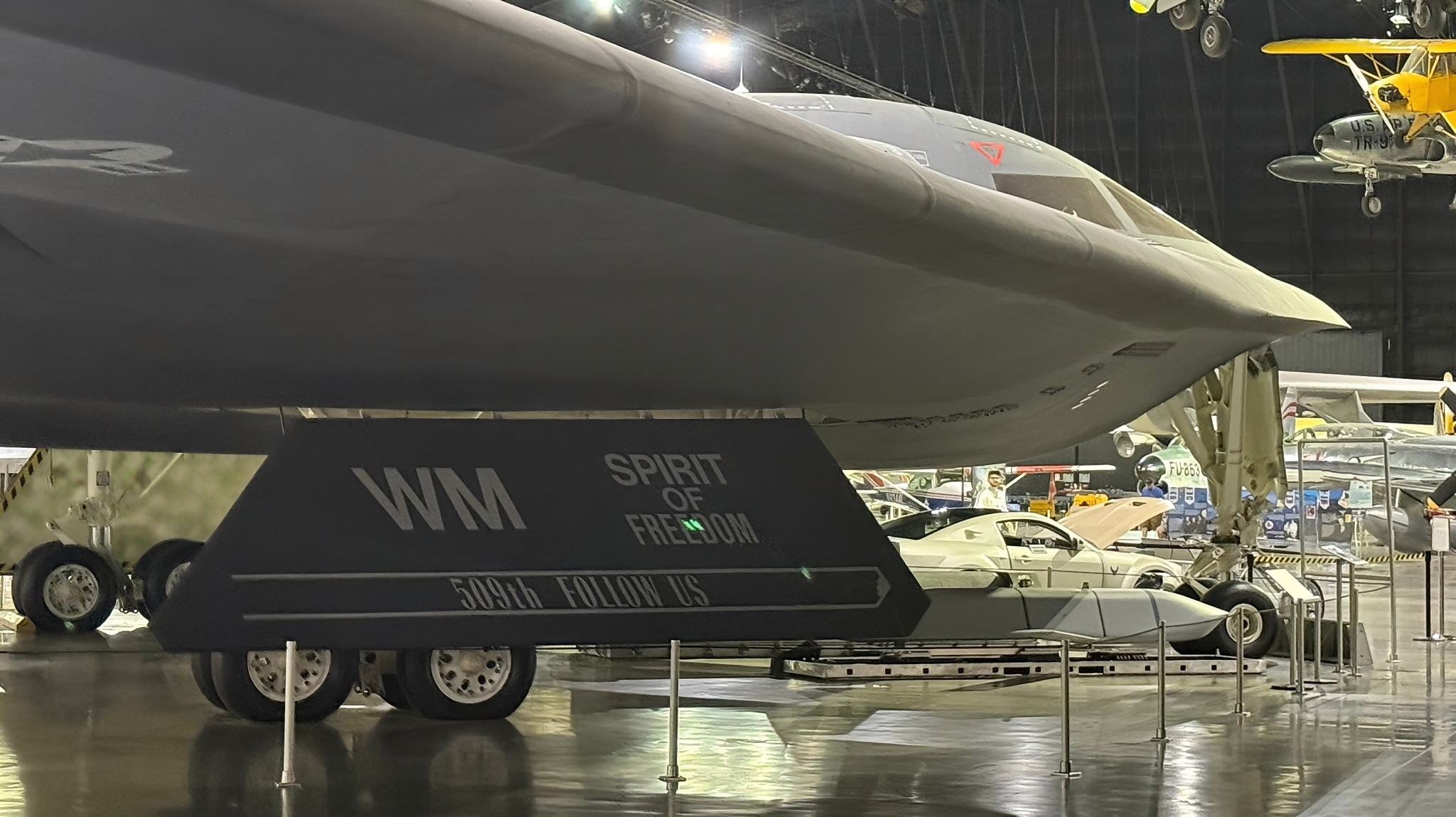
B-2 Bomber at USAF Museum National Security Journal Image. All Rights Reserved.
-That performance has impressed President Donald Trump, Defense Secretary Pete Hegseth, and senior Air Force leaders, fueling talk of adding more B-2s to fly alongside the B-21.
-Thanks to upgraded computers, new stealth coatings, improved thermal management, and earth-penetrating weapons like the GBU-57, the 36-year-old Spirit is proving that smart modernization can keep legacy stealth platforms lethal.
Operation Midnight Hammer: B-2 Stealth Raid Has a Message for the B-21 Program
The performance of the B-2 Spirit in Operation Midnight Hammer this summer has inspired senior weapons developers and decision-makers to consider building more of the 36-year-old stealth bomber. On the surface, such a prospect may seem nonsensical, given that the next-generation B-21 is arriving soon, and the B-2 is so old.
However, the plane is trustworthy and proven, and confidence in the B-2’s ability to perform in a modern threat environment has reached the U.S. President Donald Trump.
While many details of Operation Midnight Hammer remain unavailable, Defense Secretary Pete Hegseth was unaware of any shots being fired at the B-2s during the operation.
Hegseth and top Air Force generals support Trump’s praise for the B-2.
It could well inspire a move to add more B-2s to the fleet to fly alongside the B-21 as the newer bomber joins the force.
This could make sense, given that the B-2 has proven it remains effective for modern combat operations.
Russian Air Defenses
The B-2’s successful attack is significant in essential ways. Iran operates Russian-built S-300 and possibly S-400 surface-to-air missile systems.
Modern variants of these weapons are increasingly enabled by digital networking, target-sharing technology, longer ranges, and the ability to detect aircraft over greater distances across a larger number of frequencies.

A U.S. Air Force B-2 Spirit bomber flies over the North Pacific Ocean, June 13, 2024. The speed, flexibility, and readiness of the Air Force’s strategic bombers plays a critical role in deterring potential adversaries and signaling unwavering support to allies and partners. Counter-maritime missions provide valuable training opportunities to improve interoperability and demonstrate that Air Force forces are capable of operating anywhere, anytime, to meet any challenge decisively. (U.S. Marine Corps photo by Sgt. Jose Angeles)
In recent years, Russian state-aligned media have made repeated claims that advanced Russian air defenses can detect and destroy stealth aircraft; this has not been confirmed.
The B-2’s ability to elude detection and pinpoint high-value targets while operating in territory covered by such systems—combined with the Spirit’s unparalleled bombing power—highlights a fundamental truth about force modernization: that decades-old platforms can become almost entirely different aircraft with structural reinforcement and continual upgrades.
While there are limits to how much an older platform can be upgraded, aircraft such as the B-2, F-15, and B-52 have remained relevant, lethal, and effective in modern, high-threat environments.
The B-2 is the best example of this phenomenon. Today’s Spirit has a 1,000-fold faster computer processor, stealth coating upgrades, improved thermal management, and sensors and weapons that are effective and lethal against advanced threats.

A B-2 Spirit returns to Whiteman Air Force Base, Missouri, from a deployment to Diego Garcia, British Indian Ocean Territory, May 9, 2025. The 509th Bomb Wing and its fleet of B-2 aircraft serve as part of the U.S. Air Force’s conventional and strategic combat force with the capability to project U.S. airpower anywhere around the world. (U.S. Air Force photo by Senior Airman Devan Halstead)
The computing upgrades involved rehosting the flight management control processors—the brains of the airplane—onto much more capable integrated processing units.
This included laying new fiber-optic cable in place of the mix bus cable previously used. The original B-2 computers from the 1980s could be overloaded with data in a modern war environment.
B-2 Pilot
Several years ago, former B-2 pilot Capt. Nicola Polidor told Fox News about the impact of the computer upgrades.
“It is like a flying computer. You enter text into the computer. We can input the pressure, airspeed or target for a weapon from that panel and send it,” Polidor said. “We have autopilot just like a commercial airliner. We are able to maintain altitude without having to input into the computer system.”

A U.S. Air Force B-2 Spirit aircrafts deployed from Whiteman Air Force Base, Mo., sits on the parkway after landing from a local training flight at Andersen Air Force Base, Guam, Jan. 17, 2017. Close to 200 Airmen and three B-2s deployed from Whiteman Air Force Base, Mo., and Barksdale Air Force Base, La., in support of U.S. Strategic Command Bomber Assurance and Deterrence missions. USSTRATCOM units regularly conduct training with and in support of the Geographic Combatant Commands. USSTRATCOM, through its global strike assets, helps maintain global stability and security while enabling units to become familiar with operations in different regions. (U.S. Air Force photo by Tech. Sgt. Andy M. Kin)
New B-2 Weapons Configuration
The B-2 handles its weapons differently, too. It is now configured with new software, fire control enhancements, and interfaces to enable greater flexibility and a much more expansive arsenal.
For example, the B-2 can deliver the GBU-57 Massive Ordnance Penetrator.
Satellite images of the bomb attacks on Iranian sites reveal somewhat small holes of entry.
This is quite deliberate—the Air Force has been developing earth-penetrating weapons for many years. They are configured with pointed, sharp front ends to penetrate deep into the earth and are armed with a delayed fuse that prevents detonation until it reaches the desired depth underground.
This naturally maximizes damage to targets deliberately buried underground.
About the Author: Kris Osborn
Kris Osborn is the President of Warrior Maven – Center for Military Modernization. Osborn previously served at the Pentagon as a highly qualified expert in the Office of the Assistant Secretary of the Army—Acquisition, Logistics & Technology. Osborn has also worked as an anchor and on-air military specialist at national TV networks. He has appeared as a guest military expert on Fox News, MSNBC, The Military Channel, and The History Channel. He also has a Masters Degree in Comparative Literature from Columbia University.
More Military
The Army’s AH-64E Apache Helicopter Can Destroy Drones with Missiles
U.S. Navy Iowa-Class Battleship USS New Jersey’s ‘Comeback’ Is Now Complete
Blaze of Glory: The SR-71 Blackbird Retired Hitting Mach 3.21