

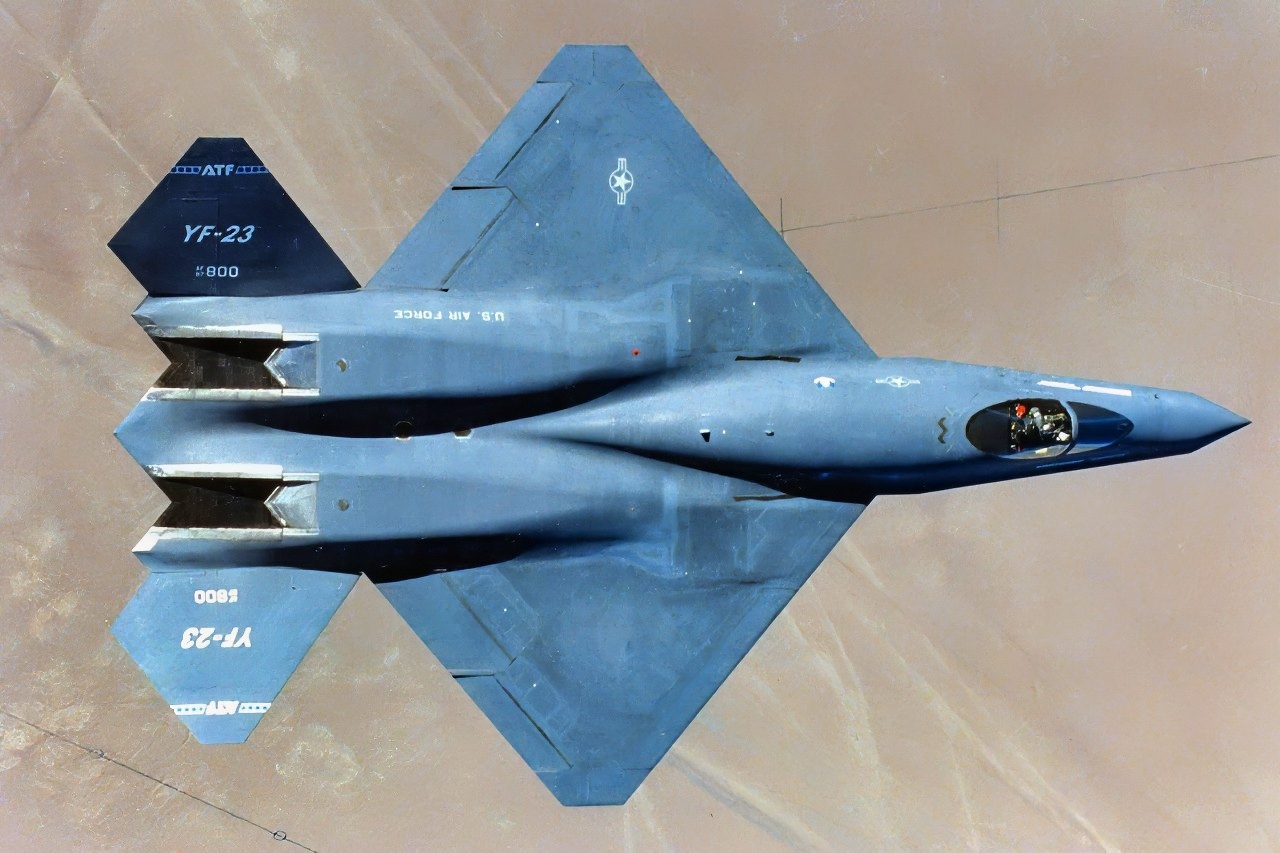
Key Points and Summary – The NATF-23 envisioned a carrier-capable YF-23 Black Widow II to replace the F-14: stealth shaping, internal bays, strengthened gear, twin tails, canards, and thrust-vectoring for low-speed control at sea.
-But turning the YF-23 into a deck jet meant a deep redesign—wider wings, new intakes, reinforced structure—driving risk and cost just as the Cold War ended and budgets tightened.

Northrop YF-23 National Security Journal Photo. Taken on July 19, 2025.
-With the ATF crown going to the YF-22 and the Navy favoring a versatile, affordable path, the F/A-18E/F won the day.
-The NATF-23 remains a compelling what-if: a stealthy fleet defender shelved by timing, money, and shifting strategy rather than technology.
The YF-23 Black Widow II: An Aircraft Carrier Fighter?
Today, the YF-23 has something of a cult following among aviation experts and enthusiasts.
Many people, myself included, have imagined what might have happened had the fighter won the ATF instead of the YF-22.
What many people do not know is that the Navy also had plans for the YF-23 in case it was accepted into service.
This carrier-capable variant of the Black Widow was unofficially dubbed the NATF-23.
Unfortunately, like its land-based version, the NATF-23 was ultimately cancelled.
The YF-23 and the ATF Program
To understand the NATF-23, it’s important to first explore the origins of the YF-23 and the ATF program.
The ATF program was initiated by the U.S. Air Force in response to emerging threats from advanced Soviet fighters such as the Su-27 and MiG-29.
These aircraft posed a significant challenge to American air superiority, prompting the development of a next-generation fighter that would incorporate stealth technology, supercruise capability, and superior agility.

YF-23 National Security Journal Photo. Taken by Harry J. Kazianis at U.S. Air Force Museum on 7/19/2025.
Two prototypes were built for the ATF competition: the YF-22 by Lockheed, Boeing, and General Dynamics, and the YF-23 by Northrop and McDonnell Douglas.
The YF-23, nicknamed “Black Widow II,” was a sleek, futuristic-looking aircraft with a diamond-shaped wing and V-tail configuration.
It was designed with stealth as a primary consideration, featuring smooth surfaces and internal weapons bays to minimize radar cross-section. The aircraft demonstrated impressive speed and stealth characteristics during testing, including supercruise capability.
However, it was ultimately passed over in favor of the YF-22, which became the F-22 Raptor. The decision was influenced by the YF-22’s superior maneuverability and its more conventional design, which was deemed easier to transition into production.
The Navy Wants a Stealth Fighter
While the ATF program was focused on the Air Force, the U.S. Navy also expressed interest in a navalized version of the winning ATF design. This initiative became known as the Naval Advanced Tactical Fighter (NATF) program.
The goal was to develop a stealthy, carrier-capable fighter that could replace the F-14 Tomcat and operate effectively in the demanding environment of naval aviation. Both Lockheed and Northrop explored naval variants of their respective ATF entries, with Northrop proposing the NATF-23 based on the YF-23 platform.
The NATF-23 was not simply a modified YF-23; it was a fundamentally reimagined aircraft designed to meet the unique requirements of carrier operations. One of the most significant changes was the replacement of the YF-23’s V-tail with conventional twin vertical stabilizers. This change was necessary to improve stability and control during carrier landings and takeoffs. The NATF-23 also featured forward canards, which would have enhanced low-speed handling and provided additional lift during approach and recovery.

YF-23 on Taxiway USAF. Image Credit: Creative Commons.
Thrust vectoring nozzles were proposed to improve maneuverability, addressing one of the key criticisms of the original YF-23 design.
The Black Widow for Carriers
Other modifications included a wider wingspan and a longer fuselage to accommodate the structural demands of carrier launches and recoveries. The air intakes were also redesigned to better suit naval operations, and the aircraft would have incorporated reinforced landing gear and tailhooks for arrested landings.
These changes represented a significant departure from the original YF-23 design, reflecting the challenges of adapting a stealth interceptor for the rigors of carrier aviation.
Despite its promising design, the NATF-23 never advanced beyond the conceptual stage. Several factors contributed to its cancellation. First and foremost were cost concerns. Naval aircraft are inherently more expensive to develop and produce due to the need for reinforced structures, folding wings, and specialized landing gear.
The extensive redesign required for the NATF-23 would have added significant development costs, making it a less attractive option compared to existing platforms.
The YF-23 Loses the Race
The complexity of the ATF program also played a role in the NATF-23’s demise. Developing a naval variant would have introduced additional layers of risk and required close coordination between the Air Force and Navy.
Given the challenges already faced by the ATF program, adding a naval component was deemed too ambitious.
Lockheed’s YF-22 was seen as more adaptable and closer to production, and while a navalized version of the YF-22 was considered, it too was eventually shelved.
Additionally, the strategic landscape was shifting in the early 1990s. With the end of the Cold War, the perceived need for a high-speed stealth interceptor diminished. The Navy began to prioritize multirole platforms that could perform a variety of missions at a lower cost.

YF-23 Black Widow II Fighter In California. Image Credit: Harry J. Kazianis/National Security Journal.
The F/A-18E/F Super Hornet, which was already in development, offered a more economical and versatile solution.
It could perform air-to-air, air-to-ground, and reconnaissance missions, and was based on a proven design already in service.
The YF-23 was an impressive aircraft, but it was not designed for carrier operations. Neither ATF candidate would have been suitable for carrier operations, for that matter.
One of Northrop’s primary goals was to cut down the aircraft’s weight to emphasize stealth and speed. While this approach worked, it would have made the aircraft difficult to redesign.
The F-22 could have been redesigned for carrier operations, but this would have required extensive redesigns that would have incurred significant costs.
About the Author: Isaac Seitz
Isaac Seitz, a Defense Columnist, graduated from Patrick Henry College’s Strategic Intelligence and National Security program. He has also studied Russian at Middlebury Language Schools and has worked as an intelligence Analyst in the private sector.
More Military
A New B-21 Raider Stealth Bomber Is in the Sky
Challenger 3: The Math Problem That Can’t Be Solved
F/A-XX: The Stealth Fighter That May Never Fly for the Navy
The F-35 Fighter Has a ‘Secret’ That Is Right In Front of Your Eyes