

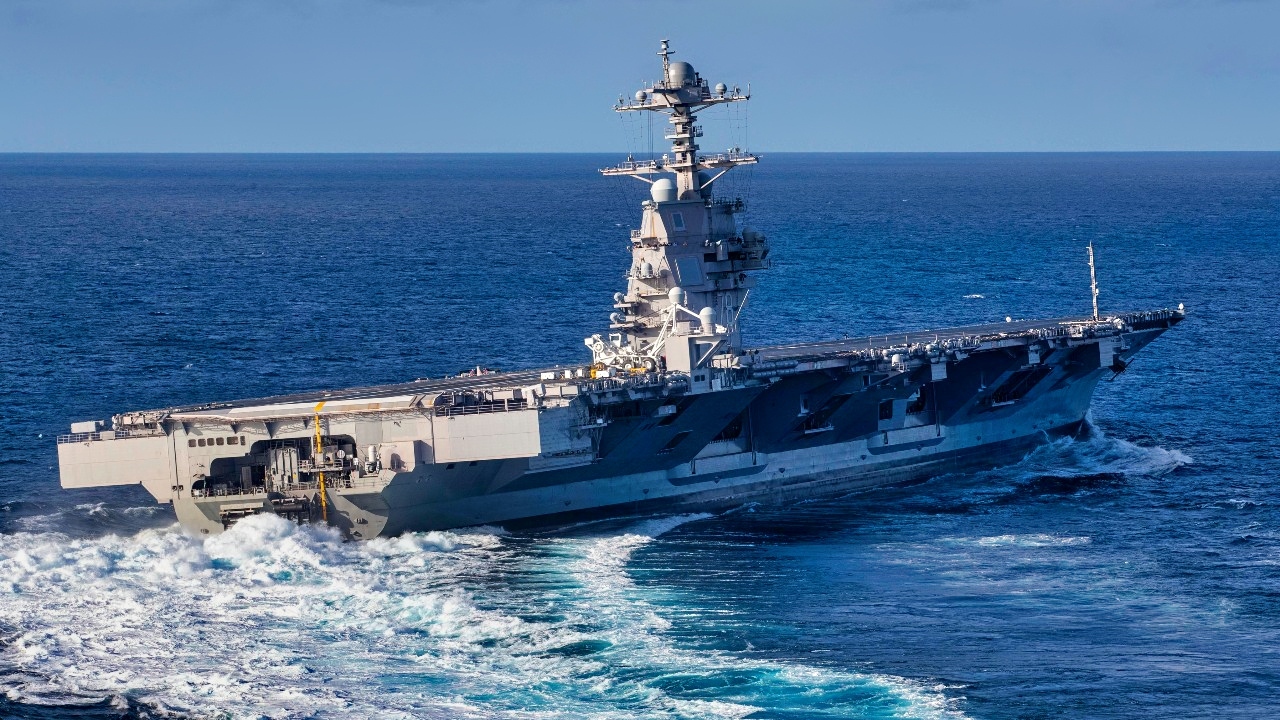
Recent unsuccessful Houthi attacks highlight its advanced defense systems. Truman’s presence underscores U.S. commitment to protecting vital shipping lanes and maintaining stability in a strategically critical region.
The United States Navy has a fleet of 11 supercarriers and nine helicopter carriers or amphibious assault ships. The 20-carrier total far outnumbers the next-closest country, China, which has three carriers and three helicopter carriers.

Amphibious assault ship USS Makin Island (LHD 8) and aircraft carrier USS Nimitz (CVN 68) perform expeditionary strike force (ESF) operations, Feb. 15, 2023 in the South China Sea. Nimitz Carrier Strike Group (NIMCSG) and amphibious assault ship USS Makin Island (LHD 8) with embarked 13th Marine Expeditionary Unit are conducting joint ESF operations, representing unique high-end war fighting capabilities, maritime superiority, and power projection, demonstrating the U.S. commitment to our allies and partners in the Indo-Pacific region. (U.S. Navy photo by Mass Communication Specialist 3rd Class Kendra Helmbrecht)
The USS Harry S. Truman (CVN-75) is the ninth nuclear-powered aircraft carrier and the eighth in the Nimitz class. Named after the 33rd president of the United States, Newport News Shipbuilding laid the keel for the $4.5 billion warship on Nov. 29, 1993.
The ship’s sponsor, the late President’s daughter Margaret Truman Daniel, christened the ship on Sept. 7, 1996, and the ship was launched on Sept. 13, 1996.
CVN-75 is part of the Atlantic Fleet and falls under the Commander, Naval Air Forces Atlantic.
The Commander, Naval Air Forces Atlantic (COMNAVAIRLANT), is responsible for six nuclear-powered aircraft carriers, 54 aircraft squadrons, 1,200 aircraft, and 43,000 officers, enlisted, and civilian personnel based on the East Coast of the United States.
It provides combat-ready, sustainable naval air forces with the right personnel, adequately trained and equipped, focusing on readiness, operational excellence, interoperability, safety, and efficient resourcing.
USS Harry S. Truman History
President Bill Clinton commissioned CVN-75 on July 25, 1998, during a ceremony attended by an estimated 20,000 people at Naval Station Norfolk, Virginia. Having adapted President Truman’s renowned assurance that “the buck stops here,” Clinton said during the ceremony that the US, as the world’s lone superpower, “must continue to be responsible, to say the buck stops with the United States.”
The USS Harry S. Truman is over 1,000 feet in length, making it one of the longest ships in the world. Its flight deck spans approximately 4.5 acres, providing ample space for various aircraft operations, including takeoffs, landings, and maintenance activities. The massive carrier can make about 30 knots.

U.S. 5TH FLEET AREA OF OPERATIONS (Aug. 6, 2024) An Aviation Boatswain’s Mate (Handling) signals aircraft on the flight deck of the Nimitz-class aircraft carrier USS Theodore Roosevelt (CVN 71), Aug. 6. Theodore Roosevelt is deployed to the U.S. 5th Fleet area of operations to support maritime security and stability in the U.S. Central Command area of responsibility. (Official U.S. Navy photo)
The ship’s size allows it to support a small city of personnel and equipment, from living quarters and dining facilities to medical centers and repair shops. This massive scale of the carrier enables the USS Harry S. Truman to function independently while deployed, with all necessary resources available onboard, ensuring the carrier remains mission-ready.
The ship’s company consists of about 3,000 sailors responsible for operating and maintaining the ship’s various systems, from navigation to power generation. The remaining 2,000 personnel belong to the air wing, including pilots, support staff, and aircraft maintenance teams who keep the carrier’s fleet mission-ready.
The Truman earned nine battle stars during her nearly 27 years of service. A tenth is sure to be awarded after its current tour in the Middle East, where the Iranian proxies, the Houthis, have been shooting missiles at the ship’s carrier strike group.
Strike aircraft from the carrier have been blasting Houthi strongholds and missile launch sites for days.
Protecting Shipping Lanes in the Red Sea
The Houthis, like their Iranian masters, make silly claims to appeal to the lowest common denominator in the Middle East. Most educated people know their boasts are pure BS.
They claimed they chased away the USS Abraham Lincoln (CVN-72) and boasted of a “victory” over the US. Also, like their Iranian masters, they suffer from a misguided belief that they are untouchable. Launching missiles at an unarmed merchant vessel is one thing. Launching at a US aircraft carrier is another. President Trump has been relatively restrained thus far in his responses; these could be much worse.
The Houthis have been trying (unsuccessfully) to target the USS Harry S. Truman as she takes over for the Lincoln.
According to CENTCOM, “The carrier strike group consists of the flagship Nimitz-class aircraft carrier USS Harry S. Truman (CVN 75); Carrier Air Wing (CVW) 1 with nine embarked aviation squadrons; staffs from Carrier Strike Group (CSG) 8, CVW-1, and Destroyer Squadron (DESRON) 28; the Ticonderoga-class guided-missile cruiser USS Gettysburg (CG 64); and two Arleigh Burke-class guided-missile destroyers, USS Stout (DDG 55) and USS Jason Dunham (DDG 109).”

210924-N-JW440-1055 SOUTH CHINA SEA (September 24, 2021). The navy’s only forward deployed aircraft carrier USS Ronald Reagan (CVN 76) transits the South China Sea. Reagan is attached to Commander, Task Force 70/Carrier Strike Group 5 conducting underway operations in support of a free and open Indo-Pacific. (U.S. Navy Photo by Mass Communication Specialist 1st Class Rawad Madanat)
The Houthis claimed two attacks on the USS Harry Truman, though US fighter jets successfully intercepted one missile and 11 drones, preventing damage. The Pentagon confirmed the interception but dismissed the Houthi’s accuracy, calling their missiles “incompetent.”
The US responded with precision strikes targeting Houthi command centers and drone facilities, warning that further attacks would hold Iran directly accountable. Thus far, the Iranians have been silent, but could they be so dumb tactically to launch cruise missiles at the USS Truman?
If they didn’t learn anything from the massive airstrike that the Israelis conducted in Iran in late October, then they are in for a rude awakening.
Gen. Michael Erik Kurilla, Commander of United States Central Command (CENTCOM), visited the USS Harry S. Truman (CVN 75) as it operated in the Red Sea as part of ongoing regional operations, protecting the shipping lanes open in mid-January.
“The USS Harry S. Truman Carrier Strike Group exemplifies the strength, power projection, and war fighting prowess of the US Navy. The Carrier Strike Group presence in the region reinforces our commitment, alongside our partners and allies, to ensuring maritime security and deterring threats to regional stability. I am inspired by the exceptional work being performed by the men and women serving our Nation and our national interests, while supporting peace, security, and stability in the region,” said Gen. Kurilla.
About the Author:
Steve Balestrieri is a 19FortyFive National Security Columnist. He served as a US Army Special Forces NCO and Warrant Officer. In addition to writing for 19FortyFive, he covers the NFL for PatsFans.com and is a member of the Pro Football Writers of America (PFWA). His work was regularly featured in many military publications