

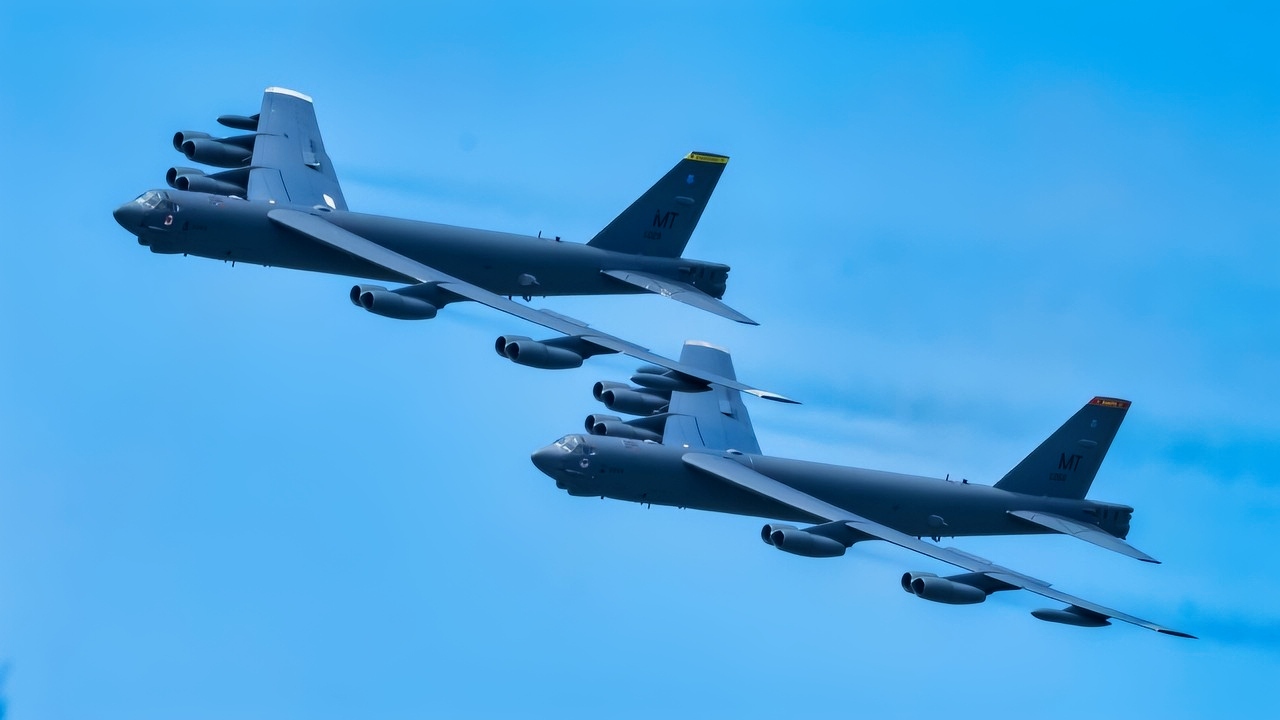
PUBLISHED on August 18, 2025, 9:51 AM EDT – Key Points and Summary: The U.S. Air Force has deployed a squadron of B-52 Stratofortress bombers to Andersen Air Force Base in Guam, a move widely seen as a strategic message to China.
-Timed with the REFORPAC exercise, the deployment reinforces the American commitment to a rules-based order in the Indo-Pacific.
-The 70-year-old bomber remains a potent symbol of U.S. power, capable of carrying over 70,000 pounds of ordnance.
-Planned upgrades to the B-52J variant will ensure the venerable “BUFF” continues to serve as a key instrument of strategic deterrence in the Pacific until the 2050s.
The B-52 Bomber Gives China Pause
A squadron of B-52 Stratofortress bombers have been sent off to Guam’s Andersen Air Force Base, likely in an attempt to intimidate Beijing.
The surprise deployment, reported by The National Interest magazine, took place at the same time as the Resolute Forces Pacific (REFORPAC) exercise.
Strategic Deterrence in the Pacific
The Air Force Global Strike Command publicly stated that the operation helps support “Pacific Air Forces’ training efforts with Allies, partners, and joint forces and strategic deterrence missions to reinforce the rules-based international order in the Indo-Pacific region.”
B-52s are not newcomers to the US military’s power plays.
The planes first took flight over 70 years ago, and have been used in the Gulf War, Cold War standoffs, and more recent Middle East campaigns.
These bombers were first designed in the wake of the Second World War for long-range strikes that need not rely on overseas bases.
The aircraft was a product of strategic thinking shaped by the nuclear age and the early days of aerial refuelling.
Cold War Airframes Re-equipped
The airframe dates back to the 1950s; new upgrades have allowed the Stratofortress to maintain relevance. In the 2000s, the planes were equipped with Combat Network Communications Technology (CONECT) systems, permitting speedier mission updates.
The current B-52H variant can haul 70,000 plus pounds of weaponry such as cruise missiles, precision bombs, and anti-ship missiles.
The bomber is now expected to be developed into the B-52J. These advanced models would be kitted out with Rolls-Royce F130 engines, along with modern radar and avionics.
The Long-Range Standoff (LRSO) weapon would also be added on, extending the bomber’s service life into the 2050s.
Guam: Washington’s Secret Weapon
Guam, an unincorporated US territory, sits some 1,800 miles off the Chinese coast, making it an ideal long-range bomber base.
As tensions over Taiwan, the South China Sea, and Chinese military expansion in the Pacific continue to spiral, Guam is well placed to grow in importance for the U.S.Washington said the deployment is merely routine, but its messaging and timing tell another story.
Beijing often sees fit to slam such bomber rotations as “destabilising”, but US officials stand firm: explaining that they help remind any rival states that any pushes to shift the balance of the Indo-Pacific will come with a heavy price.
B-52s are not only physical threats, but symbols of Washington’s vast strategic force.
The Stratofortress is not a mere Cold War relic, but a continuing warning to adversaries to not underestimate American power.
About the Author: Georgia Gilholy
Georgia Gilholy is a journalist based in the United Kingdom who has been published in Newsweek, The Times of Israel, and the Spectator. Gilholy writes about international politics, culture, and education. You can follow her on X: @llggeorgia.
Fighter Jet Fails
Russia’s Su-57 Felon Stealth Fighter Is a Waste of Rubles