

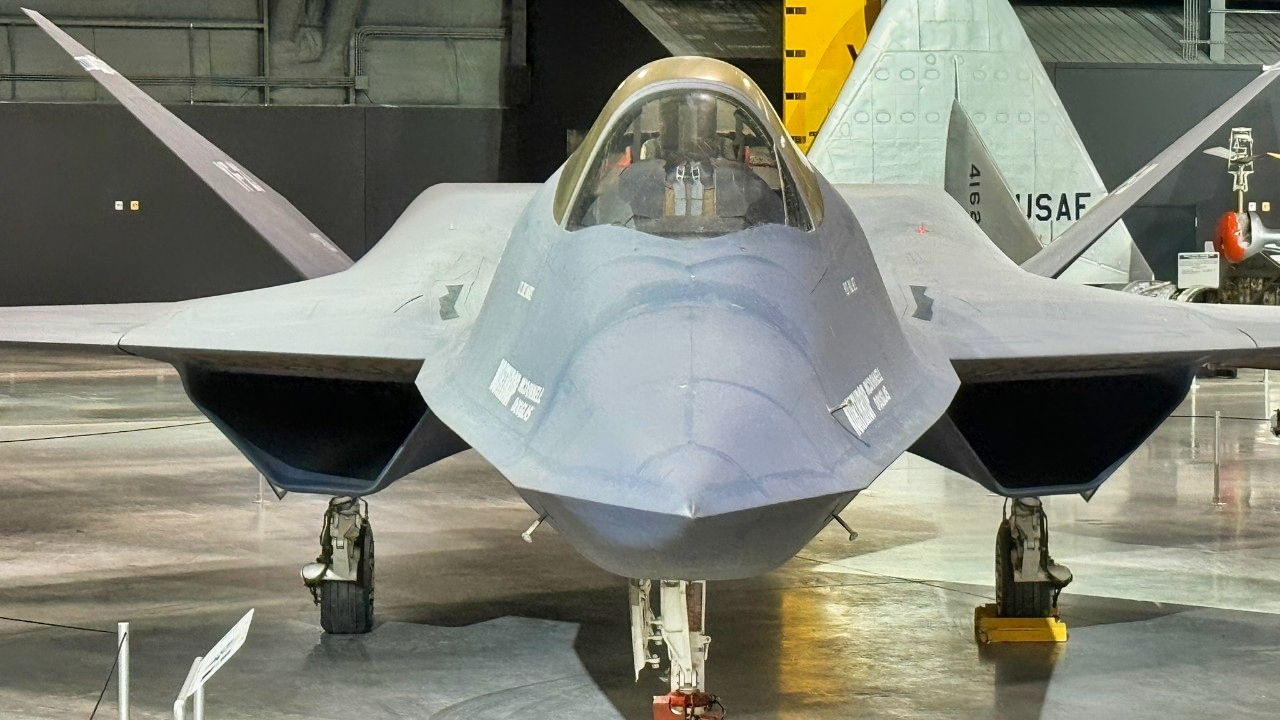
YF-23 Key Points and Summary – The Northrop YF-23 was a revolutionary stealth fighter prototype that, in the eyes of many experts, should have beaten the YF-22 in the Advanced Tactical Fighter competition.
-The “Black Widow II” was arguably the superior aircraft, boasting better speed, a longer range, and a stealthier design than its Lockheed rival.

YF-23 photo by Harry J. Kazianis at the U.S. Air Force Museum. Taken 7/19/2025.
-However, the Air Force ultimately chose the YF-22, which became the F-22 Raptor.
The YF-23 Never Made It to the Air Force
This controversial decision was likely influenced by the YF-22’s superior low-speed agility, a more conventional and less risky design, and political considerations aimed at keeping Lockheed Martin’s fighter division in business.
The ATF program was initiated in the 1980s as a response to emerging threats from advanced Soviet aircraft and air defense systems.
The U.S. Air Force sought a next-generation air superiority fighter that would replace the aging F-15 Eagle and maintain American dominance in the skies well into the 21st century.
The requirements were ambitious: the new fighter had to be stealthy, fast, maneuverable, and equipped with cutting-edge avionics and weapons systems. Two teams were selected to build prototypes: Lockheed (in partnership with Boeing and General Dynamics) developed the YF-22, while Northrop (partnering with McDonnell Douglas) created the YF-23.

YF-23. Image by National Security Journal Taken on 7/19/2025.
YF-22 vs YF-23
The YF-23 was a bold and unconventional design. It featured a sleek, blended fuselage with diamond-shaped wings and a distinctive V-tail configuration, also known as a butterfly tail. The aircraft’s engine nacelles were smoothly integrated into the body, and all weapons were carried internally to preserve its stealth profile.
Two prototypes were built: PAV-1, nicknamed “Black Widow II,” powered by Pratt & Whitney YF119 engines, and PAV-2, known as “Gray Ghost,” powered by General Electric YF120 engines. The YF-23 was designed with a clear emphasis on stealth and speed rather than extreme agility. Its mission profile was to detect and destroy enemy aircraft before being seen, a “first-look, first-shot, first-kill” philosophy.
Ever since the ATF competition, experts and aviation enthusiasts alike have been arguing whether the YF-23 was unfairly snubbed.
One of the most frequently cited arguments in favor of it over the F-22 is its superior stealth capabilities. The YF-23’s shape was optimized to minimize radar cross-section from all angles.
Its smooth, curved surfaces, lack of vertical stabilizers, and carefully designed engine inlets and exhausts contributed to a radar signature that was reportedly lower than that of the YF-22. The V-tail configuration also helped reduce radar returns from the rear and sides. While exact radar cross-section data remains classified, many analysts believe the YF-23 was the stealthier of the two aircraft.
Was the YF-23 a Better Choice?
Another area where the YF-23 excelled was speed and supercruise capability. The YF-23 was capable of supercruise at speeds exceeding Mach 1.6, and some sources suggest it could reach Mach 2.0 or higher in full afterburner.
The General Electric YF120 engine, used in the second prototype, featured variable cycle technology that allowed it to optimize performance across different flight regimes. This gave the YF-23 a potential edge in both speed and fuel efficiency over the F-22, which supercruises at around Mach 1.5.
Range was another area where the YF-23 may have had an advantage, although the exact numbers remain classified. Its larger internal fuel capacity allowed for a longer combat radius, which would have been particularly valuable in theaters like the Pacific, where vast distances between bases and targets are standard.
The aircraft’s efficient aerodynamics and engine performance contributed to this extended range, making it a more strategic asset for long-range missions.
The YF-23 was also designed to be quieter and calmer than its competitor. Its engine exhausts were shielded and flattened to reduce infrared emissions, making it harder to detect with heat-seeking missiles. The aircraft’s overall design also contributed to a lower acoustic signature, which is essential for stealth operations. These features made the YF-23 not only more challenging to detect but also more complicated to track with infrared sensors.
Why the Air Force Chose the F-22 Raptor
Despite these advantages, the U.S. Air Force ultimately selected the YF-22 as the winner of the ATF competition in 1991. Several factors contributed to this decision. One of the most significant was the YF-22’s superior agility and maneuverability.

F-22 Raptor at USAF Museum. Image Credit: National Security Journal.
The F-22 featured thrust-vectoring nozzles that allowed it to perform extreme maneuvers, such as the Cobra and J-turns, which are valuable in close-range dogfighting scenarios. While the YF-23 was fast and stealthy, it lacked the same level of kinematic performance, particularly at low speeds and high angles of attack.
The YF-22’s more conventional design was also seen as less risky and easier to transition into production. Its twin vertical stabilizers and traditional control surfaces were familiar to engineers and pilots, reducing the learning curve and potential maintenance challenges.
In contrast, the YF-23’s V-tail and blended body were more exotic and potentially more difficult to maintain or modify.
Industrial and political considerations also played a role. Lockheed Martin had a strong track record with stealth aircraft, having developed the F-117 Nighthawk. Its industrial team was larger and more experienced, and the company had strong relationships with key decision-makers in the Department of Defense.
At the time, Lockheed Martin lacked new fighter programs. The F-22 was more or less their last shot to get a deal on a new fighter project. The Air Force decided that it was essential to the country’s national security to keep Lockheed as a air manufacturer and sided with the YF-22.

F-22 Raptor Fighter National Security Journal Photo.
In the end, the decision to choose the YF-22 over the YF-23 was a safe one. Lockheed had a more conventional design, an established track record with stealth fighters, and it made more economic sense in the long run.
Lockheed was also better at pitching the benefits than the engineers at Northrop, making a more memorable and lasting impression on decision-makers at the Air Force.
Arguably, the YF-23 would have made more sense with how aerial combat has evolved, but at the time, both options were far superior to everything fielded by the Soviet Union.
About the Author:
Isaac Seitz, a Defense Columnist, graduated from Patrick Henry College’s Strategic Intelligence and National Security program. He has also studied Russian at Middlebury Language Schools and has worked as an intelligence Analyst in the private sector.
Military Matters
Russia’s Su-57 Felon Stealth Fighter Is a Waste of Rubles




Pingback: China's J-20 Mighty Dragon Fighter Has an 'Achilles' Heel' - National Security Journal