

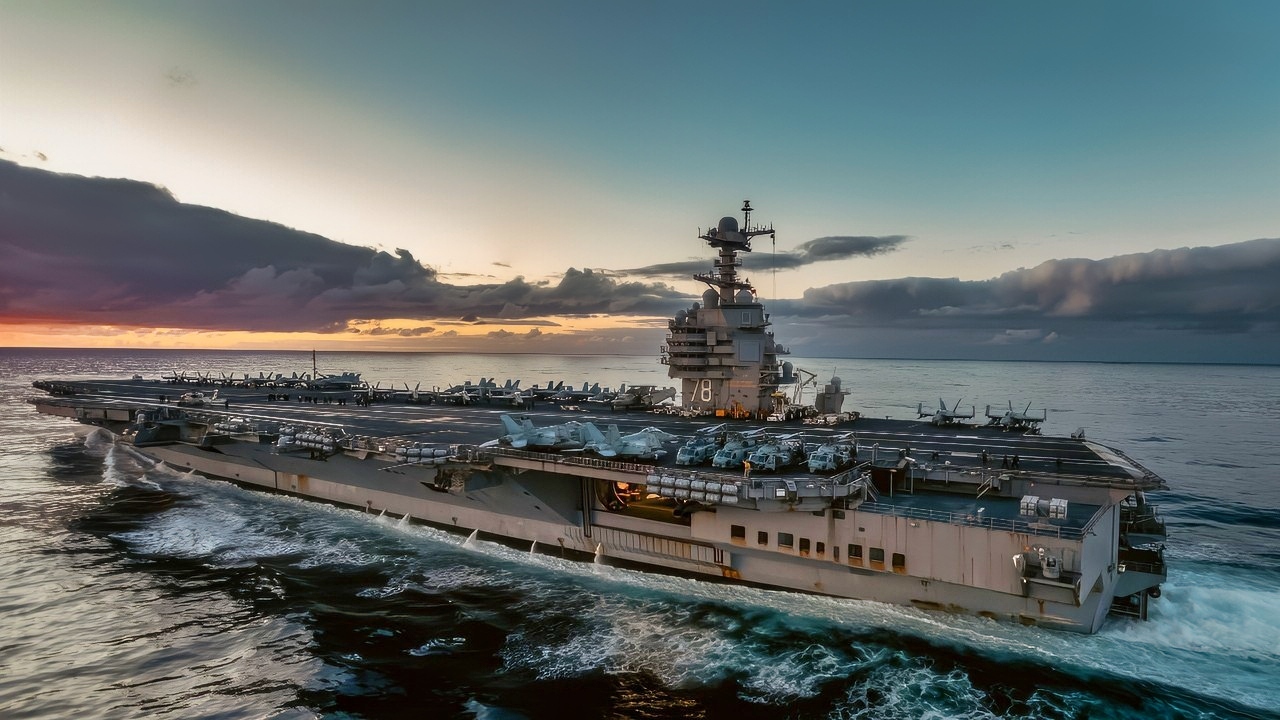
A Fading Power? The U.S. Aircraft Carrier Fleet Is Too Small for Modern Threats
Key Points and Summary
-The U.S. Navy’s fleet of eleven aircraft carriers is dangerously insufficient to counter the combined threats of a rising China and an aggressive Russia.
-The post-Cold War “peace dividend” led to complacency and a decline in naval strength, leaving a strained shipbuilding industry struggling to keep pace.
-While China rapidly expands its own carrier fleet, the U.S. faces a critical numbers gap.
-To maintain global dominance and credibly deter adversaries in multiple theaters simultaneously, a return to a Cold War-level force of 15 or more carriers is a strategic necessity.
The U.S. Navy Faces an Aircraft Carrier Shortage?
Aircraft carriers have always been the center of American naval strategy.
As far back as World War II, the carrier has been an invaluable tool of American power projection, playing a vital part in America’s island-hopping campaign. After the Cold War and the collapse of the USSR, the U.S. Navy is now in a strange period of budget cuts and downsizing.
However, this is occurring while China’s Navy has been growing rapidly and threatening Taiwan, a nation that America is obligated by treaty to defend militarily.
This, combined with Russia’s aggression in Eastern Europe and the eternal conflict in the Middle East, raises an important question: Does the U.S. Navy have enough aircraft carriers?
The U.S. Navy’s Current Aircraft Carrier Fleet
As of 2025, the United States Navy operates eleven nuclear-powered aircraft carriers, primarily composed of the Nimitz-class and the newer Ford-class supercarriers.
These vessels are among the most capable in the world, each capable of launching and recovering up to 90 aircraft, including advanced fighters such as the F/A-18E/F Super Hornet and the F-35C Lightning II.
They serve as the centerpiece of Carrier Strike Groups, which include cruisers, destroyers, submarines, and support ships. The Navy plans to replace aging Nimitz-class carriers with six Ford-class carriers over the coming decades, though this process is slow and expensive.

U.S. 5TH FLEET AREA OF OPERATIONS (Aug. 6, 2024) An Aviation Boatswain’s Mate (Handling) signals aircraft on the flight deck of the Nimitz-class aircraft carrier USS Theodore Roosevelt (CVN 71), Aug. 6. Theodore Roosevelt is deployed to the U.S. 5th Fleet area of operations to support maritime security and stability in the U.S. Central Command area of responsibility. (Official U.S. Navy photo)
In contrast, China currently has three operational aircraft carriers: the Liaoning, a refitted Soviet-era vessel; the Shandong, China’s first domestically built carrier; and the Fujian, a larger and more advanced carrier equipped with electromagnetic catapults. While these carriers are conventionally powered and not as capable as U.S. supercarriers, they represent a rapidly growing capability.
China aims to have six carriers by 2035, including the nuclear-powered Type 004, which is under development. Though China’s carriers are smaller and less experienced in blue-water operations, their presence in the Indo-Pacific is increasingly significant.
Current Naval Doctrine
To maintain a continuous carrier presence in the Indo-Pacific, the U.S. Navy typically requires three carriers per deployment cycle: one deployed, one in training or preparation, and one in maintenance.
Assuming the need for two carrier strike groups in the region at any given time, one near Taiwan and one in the South China Sea, the U.S. would need six carriers dedicated to the Indo-Pacific alone. When global commitments in Europe and the Middle East are added, the total requirement could rise to fifteen carriers to maintain dominance and deterrence across all theaters.
However, this number is not fixed. The actual need depends on several factors, including the threat level from China, the effectiveness of allied contributions from countries like Japan and Australia, the role of unmanned systems and submarines, and the ability to surge forces in a crisis. Strategic flexibility and technological innovation may reduce the need for a larger carrier fleet, but the current trajectory suggests that the U.S. must maintain or slightly increase its carrier numbers to remain competitive.

Amphibious assault ship USS Makin Island (LHD 8) and aircraft carrier USS Nimitz (CVN 68) perform expeditionary strike force (ESF) operations, Feb. 15, 2023 in the South China Sea. Nimitz Carrier Strike Group (NIMCSG) and amphibious assault ship USS Makin Island (LHD 8) with embarked 13th Marine Expeditionary Unit are conducting joint ESF operations, representing unique high-end war fighting capabilities, maritime superiority, and power projection, demonstrating the U.S. commitment to our allies and partners in the Indo-Pacific region. (U.S. Navy photo by Mass Communication Specialist 3rd Class Kendra Helmbrecht)
During the height of the Cold War, the U.S. possessed a fleet of 15 aircraft carriers to counter the threat posed by the Soviets alone. During WW2, the U.S. had a fleet of around 100 carriers of various types and classes.
Today, the U.S. faces a threat from China, Russia, and insurgent groups in the Middle East. While Russia’s Navy is still a shadow of its Soviet past, it still poses a significant threat.
With Russia and China’s naval forces combined, an argument can be made that the U.S. needs more than the 11 carriers it has on hand.
Why Doesn’t the U.S. Have More Carriers?
Despite the strategic necessity, several challenges prevent the U.S. from building more aircraft carriers. One major issue is the limitation of the industrial base. The U.S. shipbuilding industry is struggling with labor shortages, aging infrastructure, and slow production rates. Shipyards such as Newport News face difficulties hiring and retaining skilled workers, which leads to delays in carrier and frigate construction.
For example, the USS John F. Kennedy (CVN-79) and USS Enterprise (CVN-80) have experienced multi-year delays due to supply chain issues and technical challenges with advanced systems, such as the Electromagnetic Aircraft Launch System.

PHILIPPINE SEA(Feb. 22, 2016) USS John C. Stennis (CVN 74) sails through the Philippine Sea. Providing a ready force supporting security and stability in the Indo-Asia-Pacific region, Stennis is operating as part of the Great Green Fleet on a regularly scheduled 7th Fleet deployment. (U.S. Navy photo by Mass Communication Specialist Seaman Cole C. Pielop/Released) .
Cost is another significant barrier. Aircraft carriers are costly, with Ford-class carriers costing over $13 billion each, not including the cost of aircraft and escort ships.
The Navy’s 2025 Shipbuilding Plan projects an average annual cost of $40.1 billion, a 46% increase over previous levels. Congress and the Congressional Budget Office have raised concerns about the affordability and sustainability of such spending, especially given competing priorities like submarines, destroyers, and unmanned systems.
Technological complexity also plays a role. Modern carriers incorporate cutting-edge systems that are difficult to integrate and maintain.
The Ford-class, for instance, faced years of delays due to problems with its Advanced Arresting Gear and Advanced Weapons Elevators. These systems are designed to improve sortie rates and reduce crew size, but their complexity has slowed deployment and increased costs.
The Shifting Geopolitical Landscape
Strategic shifts within the Navy are also influencing carrier production. The Navy is moving toward a Distributed Maritime Operations concept, which emphasizes spreading capabilities across a larger number of smaller platforms, including unmanned vessels. This shift may reduce reliance on large carriers and favor more agile, survivable assets. However, unmanned systems are still in development, and their operational roles remain uncertain.
Another challenge is the vulnerability of carriers to modern threats. Carriers are increasingly exposed to anti-ship ballistic missiles, hypersonic weapons (which China showed off in their most recent military parade), and submarine threats, especially in contested regions like the South China Sea.
China’s Anti-Access/Area Denial strategy aims to deter U.S. carriers from operating in the region using long-range missiles, such as the DF-21D and DF-26. This has led some analysts to question whether carriers are still viable in high-end conflict scenarios, prompting calls for alternative force structures.
What is the U.S. Doing to Fix the Problem?
Fortunately, the U.S. is taking steps to help mitigate some of these issues. Strengthening alliances is a key component. The U.S. is working closely with partners like Japan, Australia, South Korea, and the Philippines to build a networked defense posture.
These nations contribute naval forces, basing access, and intelligence capabilities that reduce the burden on U.S. carriers.
Investments in submarines and unmanned systems are also increasing. Submarines are stealthier and more survivable than carriers in contested waters. The Navy is investing heavily in Virginia-class and Columbia-class submarines, as well as unmanned surface and undersea vessels. These platforms offer new ways to project power and gather intelligence without the risks associated with large surface ships.
The current Trump administration is also taking steps to revitalize the American ship building industry. This includes a comprehensive plan to make shipbuilding more economically feasible in the U.S. and to incentivize more companies to work on U.S. soil.
Economists have had their fair share of criticisms of Trump’s plans, but to me, it’s nice to see that the current administration, at the very least, understands the current issue and is trying to fix it.
Does the U.S. Need a Bigger Aircraft Carrier Fleet
With all this in mind, the U.S. could maintain its current carrier fleet assuming nothing extreme happens. If the U.S. were to engage in a war with China, its current carrier fleet would likely be sufficient to counter the threat posed by China.
However, if the U.S. were to get into a war with China and get involved in another conflict in the Middle East, then things would start to look different. The U.S. Navy can handle one theater of conflict but would struggle with two or more other theaters at the same time.
The worst-case scenario would be fighting a war with China and Russia at the same time. Both China and Russia possess robust defense industrial bases that allow them to fight high-intensity wars for prorated amounts of time, enabling them to outproduce the West in terms of ammunition production.
In my opinion, the post-Cold War peace dividend is mainly responsible for the Navy’s current predicament. With the fall of the USSR, the U.S. military grew complacent and forgot the realities of large-scale near-peer conflicts. The DoD shifted its focus away from large-scale engagements to smaller-scale operations more reliant on high-cost precision weaponry.
This worked well enough in the Gulf War and the subsequent GWOT, but it means that the U.S. is likely to struggle in protracted high-intensity conflicts.
The Decline of the U.S. Navy
Arguably, this shift in doctrine has hit the Navy the hardest. Don’t get me wrong, the U.S. Navy is still a world-class powerhouse, but the Navy is in a visible state of decline.
The offshoring of America’s industry has made things worse, as American shipbuilding is not what it used to be 50 years ago.
This has both long- and short-term implications for the U.S. carrier fleet. In the short term, the U.S. will have to rely on older Nimitz-class models while work is done on more Ford-class carriers. In the long term, more work needs to be done to revitalize the American ship building industry. China, on the other hand, is still in the process of amping up its naval output.
I will end by simply saying this: expanding the Navy’s carrier fleet is not only a good short-term investment, but it would also help in the long run by increasing America’s Naval capabilities while also deterring China.
Returning to the Cold War, a 15-carrier capability or more would go a long way in ensuring U.S. naval dominance on the world’s oceans for generations to come. However, much work needs to be done in the industrial sector before the Navy is ready to upsize its fleet again.
About the Author: Isaac Seitz
Isaac Seitz, a Defense Columnist, graduated from Patrick Henry College’s Strategic Intelligence and National Security program. He has also studied Russian at Middlebury Language Schools and has worked as an intelligence Analyst in the private sector.
More Military
The U.S. Army’s AbramsX Question No One Asks
Russia’s New T-14 Armata Tank Is a Joke
China’s Military Has 1 Goal: Beat America In a War