


Key Points and Summary – Dr. Brent Eastwood tackles the growing argument that U.S. supercarriers are overpriced targets in an era of Chinese hypersonic “carrier-killer” missiles and A2/AD strategy.
-He walks through the New York Times’ skepticism, Beijing’s obsession with Taiwan, and scenarios ranging from a rapid amphibious assault to a long blockade of the island.

New China Aircraft Carrier. Image Credit: Weibo.
-Rather than declare the carrier dead, Eastwood argues its role is shifting: operating at range with MQ-25 tankers, shaping chokepoints like the Strait of Malacca, and deterring China economically and militarily.
-The Ford-class, he concludes, remains central to any serious U.S. strategy to defend Taiwan.
Can the United States Still Use Aircraft Carriers to Win Wars?
The USS Gerald R. Ford supercarrier has endured its share of triumphs and disappointments with technological difficulty and delays due to faulty catapults and elevators. The carrier cost the Navy at least $13.3 billion and that doesn’t include the price for maintenance and keeping its air wing operating around the clock.
The Gerald R. Ford is currently in the Caribbean area of operations to overawe Venezuela and to show Central and South America that the United States will pull out all of the stops to defend the Western Hemisphere by flexing the muscles of the Navy and Marine Corps.
Critics Doubt the Efficacy of High-Priced Carriers
However, a new strategic analysis from the New York Times’ Editorial Board has a negative outlook on the Gerald R. Ford-class of carriers. Next up is the USS John F. Kennedy supercarrier that has already been delayed by two years and will probably leave the Navy with only ten carriers since the USS Nimitz is being retired in 2026.
The Times’ editors think that the Ford-class may be good to fly the flag and make a show of force against a ragtag defense force from Venezuela, but it is hardly ready for what I call the “Kinetic Missile Fight” in East Asia.

DF-26 China Missile Attack on Fake Aircraft Carrier Cut Out. Image Credit: Chinese Weibo Screenshot.
The editorial board has a point. Even the most vocal defenders of U.S. strategy in the Indo-Pacific, like Secretary of Defense Pete Hegseth, are worried about the performance of American naval assets in East Asia.
The Chinese have several “carrier killing missiles” that are hypersonic with plus-MACH 5 glide vehicles that boast stunning accuracy. These “Assassin’s Mace” asymmetric systems can keep the Americans down and out in the Taiwan Strait and block carriers throughout the critical First Island Chain.
Is A Chinese Naval Battle Protecting Taiwan Impossible to Win for the U.S.?
The Times’ editors believe it is not certain that Americans would win a showdown with the Chinese over Taiwan, and it is not clear how the U.S. military would react.
The National Security Strategy just released by the White House is not crystal clear on the Taiwan question either.
“Hence deterring a conflict over Taiwan, ideally by preserving military overmatch, is a priority. We will also maintain our longstanding declaratory policy on Taiwan, meaning that the United States does not support any unilateral change to the status quo in the Taiwan Strait,” the strategy points out.
Should We or Shouldn’t the U.S. Intervene?
This is still an ambiguous policy. During one Taiwan crisis dating back to the Clinton administration in the mid-1990s, the Americans deployed two carriers to the Taiwan Strait to tamp down tensions. China bragged about a “sea of fire” in response, but did not act.

CH-7 Drone from China. Image Credit: Chinese Government
Deploying two aircraft carriers to the Strait in 2026 would be next to impossible. The People’s Liberation Army Navy (PLAN) now has three aircraft carriers with a fourth on the way that will likely be nuclear-powered.
These could deny the U.S. carriers from deploying in the strait.
Taiwan Is the Driver of Chinese Defense Policy
Taiwan is the most critical aspect of Chinese military strategy. Chairman Xi Jinping will be defined by how he answers the Taiwan question.
Like President Lyndon B. Johnson during the Vietnam era, Xi cannot “lose” Taiwan. The Chinese president is aware of just how much his legacy depends on keeping Taiwan a part of China.
There may even be an attack on Taiwan in 2027. The amphibious invasion could take only 100 hours with little difficulty and few casualties, if you believe Chinese battle planners.
When China Blockades Taiwan
Another question for U.S. Naval strategy concerning Taiwan is the possibility of a blockade or quarantine around the island. China has the ships to execute such a contingency.
The Americans would have to decide how to intervene. Carriers like the Gerald R. Ford would need a clear plan to keep the commercial trade, food, and energy supplies flowing to Taiwan.
What would the rules of engagement be against the Chinese during a blockade? Would the United States have enough airplanes and missiles to break the quarantine?
One gambit the United States could play with its carriers is to cut off Chinese commercial transit through the critical Strait of Malacca.
This would keep the Chinese from getting commodities such as soybeans and oil. Eighty percent of Chinese oil imports come through this choke point waterway. The Strait of Malacca blockade could keep the Chinese from supplying their war effort against Taiwan.
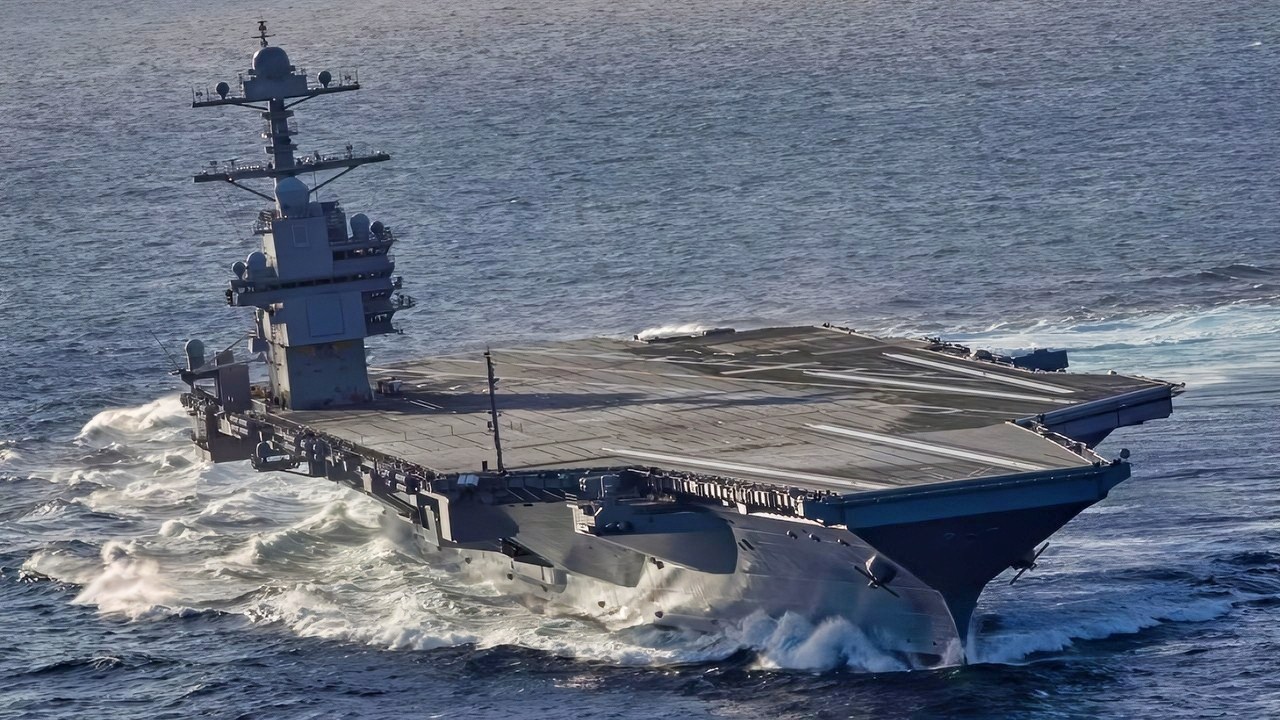
USS Gerald R. Ford Aircraft Carrier. Image Credit: Creative Commons.
What Happens Now?
The New York Times critics of U.S. military strategy in the Indo-Pacific are not as forward-looking as I am.
They offer few solutions to the Taiwan question and American military strategy in general. These critics do not believe the United States has a chance in a near-peer fight against global powers like China.
However, the aircraft carrier is not obsolete by any means, and the Americans are not giving up on the 11-carrier requirements for a future Navy that must be ready for all comers.
The Ford-class of carriers that cost so much are worth the investment.
They can respond and help Taiwan against China. The flat-tops can block the Strait of Malacca to starve China should an attack on Taiwan commence.
The Navy knows it has sailors who are combat-experienced and trained better than PLAN personnel. The Americans are prepared for a Chinese attack on Taiwan. It will just require advanced preparation to block the Strait of Malacca to show China that the Americans are not going to back down.
The Ford-class is an essential tool for this eventuality. The New York Times editors are correct to be concerned about the expense of the Ford-class and the danger of modern warfare in the Indo-Pacific. But now is not the time to panic.
The U.S. Navy is as strong as ever, and if Taiwan hangs in the balance, there are still means to discourage the Chinese from going to war against Taipei.
About the Author: Brent M. Eastwood
Author of now over 3,000 articles on defense issues, Brent M. Eastwood, PhD is the author of Don’t Turn Your Back On the World: a Conservative Foreign Policy and Humans, Machines, and Data: Future Trends in Warfare plus two other books. Brent was the founder and CEO of a tech firm that predicted world events using artificial intelligence. He served as a legislative fellow for US Senator Tim Scott and advised the senator on defense and foreign policy issues. He has taught at American University, George Washington University, and George Mason University. Brent is a former US Army Infantry officer. He can be followed on X @BMEastwood.