


Article Summary – In the interwar years, the U.S. Navy tried a radical idea: turn giant rigid airships into “flying aircraft carriers.”
-USS Akron and USS Macon carried Curtiss F9C Sparrowhawk biplanes on a retractable trapeze, using them for scouting and potential attacks far out at sea.

USS Intrepid Essex-Class Aircraft Carrier. Image Credit: National Security Journal.
-The helium-filled giants had long range and onboard hangars, but they were hard to handle, vulnerable to bad weather, and huge targets for enemy aircraft.
-A series of accidents, culminating in Akron’s deadly 1933 crash off New Jersey, doomed the concept. The experiment proved visionary—but also showed why carriers would stay on the water, not in the sky.
What Was the U.S. Navy Thinking With Its Flying Aircraft Carriers?
One surprising aspect of U.S. Navy aviation was its use of “flying aircraft carriers.” You read that right.
It was the age of zeppelins and airships around 100 years ago, and the Naval brass had a brainstorm.
Why not fly airplanes out of a blimp that was already high in the air?
Aircraft could be deployed quickly in reconnaissance and attack modes to collect enemy ship and troop locations or serve as forward observers for Naval gunfire.
The Navy actually had two airships capable of deploying airplanes.
These were the Akron-class blimps. The first and only flying aircraft carriers were put in service.
But the pair of airships met an untimely end due to two accidents that brought the concept to an end.
What Were These Ships?
The USS Akron and USS Macon were “rigid airships.” Building began in 1929. With a three-keel design, the Akron-class dirigibles had better design and framework than the first German zeppelins. Each American rigid airship had eight 560-horsepower Maybach VL-2 engines.
These were located inside the airship for easier maintenance and reduced drag. The propellers remained outside the blimps and could be folded down for takeoff and landing.

(Oct. 17, 2017) The aircraft carrier USS Nimitz (CVN 68) transits the Arabian Gulf, Oct 17, 2017. Nimitz is deployed in the U.S. 5th Fleet area of operations in support of Operation Inherent Resolve. While in this region, the ship and strike group are conducting maritime security operations to reassure allies and partners, preserve freedom of navigation, and maintain the free flow of commerce. (U.S. Navy photo by Mass Communication Specialist Seaman David Claypool/Released)
These little Biplanes Served an Important Purpose
The concept was primarily for reconnaissance and spying.
These airships were also configured to carry aircraft such as the F9C-2 Curtiss Sparrowhawk mini-biplane. The aircraft could be launched and recovered from the gargantuan airship.
Only eight of the small aircraft were made to be carried by the Navy’s helium-filled dirigibles. The Navy envisioned the 20-foot-long Sparrowhawks attacking the enemy with their .30-caliber machine guns.
The airships were 785 feet long. The range was a significant advantage. The Akron and Macon could fly a surprising 7,000 miles—this enabled coverage of large parts of the ocean at 79 miles per hour.
How Did This Concept Work?
There was a crew of 60, so enough to service five airplanes. The zeppelins had a hangar on board. This was 75 feet long and 60 feet wide.
The airplanes were deployed from a contraption resembling a trapeze that descended from the airship through a T-shaped gateway.
Then the aircraft would launch, and after finishing the mission, the trapeze would grab the airplane.
It took a daring pilot to maneuver the Sparrowhawk into recovery mode with the skyhook.
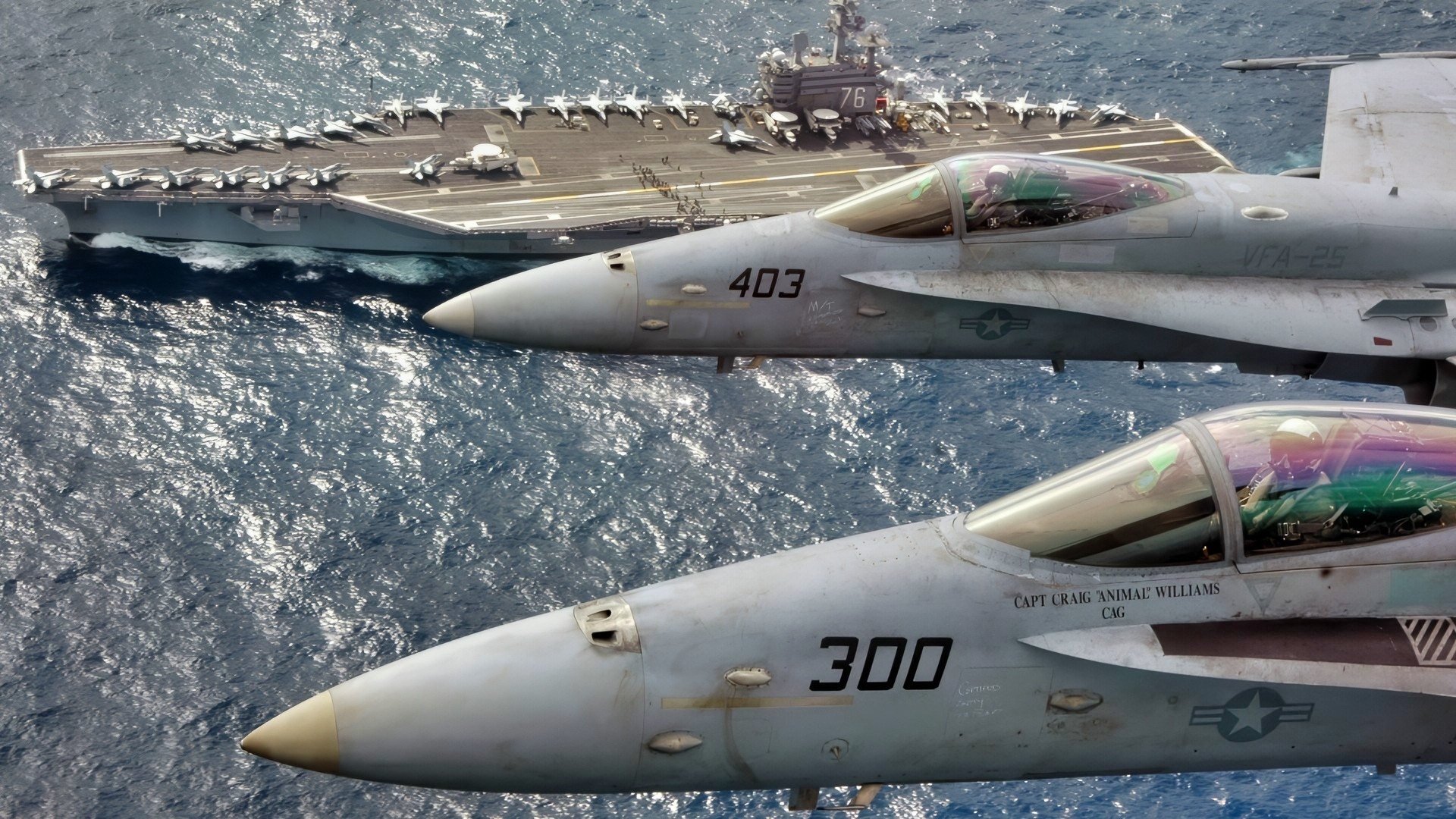
At sea (Mar. 1, 2007) – Capt. Craig “Animal” Williams (front) in a F/A 18C Hornet (front) and Capt. Richard “Rhett” Butler (back) in an F/A 18C Hornet look up for a photo as they fly over USS Ronald Reagan (CVN 76). Capt. Williams, a 22-year Naval Aviator who graduated from the United States Naval Academy, was relieved as Commander, Carrier Air Wing Fourteen (CVW-14) by 21-year Naval Aviator, Capt. Butler, a graduate of the University of Kentucky during an aerial change of command ceremony. The Ronald Reagan Carrier Strike Group is currently underway in the Pacific Ocean on a surge deployment in support of U.S. military operations in the Western Pacific. Official U.S. Navy photo by Lt. Cmdr. Tam Pham
(RELEASED)
The National Air and Space museum described the difficulty. “The pilot skillfully guided the overhead hook on the airplane to the horizontal bar of the extended recovery trapeze. Once the fighter had hooked on, its engine was stopped, and the trapeze was raised into the open belly of the dirigible, and the airplane was stored in special racks.”
The Sparrowhawks were meant to locate a large group of surface ships.
The dirigibles had to remain behind the range of enemy airplanes because they were an easy target to shoot down, although the airships had several anti-aircraft machine guns.
The Airships Were Hard to Fly
New doctrine, tactics, and procedures had to be designed for this new idea.
The zeppelin was a sitting duck if attacked.
Moreover, the flight was tricky.
The engines created ample exhaust.
So, water had to be recovered to “compensate for the weight of fuel burned during flight, to avoid the need to valve helium to maintain aerostatic equilibrium as fuel was burned,” according to Airships.net.
The crew had to work busily in short bursts of careful, dedicated activity.
The Akron had bad luck early on. A group of prominent people, including famous Congressmen, was waiting to board a demonstration flight in 1932.
The airship escaped from its moorings, and the lower fin crashed into the ground.
To make matters worse, after a cross-country flight, the Akron took off unexpectedly when three crewmen were trying to fasten it on land. The men were lifted quickly into the ai,r and two fell to their deaths.
This accident was shown repeatedly to moviegoers in a newsreel that made the Navy look bad.
But the Akron did have successful flights to Panama and Cuba. Its final mission in 1933 was sad, though.
A storm off the coast of New Jersey sent the airborne Akron to different altitudes without warning. The airship’s back end hit the water and got trapped while the entire zeppelin collapsed in the ocean.
Nearly everyone on board died.
Let’s Keep It on the Surface of the Sea
The Akron and Macon seemed like an excellent idea at the time, although the Navy soon realized the airships had to remain in the rear and depend on their reconnaissance airplanes to watch over the sea. It would be a fat target for enemy warplanes when flying ahead of a column of ground-launched airplanes. Collecting intelligence from the sky and guarding the coastline was going to be valuable, though.
The Akron-class dirigibles were inherently high-risk despite the new technology used during their production. The wreckage of the Akron still sits on the bottom of the sea near Atlantic City, New Jersey.
Despite the project’s unfortunate outcome, give some credit to the Navy for taking on original risks with a concept that may have been successful were it not for the accidents. The flying aircraft carrier was ahead of its time, but it ensured that aircraft carriers would remain floating vessels rather than flying airships.
About the Author: Brent M. Eastwood
Author of now over 3,000 articles on defense issues, Brent M. Eastwood, PhD is the author of Don’t Turn Your Back On the World: a Conservative Foreign Policy and Humans, Machines, and Data: Future Trends in Warfare plus two other books. Brent was the founder and CEO of a tech firm that predicted world events using artificial intelligence. He served as a legislative fellow for US Senator Tim Scott and advised the senator on defense and foreign policy issues. He has taught at American University, George Washington University, and George Mason University. Brent is a former US Army Infantry officer. He can be followed on X @BMEastwood.




Ari Saarinen
December 1, 2025 at 7:36 pm
Calling them “blimps” revealed the author’s complete lack of knowledge and understanding of turn concept of lighter-than-air operations. Not worth the read …