


Key Points and Summary – For decades, American supercarriers like the Nimitz- and Ford-class have been the Navy’s ultimate symbols of power projection.
-But expert Christian D. Orr argues their future is under real strain.

PACIFIC OCEAN (Jan. 18, 2017) The Nimitz-class aircraft carrier USS Carl Vinson (CVN 70) transits the Pacific Ocean. Carl Vinson is on a scheduled western Pacific deployment with the Carl Vinson Carrier Strike Group as part of the U.S. Pacific Fleet-led initiative to extend the command and control functions of the U.S. 3rd Fleet in the Indo-Asia-Pacific region. (U.S. Navy photo by Mass Communication Specialist 2nd Class Nathan K. Serpico/Released)
-Eye-watering construction and maintenance costs, lengthy refueling overhauls, limited shipyard capacity, and supply-chain woes keep many carriers pier-side.
-Meanwhile, anti-ship missiles from states and proxies—from China to the Houthis—raise questions about survivability, especially inside contested zones.
-Foreign carrier fiascos like Russia’s Admiral Kuznetsov and India’s Vikramaditya underline how complex and fragile these ships can be.
-Yet, given geography and slow submarine production, Orr concludes the U.S. still has no real alternative to carriers—for now.
Is the Age of the Aircraft Carrier Really Over?
Ever since they replaced battleships for the status of “capital ships” during World War II, aircraft carriers (AKA “flattops“) have remained the ultimate power projectors in the arsenal of the United States Navy. This is especially true of the venerable and time-honored Nimitz-class supercarriers (CVNs) and their anointed successors, the Gerald R. Ford-class CVNs. The Nimitz- and Ford-class warships alike are marvels to behold in terms of sheer size and technological capabilities.
The double-downsides to carriers are: (1) exorbitant expense, both from the price of building new carriers and well as never-ending, constant maintenance needs for the existing ships, the latter of which all too often relegates to mere “hangar queen” or “dock dweller” status; and (2) vulnerability to ship-killing missiles, making them potential “floating coffins.” All of which begs the question: Is the Age of the Aircraft Carrier over?
The Case Against Carriers Part 1: Expense and Maintenance Nightmares
There are multiple reasons for these particular nightmares:
-USN logisticians apply a “rule of thirds” to their flattops’ work schedule, i.e., at any given time, one-third of carriers are deployed, one-third are preparing for deployment, and one-third undergo maintenance. With 11 carriers in the fleet, this means that only three to four are typically out to sea.
-The ROCH rigamarole. That particular acronym stands for Refueling Complex Overhaul. It’s a complex procedure that CVNs are required to undergo every 25 years, and it entails cutting a massive hole into the hull and replacing everything from catapult systems to water purifiers.
A prime example of the frustratingly slow RCOH process is the USS Harry S. Truman (CVN-75). Back on February 12, 2025, she collided with the Panamanian-flagged bulk carrier M/V Besiktas-M whilst transiting near Port Said, Egypt.
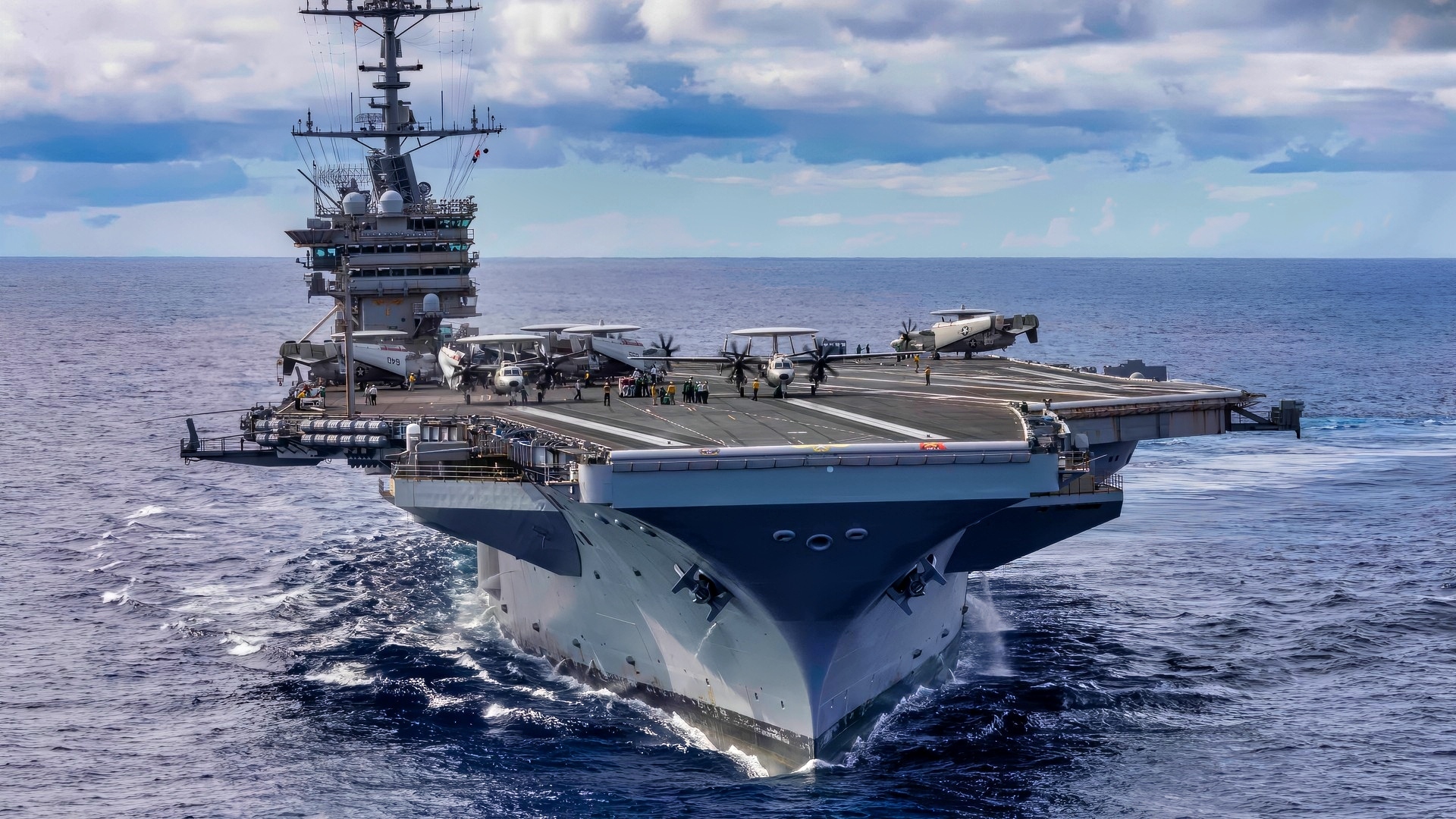
250923-N-FY193-1405 ATLANTIC OCEAN (Sept. 23, 2025) The Nimitz-class aircraft carrier USS Harry S. Truman (CVN 75) conducts carrier qualifications in the Atlantic Ocean. Truman is currently underway carrying out routine operations that support the Navy’s commitment to readiness, innovation, and future fleet lethality. (U.S. Navy photo by Mass Communication Specialist 2nd Class Mike Shen)
Fast-forward eight months, and “HST” was finally scheduled for the completion of her repair work as part & parcel of her RCOH procedure at the Newport News Shipbuilding docks.
The process is expected in the next 11 months. In addition, the Truman’s sister ship USS George Washington (CVN-73), which was out of action for a whopping 2,100 days whilst awaiting ROCH!
-America has a measly four national shipyards capable of carrying out carrier repairs (a sobering reflection on just how much U.S. shipbuilding capability has declined in the post-Cold War era). Many experienced workers have retired, and new hires lack hands-on expertise.
The opprobrious COVID-19 lockdowns disrupted production and maintenance further, creating multi-year delays that continue to adversely impact readiness throughout the fleet adversely.
The Case Against Carriers Part 1A: Foreign Flattop Failures
It should be noted that it’s not just American aircraft carriers that are being plagued by maintenance issues.
Russia’s lone remaining flattop, the Admiral Kuznetsov, has been out of action for so long that it’s been practically a running joke (or perhaps more accurately, a floating, non-sailing joke), thanks to the following follies and foibles:
-Reliance upon a noxious, tarry, ultra-thick black substance called Mazut as its power source.
-A sunken dry dock in 2018.
-An onboard fire in 2019 that cost 300-350 million rubles ($3.6 million–4.3 million USD) in damages.
Not to be outdone, back in 2004, India purchased the carrier Admiral Gorshkov from Russia, renamed her the INS Vikramaditya, and made the recommissioned flattop the Indian Navy’s flagship. And alas, the Indian Navy hasn’t had much better luck:

Admiral Kuznetsov Aircraft Carrier Russia. Image Credit: Creative Commons.
-In 2016, a toxic gas leak during maintenance work in the vessel’s sewage treatment plant compartment resulted in two deaths.
-In April 2019, Indian Navy officer Lt. Cdr. DS Chauhan died of smoke inhalation from a boiler room fire
-In May 2021, a second fire occurred while the ship was undergoing a refit. Thankfully, no casualties resulted this time.
–Yet another fire occurred in July 2022, this time while the Vikramaditya was operating off the Karnataka coast. Again, thankfully, no casualties resulted, but a disturbing pattern had fully emerged by now.
The Case Against Carriers Part Deux: Vulnerability to Ship-Killing Missiles
Luckily, none of the USN’s carriers have been hit by any of these missiles yet. But that’s not to say there haven’t been close calls. On or about April 28, 2025, the aforementioned USS Harry S. Truman had to turn sharply while taking evasive action against a missile fired by Yemen’s Houthi terrorists, in the process losing one of her precious F/A-18 Super Hornets when the warbird fell overboard.
The Case for Keeping the Carriers
However, this doesn’t necessarily mean that carriers are (metaphorically) dead in the water just yet.

151111-N-KM939-021 PACIFIC OCEAN (Nov. 11, 2015) – USS John C. Stennis (CVN 74) travels behind the guided-missile destroyer USS Stockdale (DDG 106) during a Missile Exercise (MSLEX). Sailors from the John C. Stennis Strike Group are participating in a sustainment training exercise (SUSTEX) to prepare for future deployments. (U.S. Navy photo by Mass Communication Specialist 3rd Class David A. Cox/Released)
Dr. James Jay Carfano, a retired U.S. Army lieutenant colonel and one of the nation’s leading experts in national security and foreign policy challenges, sums it up thusly: “The ‘tyranny of distance’ in the Indo-Pacific and the need to maintain sea control in contested areas like the first and second island chains make mobile airpower essential…While the U.S. rightly prioritizes its submarine programs, the slow production rate of new boats means there is no near-term alternative to the carrier for maritime dominance.”
Indeed, USS Gerald R. Ford (CVN-78) is currently proving her worth, as she’s been tasked with helping to kill the drug-smuggling boats (“taking out a pesky fly with a shotgun blast,” as Guy D. McCardle of SOFPREP puts it) of Venezuela’s socialist dictator, Nicolas Maduro.
About the Author: Christian D. Orr, Defense Expert
Christian D. Orr is a Senior Defense Editor. He is a former Air Force Security Forces officer, Federal law enforcement officer, and private military contractor (with assignments worked in Iraq, the United Arab Emirates, Kosovo, Japan, Germany, and the Pentagon). Chris holds a B.A. in International Relations from the University of Southern California (USC) and an M.A. in Intelligence Studies (concentration in Terrorism Studies) from American Military University (AMU). He is also the author of the newly published book “Five Decades of a Fabulous Firearm: Celebrating the 50th Anniversary of the Beretta 92 Pistol Series.”