


Key Points and Summary – A stark analysis argues that the U.S. Navy’s 11 aircraft carriers are no longer sufficient to meet global threats.
-At any given time, only 3-4 carriers are deployed, stretching the force dangerously thin.

(Aug. 1, 2016) – The Nimitz-class aircraft carrier USS John C. Stennis (CVN 74) receives stores while conducting a vertical replenishment at sea, during Rim of the Pacific 2016. Twenty-six nations, more than 40 ships and submarines, more than 200 aircraft and 25,000 personnel are participating in RIMPAC from June 30 to Aug. 4, in and around the Hawaiian Islands and Southern California. The world’s largest international maritime exercise, RIMPAC provides a unique training opportunity that helps participants foster and sustain the cooperative relationships that are critical to ensuring the safety of sea lanes and security on the world’s oceans. RIMPAC 2016 is the 25th exercise in the series that began in 1971. (U.S. Navy photo by Mass Communication Specialist 2nd Class Ryan J. Batchelder)
-This “readiness strain” is compounded by the threat of Chinese “carrier-killer” missiles (DF-21D, DF-26) and wargames suggesting the U.S. could lose 2-4 carriers in a Taiwan conflict.
-While a 15-carrier fleet is considered ideal for a two-front war, the U.S. shipbuilding industry is “struggling” and cannot meet demand, forcing the Navy to rely on alternative, more distributed strategies.
The U.S. Navy’s Grim Aircraft Carrier Challenge
Two decades ago, the U.S. Navy was unquestionably the dominant force on the planet. Its strength surpassed that of every other competitor by orders of magnitude.
Today, the U.S. still maintains the best navy on the planet, but the gap is closing faster than many people realize. China has surpassed the U.S. in raw materials and is becoming more sophisticated.
Meanwhile, the Russian Navy, though it struggles with shipbuilding, still maintains a deadly fleet of nuclear submarines that poses a significant threat to the Navy. At the core of U.S. naval doctrine is the carrier strike group.
The Navy currently operates 11 carriers, but with threats emerging across the globe, the question is whether it has enough carriers to keep up with the rapidly changing geopolitical landscape.
How Many Carriers Does the U.S. Currently Have?
As of 2025, the U.S. Navy operates eleven nuclear-powered aircraft carriers, divided between the older Nimitz-class and the newer Gerald R. Ford-class supercarriers.
These vessels are the largest and most capable in the world, displacing around 100,000 tons and carrying an air wing of roughly 65 to 70 aircraft.
Each carrier typically deploys as part of a Carrier Strike Group, which includes cruisers, destroyers, submarines, and logistical support ships.
This configuration allows the United States to project power globally without relying on foreign bases, a capability unmatched by any other nation.
However, the number of carriers does not tell the whole story. The Navy maintains a forward presence in critical regions through rotational deployments.
Still, at any given time, only three to four carriers are deployed or on station in areas such as the Indo-Pacific, the Mediterranean, or the Middle East. The rest are in maintenance or training cycles, which can last months or even years due to nuclear refueling and complex overhauls.

The aircraft carrier USS Gerald R. Ford (CVN 78) successfully completes the third and final scheduled explosive event of Full Ship Shock Trials while underway in the Atlantic Ocean, Aug. 8, 2021. The U.S. Navy conducts shock trials of new ship designs using live explosives to confirm that our warships can continue to meet demanding mission requirements under harsh conditions they might encounter in battle. (U.S. Navy photo by Mass Communication Specialist 3rd Class Novalee Manzella)

The aircraft carrier USS Gerald R. Ford (CVN 78) completes the first scheduled explosive event of Full Ship Shock Trials while underway in the Atlantic Ocean, June 18, 2021. The U.S. Navy conducts shock trials of new ship designs using live explosives to confirm that our warships can continue to meet demanding mission requirements under harsh conditions they might encounter in battle. (U.S. Navy photo by Mass Communication Specialist 3rd Class Riley B. McDowell)
This high operational tempo strains readiness and personnel, leading to more extended deployments and shorter maintenance windows, which, in turn, affect the ability to surge forces in a crisis.
Today’s Threats
Currently, the United States still enjoys a significant numerical and qualitative advantage. China currently operates two carriers, Liaoning and Shandong, and is testing a third, the Type 003 Fujian, which features electromagnetic catapults similar to those on U.S. Ford-class carriers. Beijing’s long-term plans suggest a fleet of five to six carriers by the 2030s, signaling ambitions for global reach.
Russia, by contrast, maintains only one aging carrier, Admiral Kuznetsov, which has been in overhaul for years and may never return to full operational status. Future Russian carrier projects remain conceptual and face severe financial and industrial constraints.
To make up for this gap, Russia has been expanding its fleet of smaller cruisers armed with hypersonic anti-ship missiles. Russia has also been expanding its fleet of nuclear submarines, which pose the most significant threat to America’s Carriers.
China’s DF-21D and DF-26 “carrier-killer” missiles, along with Russia’s hypersonic weapons, force U.S. carriers to operate farther from hostile shores, reducing sortie rates and response times.
War games simulating a Taiwan conflict suggest the United States could lose two to four carriers early in a fight, even if it ultimately prevails. Geography compounds the problem.
Responding to simultaneous crises, such as a Chinese invasion of Taiwan and a Russian move against NATO, would require carriers in the Western Pacific, the North Atlantic, and possibly the Middle East to maintain ongoing commitments.
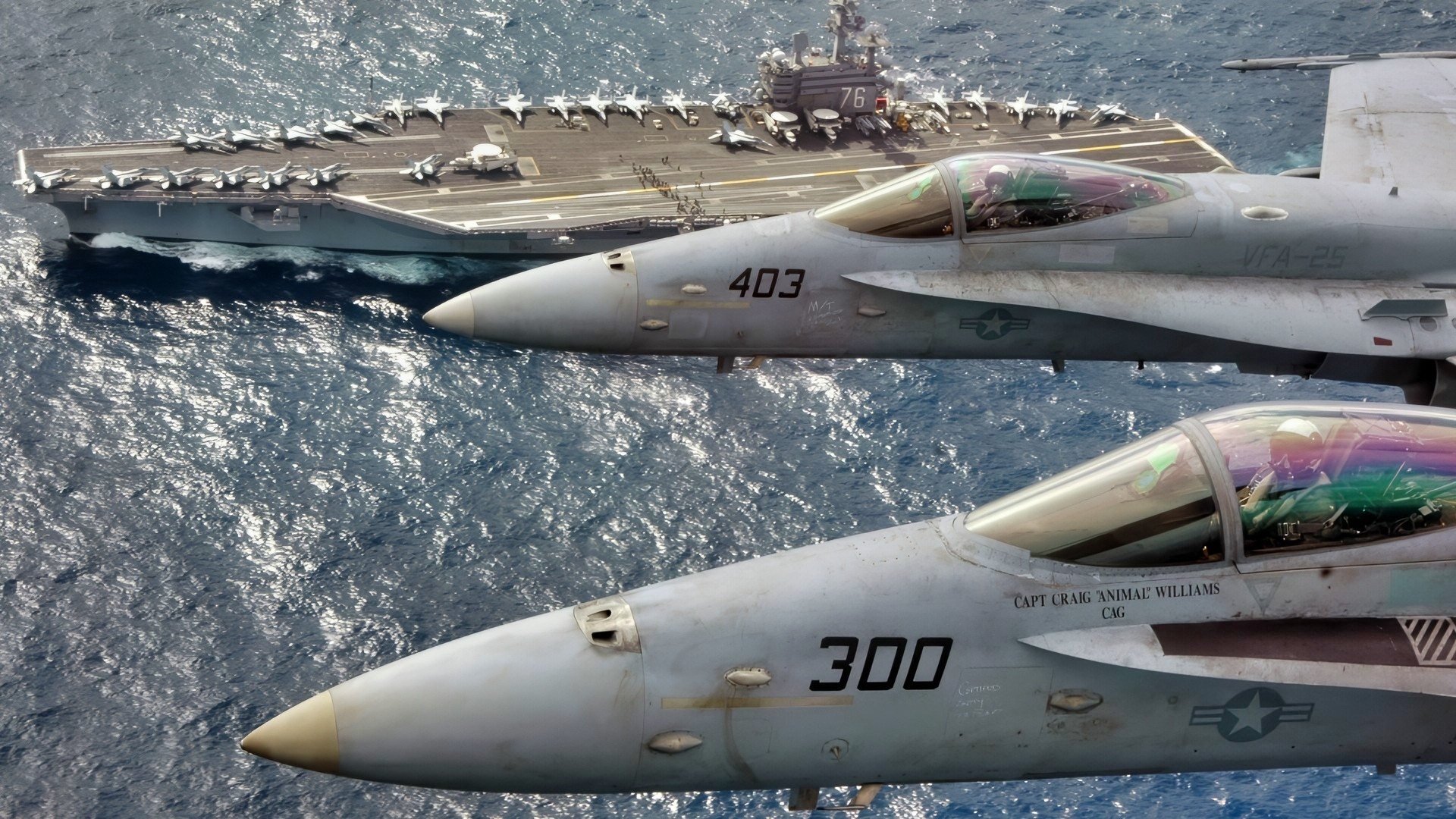
At sea (Mar. 1, 2007) – Capt. Craig “Animal” Williams (front) in a F/A 18C Hornet (front) and Capt. Richard “Rhett” Butler (back) in an F/A 18C Hornet look up for a photo as they fly over USS Ronald Reagan (CVN 76). Capt. Williams, a 22-year Naval Aviator who graduated from the United States Naval Academy, was relieved as Commander, Carrier Air Wing Fourteen (CVW-14) by 21-year Naval Aviator, Capt. Butler, a graduate of the University of Kentucky during an aerial change of command ceremony. The Ronald Reagan Carrier Strike Group is currently underway in the Pacific Ocean on a surge deployment in support of U.S. military operations in the Western Pacific. Official U.S. Navy photo by Lt. Cmdr. Tam Pham
(RELEASED)
Historical analysis indicates that fifteen carriers would be needed for a persistent presence in three theaters. The United States has eleven, meaning any two-front war would stretch resources thin.
Can the U.S. Expand its Fleet?
Expanding the fleet is much easier said than done, unfortunately. Each Ford-class carrier costs more than $13 billion, and shipbuilding plans project a fleet of roughly 390 ships by 2054, but carriers will remain capped near current levels due to cost and industrial constraints.
Maintenance cycles and nuclear refueling further limit availability, as at least one carrier is always in overhaul. These constraints make it unlikely that the U.S. will return to the fifteen-carrier force once considered ideal for global dominance.
The problem is further compounded by the poor state of the U.S. shipbuilding industry, which has struggled with budget cuts, labor shortages, and other economic factors.
Various projects, including some Ford-class carriers, have been delayed multiple times due to manufacturing issues.
Even if the U.S. were to order more carriers, the reality is that America’s industrial base as it is now would not be able to handle such a surge, and it would be many decades until the Navy sees the results it needs.
Given these realities, analysts argue for alternative strategies. Distributed Maritime Operations, which rely on smaller, cheaper platforms such as destroyers, frigates, and unmanned systems, could complement carriers and reduce vulnerability.
A submarine-centric approach, emphasizing attack submarines armed with cruise missiles, offers survivability in contested zones. Enhancing missile defense and electronic warfare capabilities is also critical to countering A2/AD threats from China and Russia. These adaptations would allow the U.S. to maintain deterrence and combat effectiveness without relying solely on carriers.
The problem with this strategy is that naval aviation is invaluable. Other analysts argue that maintaining a larger carrier fleet is not only necessary but also vital to America’s national security.
While it may not be feasible to return to the days of 27 carriers, maintaining a fleet of around 15 aircraft carriers is the most logical solution given today’s threats and the economic realities in the U.S.
About the Author: Isaac Seitz
Isaac Seitz, a Defense Columnist, graduated from Patrick Henry College’s Strategic Intelligence and National Security program. He has also studied Russian at Middlebury Language Schools and has worked as an intelligence Analyst in the private sector.
More Military
The Mach 3 SR-71 Blackbird Spy Plane ‘Broke All the Rules’ Thanks to Titanium
SR-72: The Air Force’s New Hypersonic Bomber?
Russia’s Admiral Kuznetsov Aircraft Carrier Is Now ‘Non-Operational’
New Army M1E3 Tank vs. Russia’s T-14 Armata: Who Wins Summed Up in 2 Words




Patrick Galliher
November 4, 2025 at 8:15 pm
The US needs to take a serious look at building smaller conventional carriers. In addition to the cost saving to build, they are significantly cheaper to maintain and operate. You can build four conventional carriers for less cost as a Ford class, the Queen Elizabeth class cost $3 billion to build, versus $13 billion for the Ford. It carries 60 aircraft versus 75 for the Ford. Crew size is less than 1000 versus 4500. The US could field 40 conventional carriers for less cost than the 11 nuclear we have now.