


Key Points and Summary – The United States has massed a powerful naval force in the Caribbean as part of Southern Command’s pressure campaign on Nicolás Maduro’s regime.
-Centered on the USS Gerald R. Ford carrier strike group, the deployment includes destroyers, at least one nuclear-powered attack submarine, and EA-18G Growler electronic-warfare jets—assets suited for both drug interdiction and a potential air campaign.
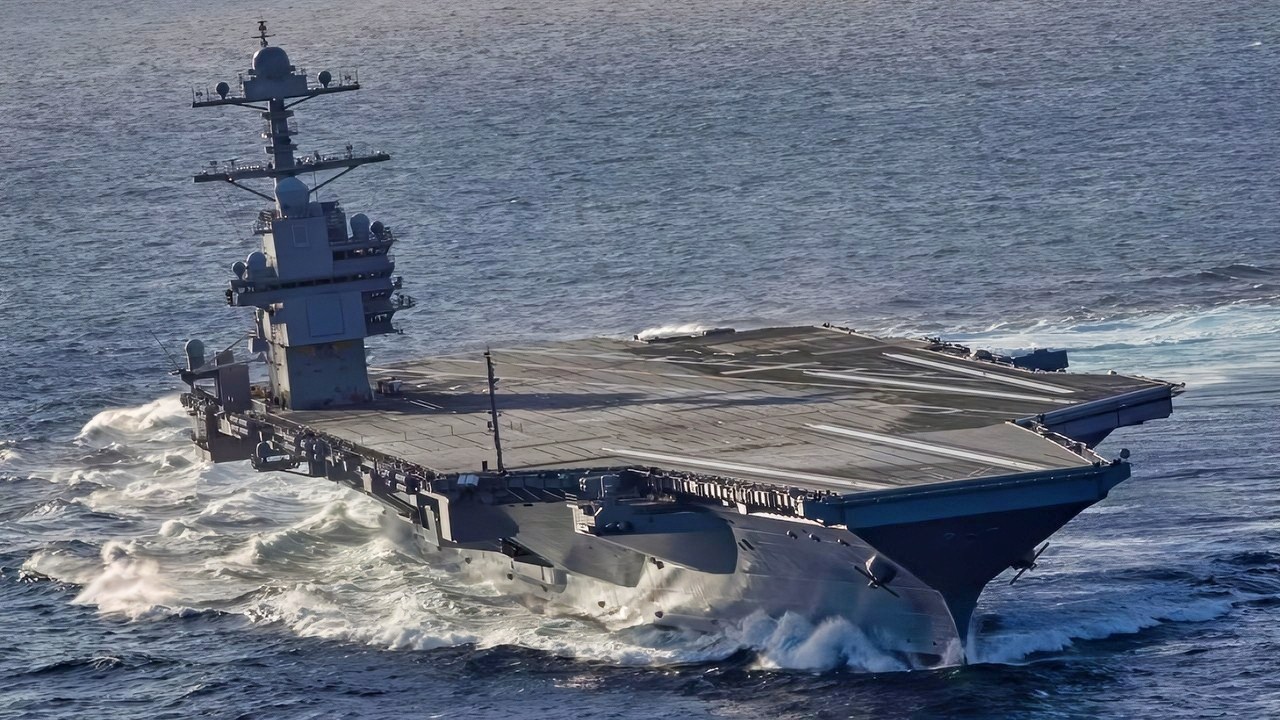
USS Gerald R. Ford Aircraft Carrier. Image Credit: Creative Commons.
-Washington frames the buildup as targeting Venezuela-linked narco-traffickers, now designated a Foreign Terrorist Organization, but disputed strikes on suspected smuggling boats and the weakness of Venezuela’s aging F-16 and Su-30 fleet underscore a sharper message: the U.S. is prepared to apply overwhelming force.
Gerald R. Ford Supercarrier Parks on Venezuela’s Doorstep
The U.S. Navy has assembled a sizable force in the Caribbean as part of U.S. Southern Command’s pressure campaign against strongman Nicolás Maduro in Venezuela.
The American forces streaming into the region include the world’s largest warship, as well as several destroyers, at least one nuclear-powered attack submarine, advanced electronic warfare platforms, and thousands of airmen, Marines, and sailors.
USNI News’ Fleet Tracker shows the approximate location of U.S. Navy Carrier Strike Groups (CSGs), Amphibious Ready Groups (ARGs), amphibious assault ships, destroyers, and other U.S. warships around the globe. Their latest update, from December 8, shows the wide array of warships assembled in the Caribbean. However, USNI News adds that “in addition to these major formations, not shown are others serving in submarines, individual surface ships, aircraft squadrons, SEALs, Special Purpose Marine Air-Ground Task Forces, Seabees, EOD Mobile Units and more throughout the globe.”
A recently published selection of photos by Reuters shows Marines and Navy personnel disembarking from landing craft on Puerto Rico.
While open-source tracking websites such as MarineTraffic can show close to real-time vessel positions, warships are not always viewable—they may turn off their Automatic Identification System transponders for security reasons.
However, some of the U.S. Navy warships deployed to the Caribbean are known.
The largest of these is the USS Gerald R. Ford (CVN-78), the lead ship of the Navy’s Ford-class supercarriers. These enormous nuclear-powered ships are slated to replace Nimitz-class aircraft carriers on a one-to-one basis.
That ship’s deployment to the Caribbean has been widely reported. One webcam captured images of the Ford leaving St. Thomas, one of the U.S. Virgin Islands.
“The enhanced U.S. force presence in the USSOUTHCOM AOR will bolster U.S. capacity to detect, monitor, and disrupt illicit actors and activities that compromise the safety and prosperity of the United States homeland and our security in the Western Hemisphere,” a Pentagon spokesman said as part of a statement published by U.S. Southern Command. “These forces will enhance and augment existing capabilities to disrupt narcotics trafficking and degrade and dismantle transnational criminal organizations.”

ATLANTIC OCEAN (Sept. 06, 2008) – The guided-missile destroyer USS Roosevelt (DDG 80) steams through the Atlantic Ocean. Roosevelt is deployed as part of the Iwo Jima Expeditionary Strike Group (ESG) in support of maritime security operations in the Navy’s 5th and 6th fleet areas of responsibility. The Iwo Jima ESG is made up of Roosevelt, homeported at Mayport, Fla.; the amphibious assault ship USS Iwo Jima (LHD 7); the amphibious dock landing ship USS San Antonio (LPD 17); the amphibious transport dock ship USS Carter Hall (LSD 50); the guided-missile cruiser USS Vella Gulf (CG 72); the guided-missile destroyer USS Ramage (DDG 61); all homeported at Norfolk, Va.; and the fast attack submarine USS Hartford (SSN 768), homeported at Groton, Conn. U.S. Navy photo by Mass Communication Specialist 2nd Class Jason R. Zalasky (Released)
Southern Command added that “alongside Gerald R. Ford, the Carrier strike group brings additional capable, lethal, and adaptable warfighting assets including the nine embarked squadrons of Carrier Air Wing Eight, Destroyer Squadron Two’s Arleigh Burke-class guided-missile destroyers USS Bainbridge (DDG 96) and USS Mahan (DDG 72), and the integrated air and missile defense command ship USS Winston S. Churchill (DDG 81).”
The military buildup began in September, when U.S. assets assembled near Venezuelan waters as part of a declared interdiction effort against alleged drug runners supposedly operating high-speed boats from Venezuela. The U.S. Department of State designated the Cartel de los Soles, which it says is headed by Nicolás Maduro, as a Foreign Terrorist Organization last month and has used that designation as a partial justification for airstrikes against smuggling vessels. There have been at least 22 strikes since September. While some of those vessels may have indeed ferried narcotics around the Caribbean, one investigation casts doubt on the Pentagon’s claims that these boats are associated with a Venezuelan cartel.
One of these strikes has proven extremely controversial. Though facts are still coming to light, an alleged follow-up strike may have violated the Department of Defense’s rules on the use of force. Lawmakers have repeatedly asked Defense Secretary Pete Hegseth for clarification, which has been slow to materialize.
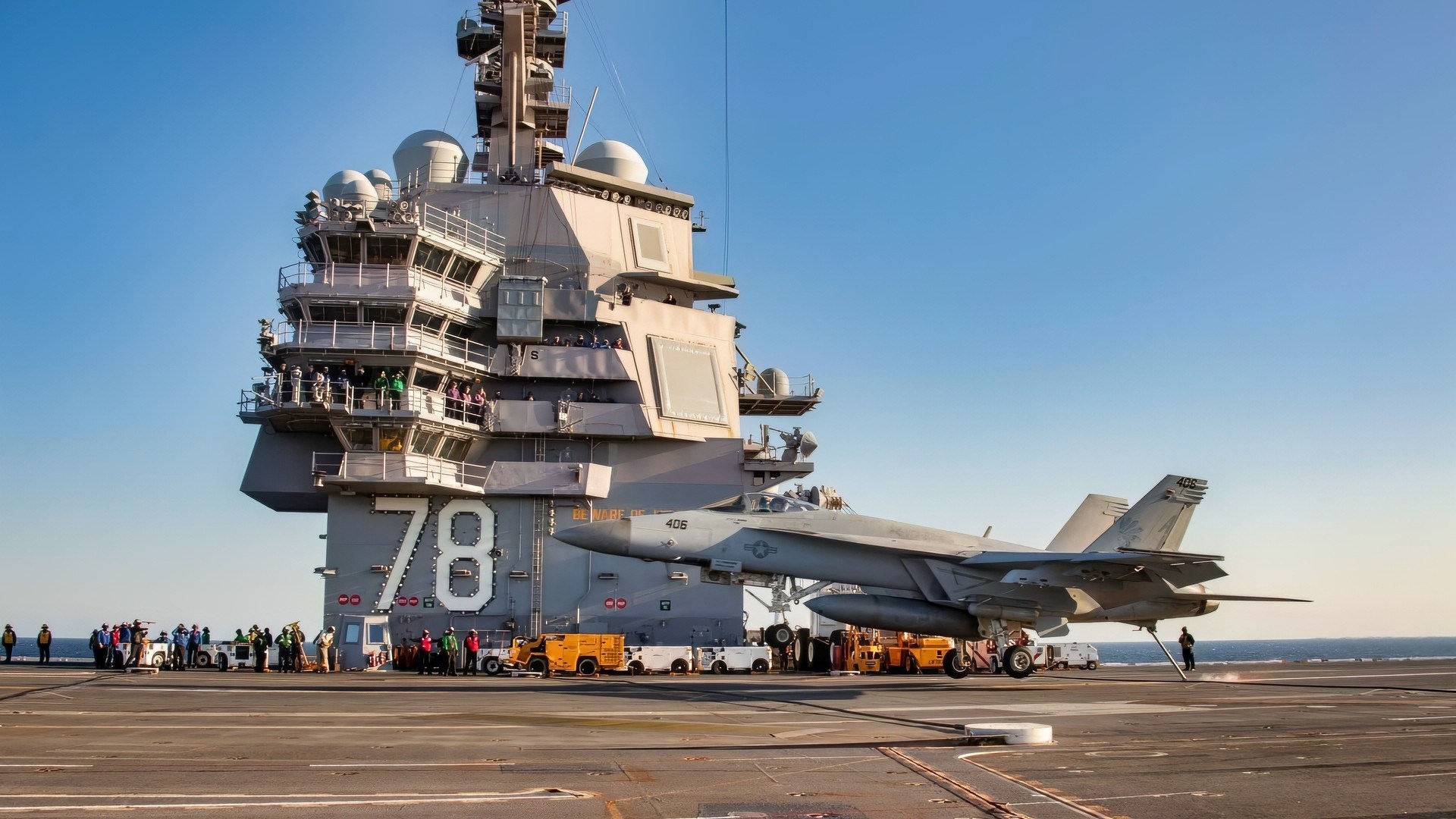
USS Gerald R. Ford Training. Image Credit: U.S. Navy.
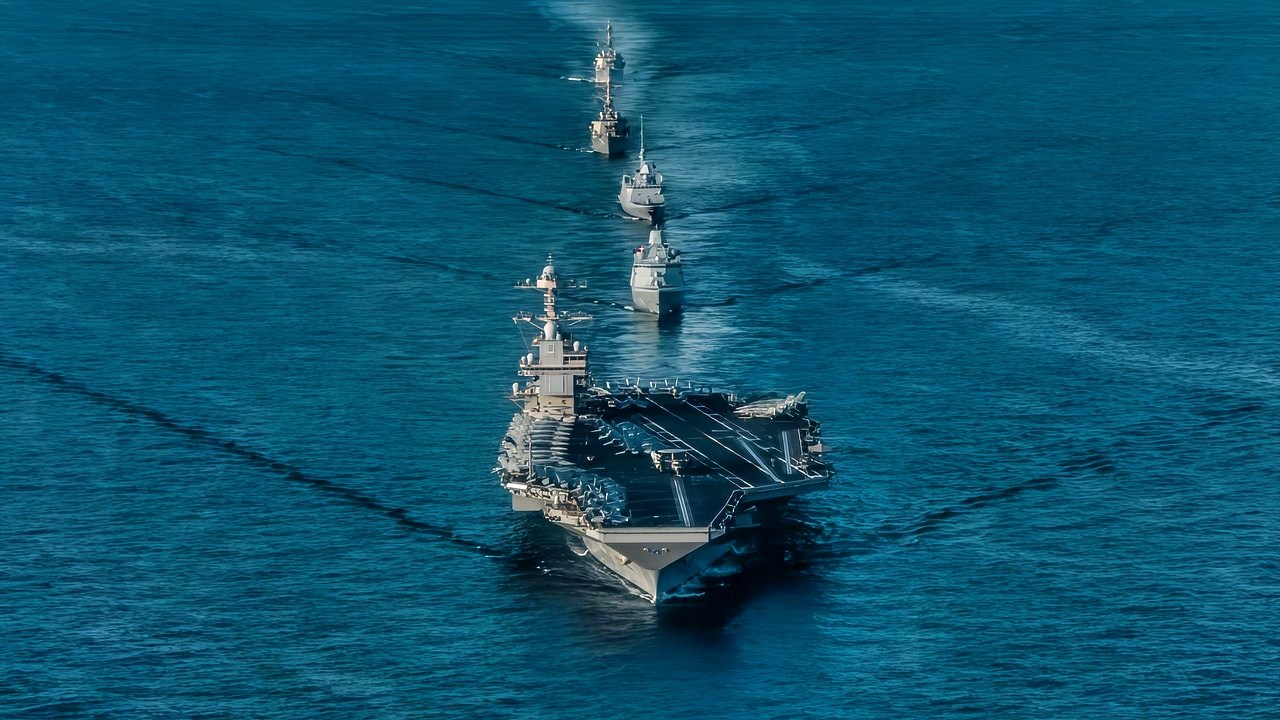
USS Gerald R. Ford Aircraft Carrier Training. Image Credit: U.S. Navy.
More and More Firepower from the U.S. Navy
Besides a multitude of warships and at least one attack submarine, significant aerial assets are also in the region, including highly specialized aircraft that would be a necessary prerequisite to a bombing campaign: EA-18G Growler electronic warfare jets.
Growlers are already embarked on the USS Gerald R. Ford, but a recent Growler deployment is presumably land-based and augments the ability of U.S. forces in the region to disable ground-based anti-aircraft assets as well as adversary jets.
Venezuela’s air force, the Bolivarian Military Aviation of Venezuela, operates primarily F-16 Fighting Falcons and Su-30MK2 jets from Russia. While Venezuela may have nearly two dozen Sukhoi jets, the country’s F-16 fleet is seemingly in dire straits. Few of the original 24 F-16s purchased from the United States in the early 1980s are operational, thanks to restrictions on spare part exports to Venezuela.

A 35th Fighter Squadron F-16 Fighting Falcon flies near the Korean peninsula during a dogfighting training scenario during exercise Ulchi Freedom Shield 25 at Kunsan Air Base, Republic of Korea, Aug. 20, 2025. UFS25 is a combined, joint, all-domain military training exercise that integrates ground, air, naval, space, cyber and information elements, enhancing readiness through realistic combat simulations. (U.S. Air Force photo by Senior Airman Landon Gunsauls)
FlightGlobal lists a paltry three F-16s in service with Venezuela, along with the aforementioned Russian-sourced Su-30 jets and six F-5A light fighter jets that were originally designed during the early years of the Cold War.
The threat of overwhelming force used against Maduro’s regime is becoming a distinct possibility.
About the Author: Caleb Larson
Caleb Larson is an American multiformat journalist based in Berlin, Germany. His work covers the intersection of conflict and society, focusing on American foreign policy and European security. He has reported from Germany, Russia, and the United States. Most recently, he covered the war in Ukraine, reporting extensively on the war’s shifting battle lines from Donbas and writing on the war’s civilian and humanitarian toll. Previously, he worked as a Defense Reporter for POLITICO Europe. You can follow his latest work on X.