

Key Points and Summary – This analysis argues that the B-21 Raider, while the most advanced bomber ever, is not a “museum piece” yet, but faces a “shockingly faster” innovation pace from China.
-While the B-21 is superior, China is rapidly iterating its own 6th-gen J-36 prototype (two different versions in less than a year) and building large stealth drones (GJ-X).

The B-21 Raider was unveiled to the public at a ceremony Dec. 2, 2022 in Palmdale, Calif. The B-21 will provide survivable, long-range, penetrating strike capabilities to deter aggression and strategic attacks against the United States, allies, and partners. (U.S. Air Force photo)
-The author warns that China’s main weakness—a lack of pilot experience—will become irrelevant in an autonomous war. The U.S. must ramp up its own production and innovation speed or risk being “leap-frogged.”
Will the B-21 Raider Quickly Become A Museum Piece?
The age of the B-21 Raider will soon be upon us.
Still, some are already speculating that America’s next-generation stealth bomber may soon be a museum piece, citing the rise of autonomous strike platforms.
But will these unmanned systems really make this much-anticipated bomber worthless in the near term, and potentially before it even reaches its full fleet scale?
The answer depends on three variables: how fast the U.S. can build a whole fleet of Raiders, how rapidly adversaries like China can field large numbers of unmanned strike aircraft, and whether autonomy can truly replicate human judgment in contested deep-strike missions.
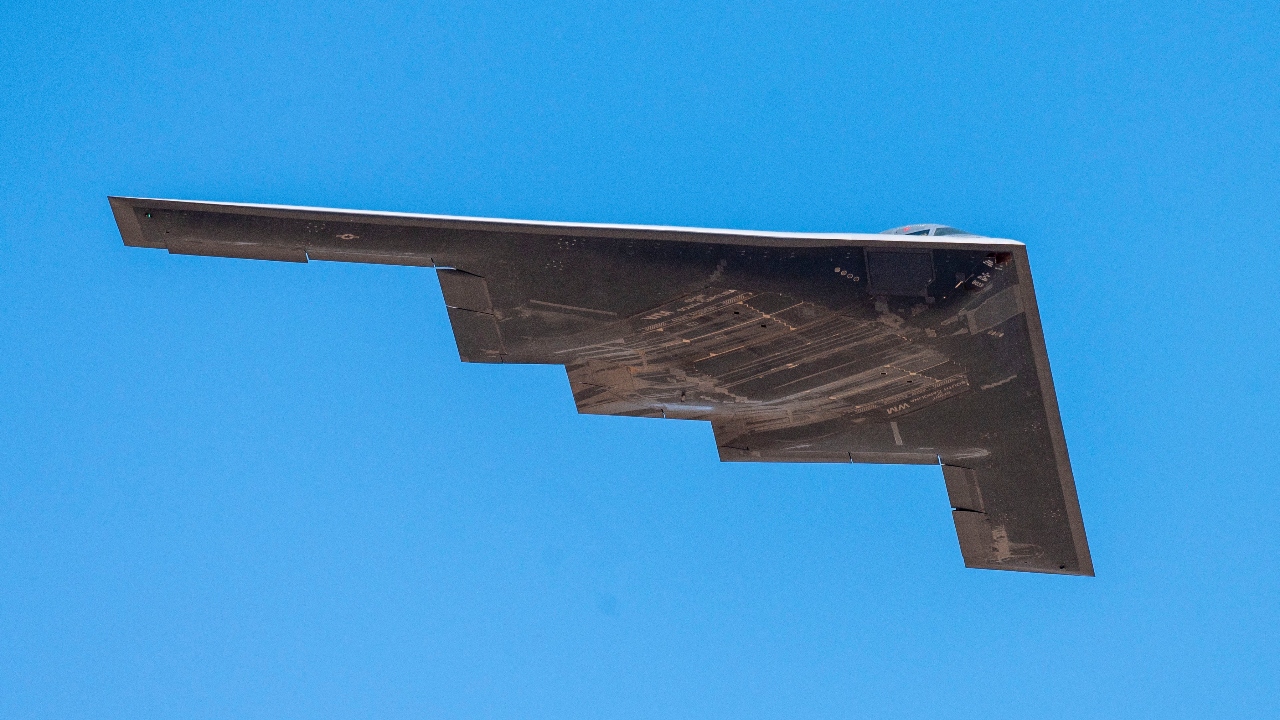
A B-2 Spirit makes a low pass flyover as part of the Warriors over the Wasatch airshow at Hill Air Force Base June 29, 2024. The 2024 Warriors over the Wasatch airshow was centered around the “Breaking Barriers Together” theme, celebrating one community. The B-2 Spirit, the predecessor to the new B-21 Raider, has been the U.S. Air Force’s premiere stealth bomber for more than 20 years. (U.S. Air Force photo by Senior Airman Jack Rodgers)
The B-21 and Its Coming Competition
The B-21 is the U.S. Air Force’s next-generation long-range stealth bomber developed by Northrop Grumman. It is designed to penetrate advanced integrated air-defense systems and deliver both conventional and nuclear payloads.
The current program of record is approximately 100 aircraft, but USAF leadership and industry analysts argue that far more are needed. Writing for this outlet, Harry Kazianis has repeatedly warned that no fewer than 200 B-21s are necessary to ensure that the Air Force is fully prepared for the next major war.
So far, the B-21 has completed its first flight campaign and has now entered low-rate initial production—but ramping up production and establishing the necessary sustainment procedures will remain a key challenge.
The B-21s are nearly here – in theory – but it’s hard to predict just how long it will take before these platforms are fully matured and ready to defend American interests.
At the same time, the U.S. is working on new technologies that lean heavily on automation. Its approach is by no means “manned bomber or nothing,” but “manned plus unmanned.”
The U.S. and its allies are fielding “loyal wingman” unmanned combat air vehicles (UCAVs) and collaborative combat aircraft (CCA) designed to fly alongside modern crewed platforms. For example, the XQ-58 Valkyrie is an attritable UCAV designed to accompany manned fighters and assume much of the risk that used to lean entirely on pilots and high-value aircraft.
These systems offer increased reach, reduced risk to human crews, and great scale potential—but at present, they only supplement rather than replace deep-penetration strike assets like the B-21. And the industrial capacity to mass-produce these systems has yet to be proven at the scale needed during wartime. With that in mind, the B-21 won’t be in a museum any time soon, but not because the technology to replace manned systems isn’t in the pipeline.
China Is Stepping Up
Meanwhile, China’s aerospace industry is demonstrating a shockingly faster iteration pace than typical Western programs.
A clear example is the Chengdu J-36, the speculative designation given to the country’s ongoing next-generation stealth fighter program.

J-36 Fighter YouTube Screenshot/Artist Rendering.

J-36 Fighter Artist Rendition from X Screenshot

J-36 Fighter. Image Credit: Screenshot from X.
The aircraft first appeared in images in December 2024, but within less than a year, by late October 2025, a second prototype emerged, showing significant design changes.
Among the changes were redesigned engine nozzles, revised intake shapes, and altered landing gear.
These are the kinds of changes that, in a typical Western program, would take years to pull off. China’s rapid iteration reflects the country’s already impressive infrastructure and manufacturing capabilities—and the J-36, a product of this rapid growth, will soon be here.
From what we know so far, it is a heavy-tailed, triple-engine stealth platform with large weapons bays and potentially the ability to assume both fighter and strike roles.
But beyond the J-36 prototype, China has also been spotted developing a large stealthy flying-wing unmanned platform.
For example, a large stealth drone dubbed the GJ-X with a roughly 42 m wingspan appeared in satellite imagers in September 2025, leading analysts to speculate about the arrival of a new unmanned Chinese bomber class.
This increasingly rapid pace of Chinese development, particularly with regard to new autonomous strike platforms, will ultimately determine whether the upcoming B-21 deserves to be labeled a museum piece already.
The reality is that, no, the Raider is by no means dead on arrival. It will, in fact, be the most advanced and stealthy bomber the world has ever seen. But China is catching up, and its main disadvantage—a lack of pilot combat experience—may not matter at all once autonomous systems have been perfected.
Between Chinese logistics, weapons integration, technological development, and the ability to iterate and develop quickly, there’s no telling how soon China and the United States will be on a level footing. And there’s also no telling how quickly China may field more autonomous systems than the United States.
Now, the U.S. must take the threat seriously and begin developing at the same scale. That means infrastructure upgrades and production increases, and it also means a rapid pivot towards fully or largely autonomous systems.
Fail to do so, and China will soon be the world’s greatest superpower in terms of military aviation – even if the B-21 is the most advanced manned bomber ever made.
About the Author:
Jack Buckby is a British author, counter-extremism researcher, and journalist based in New York. Reporting on the U.K., Europe, and the U.S., he works to analyze and understand left-wing and right-wing radicalization, and reports on Western governments’ approaches to the pressing issues of today. His books and research papers explore these themes and propose pragmatic solutions to our increasingly polarized society. His latest book is The Truth Teller: RFK Jr. and the Case for a Post-Partisan Presidency.
More Military
Northrop Grumman Is Likely Winner of F/A-XX, But Big Questions Remain
USS United States: The Aircraft Carrier Designed to Launch Bombers
The U.S. Air Force’s B-21 Raider Bomber Nightmare Has Just Begun
How Long Can a Nuclear U.S. Navy Aircraft Carrier Stay in Service?
The Air Force’s B-52 Stratofortress Bomber ‘Nightmare’ Is Real




Jimmie L Walker
November 6, 2025 at 7:50 am
That’s because we Americans think more in terms of bottom line profits while China is mass producing in record numbers and in less time
Joe
November 6, 2025 at 3:28 pm
“some are already speculating that America’s next-generation stealth bomber may soon be a museum piece, citing the rise of autonomous strike platforms”…..One major flaw in that argument. The B21 is being designed to be autonomous.
Commonsense
November 6, 2025 at 11:23 pm
So let me get this straight… We sacrifice infrastructure, health care, housing, education, etc. to have the best military on earth and we are about to be leap frogged? Pack it in then, we’re cooked.
Stephan Larose
November 8, 2025 at 9:50 pm
“to deter aggression and strategic attacks against the United States, allies, and partners.“ this is false. The US doesn’t do “deterrence.” It is an imperial hegemon. None of its military actions are defensive in nature. The US engages only in wars of aggression or proxy wars far from its shores, maintaining global hegemony by force of arms rather than moral leadership or astute trade/diplomacy. The US is the world’s foremost terrorist state, recently installing the former leader of Al Queda in Syria as president of that country. US weapons systems are intended for use in global domination and mass murder. Nothing more.
John p. Sorg
November 9, 2025 at 12:42 pm
So who has the moral high ground? Russia? China? Middle East, anyone? Russia holds the world record for people falling from windows, or being sent to the gulag. China has the uyghurs in concentration / reeducation camps. The Middle East has a civil war amongst the Shia and Sunni factions of Islam. The United States now has concentration camps all over the country and dark sight camps outside of the country. So again, who really has any moral high ground at all. Every single country has a picture of their evil selves inside their closet, really Dorian gray-esque. Huge military spending budgets, while people starve, sleep in the streets, are trafficked all over this planet, all in front of blind eyes. So again, who has the moral high ground?