


Key Points and Summary – The B-21 Raider, the Air Force’s new sixth-generation stealth bomber, represents a significant evolution over its B-2 ancestor. In fact, the only real threat or enemy this stealth bomber faces is the indecisiveness of how many will be built.
-While visually similar, its key upgrades are internal. New, more efficient engines give it greater range and a lower infrared signature.
-Crucially, its advanced composite materials and stealth skin are designed to require far less maintenance than the notoriously finicky B-2.
-Beyond its strategic bombing role, its versatility has sparked concepts for future missions, such as serving as a “flying wing arsenal plane” loaded with air-to-air missiles to support other fighters.
-BONUS: This piece is filled with images and video of a recent visit we made to a real B-2A Spirit stealth bomber at the U.S. Air Force Museum in Dayton, Ohio back in July.
B-21 Raider Capabilities: Just What Does It Bring to the Table?
The word “Raider” means different things to different people. To movie buffs, it brings to mind “Raiders of the Lost Ark,” the original 1981 film in the blockbuster Indiana Jones franchise. To fans of American football, it brings to mind a once-great NFL franchise (“Just Win, Baby”) that has fallen on hard times since its last Super Bowl appearance in the 2002 season. And to members of the U.S. Special Operations community, there’s the rough & ready Marine Raiders.

Really Up Close B-2A Spirit Bomber. Image Credit: Harry J. Kazianis/National Security Journal.
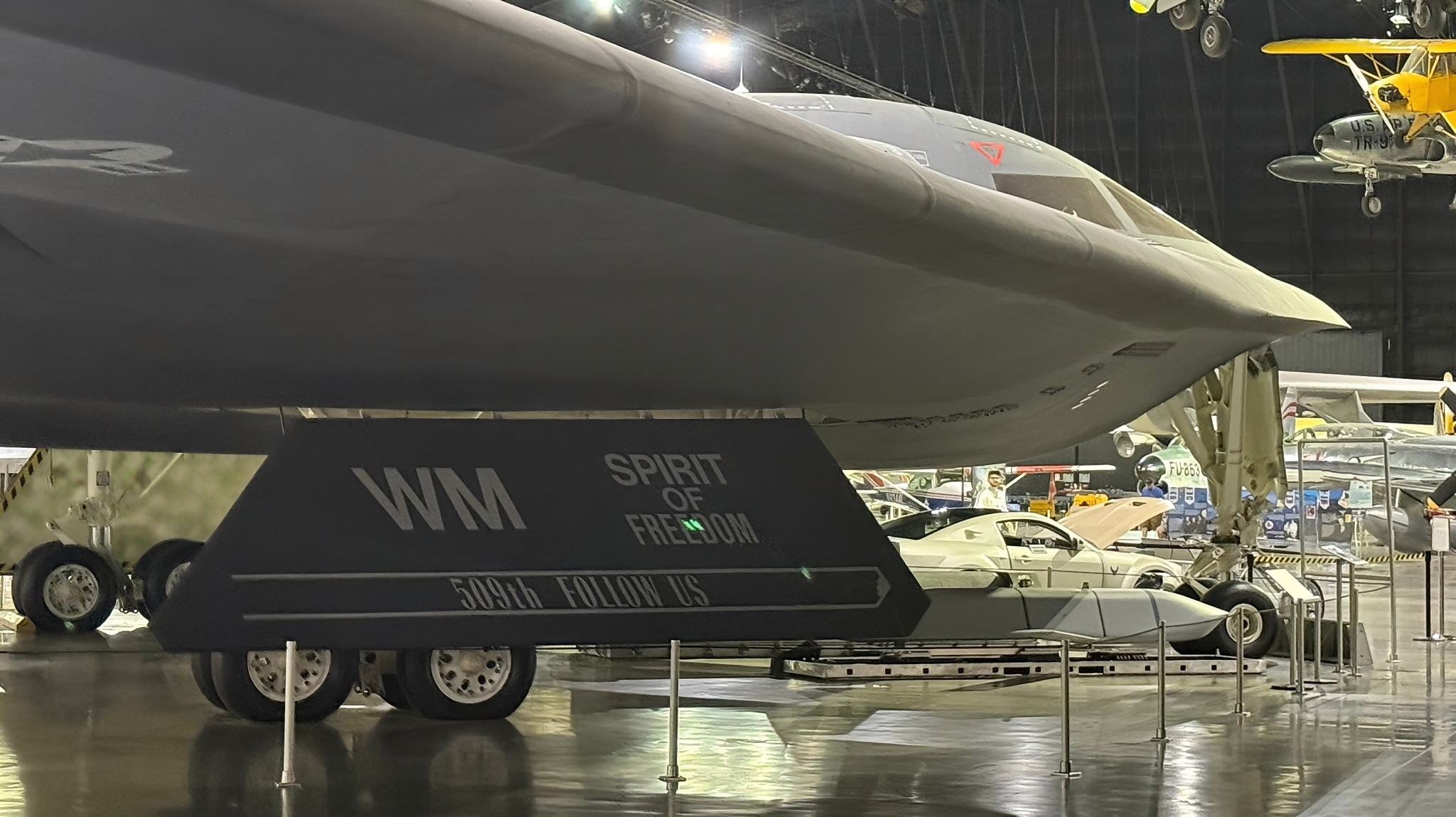
B-2 Bomber at USAF Museum National Security Journal Image. All Rights Reserved.

B-2 Bomber from U.S. Air Force Display. Image Credit: Harry J. Kazianis/National Security Journal.

B-2 Stealth Bomber at USAF Museum July 19 2025. Image Credit: Harry J. Kazianis/National Security Journal.
In the context of military aviation, meanwhile, “Raider” refers to the U.S. Air Force’s sixth-generation strategic bomber, the B-21 Raider. Recently, National Security Journal has published articles discussing the who, when, where, why, and how of the B-21, i.e. projecting how many B-21s the Air Force (“who”) needs, especially to counter the threat of China (“why”) in the Indo-Pacific region (“where”), and its projected operational date of 2026 (“when”).
Now, we cover the “what:” the capabilities the B-21 will bring to the fight.
Origins and Known Specifications & Tech Specs of the B-21
The Air Force’s current strategic stealth bomber, the Northrop B-2 Spirit — the original and oh-so-controversial stealth bomber — is the direct ancestor of the B-21. And the Raider is the near-spitting image of the Spirit in terms of cosmetic appearance.
The plane appears to be an absolute powerhouse. In fact, the only real ‘enemy’ or threat the plane faces is if too few are built, a challenge that could limit its effectiveness in great power war.
Initially designed in 2011 under the Long Range Strike Bomber program, the Raider finally made her maiden flight on Nov. 10, 2023 (the day before Veteran’s Day, poetically enough), embarking from the Air Force Plant 42 in Palmdale, California.
As might be expected from a project shrouded in secrecy for the sake of operational security, a lot of the B-21’s specifications are still hush-hush. However, Bill Sweetman of Aviation Week was able to cull the following figures:
Length: 54 ft (16 m)
Wingspan: 132 ft (40 m)
Empty weight: 70,000 lbs. (31,751 kg)
Max takeoff weight: 180,000 lbs. (81,647 kg)
Max airspeed: Mach 0.8+ (613.8+ Mach; 987.8+ km/h; 533.3+ knots)
Weapons Payload: 20,000 lbs. (9,100 kg) weapon load (presumably including the AGM-181 Long Range Stand Off Weapon (LRSO)
Those payload stats sound a tad conservative — and even underwhelming vis-à-vis the Spirit’s payload, which has an official limit of 40,000 lbs. Under extraordinary circumstances, that payload can be increased significantly. This was demonstrated during Operation Midnight Hammer when six B-2s were each loaded up with two GBU-57A/B Massive Ordnance Penetrator bunker-buster bombs, each weighing 27,125 lbs., to destroy Iran’s nuclear facilities.

The B-21 Raider was unveiled to the public at a ceremony December 2, 2022 in
Palmdale, Calif. Designed to operate in tomorrow’s high-end threat environment, the B-21 will play a critical role in ensuring America’s enduring airpower capability. (U.S. Air Force photo)

A B-21 Raider conducts flight tests, which includes ground testing, taxiing, and flying operations, at Edwards Air Force Base, California, where it continues to make progress toward becoming the backbone of the U.S. Air Force bomber fleet. The B-21 will possess the range, access, and payload to penetrate the most highly-contested threat environments and hold any target around the globe at risk. The B-21 program is on track to deliver aircraft in the mid-2020s to Ellsworth Air Force Base, South Dakota, which will be the first B-21 main operating base and location for the B-21 formal training unit. (Courtesy photo)

The B-21 Raider is designed with an open systems architecture, enabling rapid insertion of mature technologies and allowing the aircraft to be effective as threats evolve. The bomber was designed up front for supportability and maintainability-based upon decades of lessons learned and best practices from prior aircraft programs-to improve long-term affordability and outcomes in operations and sustainment. The B-21 first flight is anticipated to take place in calendar year 2023. (U.S. Air Force photo)

A second B-21 Raider test aircraft takes off, Sept. 11, from Palmdale, Calif., to join the Air Force’s flight test campaign at Edwards Air Force Base, Calif. The addition of the second test aircraft expands mission systems and weapons integration testing, advancing the program toward operational readiness. (Courtesy photo)

U.S. Air Force Airmen with the 912th Aircraft Maintenance Squadron prepare to recover the second B-21 Raider to arrive for test and evaluation at Edwards AFB, Calif., Sept. 11, 2025. The arrival of a second test aircraft provides maintainers valuable hands-on experience with tools, data and processes that will support future operational squadrons. (U.S Air Force photo by Kyle Brasier)
It would seem a concern, then, that the B-21 would sacrifice 50 percent or more of the payload capacity of its ancestor, when another Midnight Hammer-type mission might be needed in the future.
Additional Features and Intangibles
As stated by Gen. Thomas A. Bussiere, Commander, Air Force Global Strike Command, “[The B-21] was developed with a combat lethality mindset, hand in glove with the engineers, acquisition professionals, and industry professionals that knew how to develop a capability so exquisite.”
Meanwhile, Sweetman delves into greater detail on how the B-21 improves upon the B-2:
“A higher bypass ratio provides much better specific fuel consumption than the B-2’s fighter-type engine, improving range, and would enable a cooler, lower-velocity exhaust, not only lowering the B-21’s infrared signature but also alleviating thermomechanical stress on the open ‘aft deck’ area of the exhaust, immediately ahead of the trailing edge.
“The B-21’s structure benefits from the absence of a low-level flight requirement and improvements in both composite materials and RAM, reducing the use of fillers and tapes. While the RAM itself would perform the same functions as on earlier stealth aircraft, with multiple layers to absorb energy, diffuse surface currents and protect the skin from lightning, it would require less maintenance than the notoriously finicky B-2 surface.”
Meanwhile, the avionics package of the Raider benefits from open-mission systems architecture wherein changes to the mission systems cannot affect flight-critical functions.
“Flexibility is the key to airpower,” to quote 20th-century airpower theorist Gen. Giulio Douhet, and versatility goes hand-in-hand. Attesting to the potential versatility of the B-21, there is already talk about the Raider’s potential for use as more than just a strategic bomber. It could also be used as a “flying wing arsenal plane” bristling with air-to-air missiles, and thus provide magazine depth for the F-22 Raptor and F-35 Lightning II fifth-generation stealth fighters, and the future sixth-generation F-47.
Time will tell. Right now, it appears as though the sky’s the limit for the B-21 Raider’s potential as a warfighting platform.
About the Author: Christian D. Orr, Defense Expert
Christian D. Orr is a Senior Defense Editor. He is a former Air Force Security Forces officer, Federal law enforcement officer, and private military contractor (with assignments worked in Iraq, the United Arab Emirates, Kosovo, Japan, Germany, and the Pentagon). Chris holds a B.A. in International Relations from the University of Southern California (USC) and an M.A. in Intelligence Studies (concentration in Terrorism Studies) from American Military University (AMU). He is also the author of the newly published book “Five Decades of a Fabulous Firearm: Celebrating the 50th Anniversary of the Beretta 92 Pistol Series.”
More Military
USS America: The U.S. Navy Failed To Sink Its Own Aircraft Carrier
The Mach 3 SR-71 Blackbird Summed Up in 4 Words
The Russian Military: A Spent Force?
How China Would Decide to Invade Taiwan
Russia’s ‘New’ Su-75 Checkmate Stealth Fighter Looks Like a ‘Fake Out’