

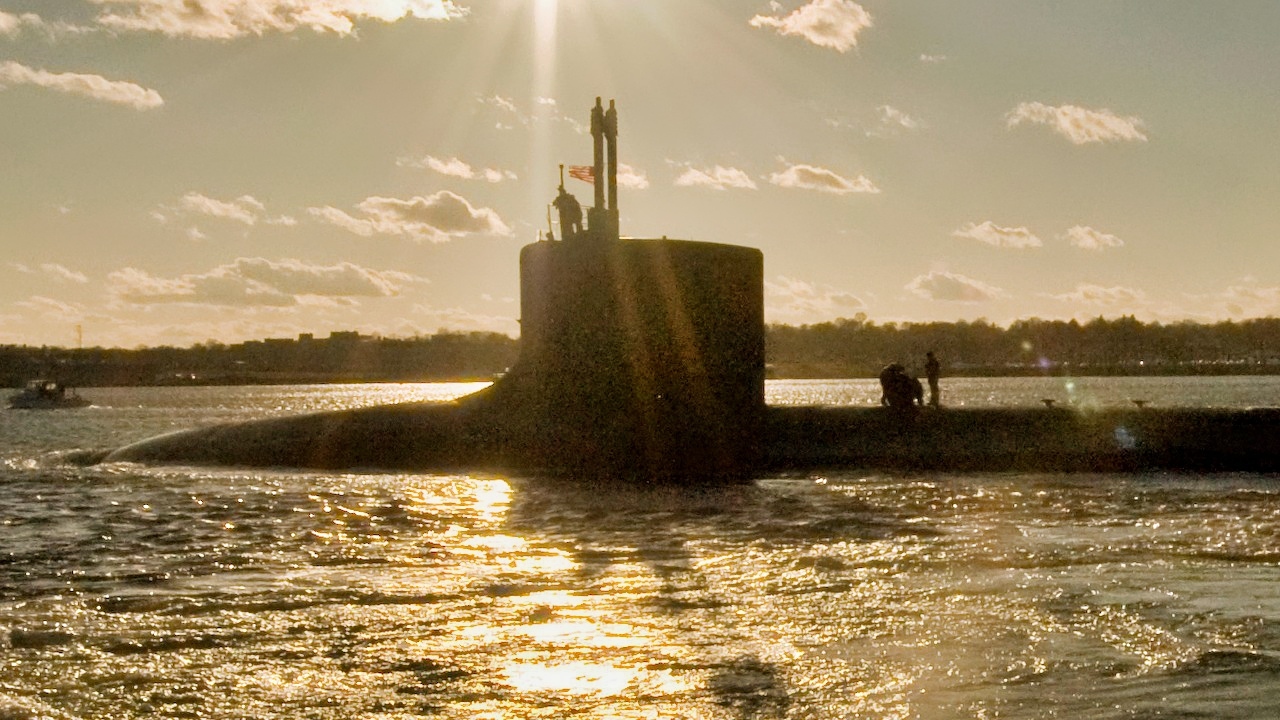
Summary and Key Points: The U.S. Navy’s Virginia-class submarine program faces severe delays, cost overruns, and workforce shortages.
-Despite aiming to build two subs per year, production has averaged just 1.2 annually.
-Each submarine now costs $4.5 billion, significantly higher than initially budgeted. Labor shortages at shipyards and residual inflationary pressures contribute to a staggering 410-month total delay.
-The U.S. also promised Australia three submarines under the AUKUS agreement, further stretching production capabilities.
-Although Secretary of Defense Pete Hegseth supports the program, drastic improvements in shipyard staffing and acquisition practices are required to reach goals, maintain deterrence, and compete effectively with Chinese naval expansion.
The Virginia-Class Submarine Is Behind 410 Months or 12,470 Days
The U.S. Navy’s Virginia-class fast attack cruise missile submarine program is dreadfully behind schedule – I am talking about a shocking 410-month schedule slip.
This is mainly because of labor shortages and cost overruns, even though the sub is one of Secretary of Defense Pete Hegseth’s priorities.
The Navy has procured two Virginia-class boats per year, but only one per year is being built.
Forty of the new subs have been purchased through FY24. The Navy has operated the program since 1998. These delays have ballooned the unit cost to at least $4.5 billion each. The production rate has never hit its goal of two Virginia-class subs per year.
This is frustrating for Congress members who have supported the program for decades.
Barely One Virginia-class Boat a Year Has Been Built
The average build has been 1.2 submarines a year. The Congressional Research Service has written reports to warn lawmakers about the problems inherent in the program.
The Navy is trying to meet the two boats per year goal by 2028. That means one per year over the next three year,s which will not allow the program to reach its objectives while President Donald Trump and Hegseth are in office.
Don’t Forget the Needs of Australia
To make matters more challenging, the United States promised Australia to build three Virginia-class submarines and sell them to the Aussies under the AUKUS security partnership by 2032.
There is definitely a shortage of Virginia-class subs. Congress is trying to help repair the maritime defense industrial base to meet these goals.
Still, it appears that the United States cannot adhere to its submarine objectives, much less match the surface shipbuilding prowess of China.
Only One Built This Year That Is Still Over-priced
There is one Virginia-class ordered for FY25, and that will cost $4.8 billion. The Navy also invests $1 billion into “materials and equipment” for future Virginia-class boats.
Procuring two desperately needed boats would cost another $3.2 billion, which is a better deal due to economies of scale, but it is still not possible in FY25.
“Due to the residual effects of inflationary pressures of the past few years, workforce challenges, plus increased labor and supply costs across the defense enterprise, all drove costs associated with our shipbuilding account up roughly 20 percent over the last couple of years. Hard choices were made, particularly in the procurement accounts. An analytic review of production performance identified areas where we could take risk to comply with the congressional fiscal caps,” the Congressional Research Service wrote in its most recent report on the Virginia-class.
The Navy is also procuring the Columbia-class ballistic missile (SSBN) subs, which has been the highest priority for the service branch for years. It is unclear if the Department of Defense is prepared to delay both programs without Congress requesting additional remedies.
Doing the Same Thing Over and Over
Pentagon comptroller Mike McCord said this repetitive practice has not resulted in the production increase needed. “The boats that are delivering … this year are averaging over 30 months late, and we have more than a dozen on order that are already in production. So, the question was really: What can we do to get a better result [rather] than keep doing the same thing and hoping for a different result?”
This state of affairs for the Virginia-class is unacceptable, but it is unclear what the Navy can do but to forge on with building one boat per year until the problems with the defense industrial base are fixed.
The shipyards must do a better job at recruiting and retaining workers. These are high-paying and highly-skilled jobs but the younger generation does not see them as realistic options. It may take several years to fix this problem.
Where Is the Leadership?
The Pentagon under Hegseth reviewed all defense spending after he was confirmed. The department maintained that the Virginia-class program would be safe from budget cuts.
Hegseth has recommended $50 billion or eight percent in cuts for “non-lethal” programs to offset the cost of the Virginia-class program and other Navy priorities.
The Virginia-class is needed to provide deterrence against U.S. adversaries and improve the ability to form an undersea warfare strategy for the next decades that continues the use of accurate cruise missile strikes that the U.S. military has come to expect.
The Navy needs two Virginia-class boats per year and is years behind schedule. The Pentagon and Congressional defense analysts keep reminding the public that the program’s objectives are not being met.
It doesn’t appear that Hegseth knows that the Virginia-class program is suffering so much. It is good to make sure defense programs are a priority to maintain parity with China. Still, it is less than desirable to continue repeating poor acquisition practices for such an expensive program.
About the Author: Dr. Brent M. Eastwood
Brent M. Eastwood, PhD is the author of Don’t Turn Your Back On the World: a Conservative Foreign Policy and Humans, Machines, and Data: Future Trends in Warfare plus two other books. Brent was the founder and CEO of a tech firm that predicted world events using artificial intelligence. He served as a legislative fellow for U.S. Senator Tim Scott and advised the senator on defense and foreign policy issues. He has taught at American University, George Washington University, and George Mason University. Brent is a former U.S. Army Infantry officer. He can be followed on X @BMEastwood.