


Key Points and Summary – The secretive SR-72 “Darkstar” is Lockheed Martin’s ambitious project to build a Mach 6+ hypersonic ISR and strike aircraft.
-Its success hinges on a revolutionary and highly classified Turbine-Based Combined Cycle (TBCC) engine.

SR-72 Artist Image by Lockheed Martin.

SR-72 Darkstar Lockheed Martin Image.
-This “insane” hybrid system combines a traditional turbine engine (for takeoff to Mach 3) with a scramjet (for speeds over Mach 3).
-This design, which allows it to take off from a runway and reach hypersonic speeds, is incredibly complex and faces enormous challenges in thermal management (withstanding 1,000°F+ heat) and seamlessly transitioning between engines.
-The $11B+ program “went dark” in 2018 but is expected to enter service in the 2030s.
The SR-72 Darkstar: What About the Engines to Hit Mach 6?
The SR-72 is an ambitious project by Lockheed Martin’s Skunk Works division to develop an aircraft capable of hypersonic flight.
The project seeks to replace the iconic SR-71 Blackbird as the U.S.’s new reconnaissance aircraft.
According to rumors and reports, the aircraft will also be able to conduct some sort of strike mission.
However, because of the project’s secrecy, very little is known about the aircraft itself. Its performance specs, avionics, and even its design are still unknown.
The SR-72’s success hinges on whether Lockheed’s engineers can figure out its engines.
Achieving sustained hypersonic flight will require engineering techniques never before seen.
What Engines Does the SR-72 Use?
The SR-72 was first publicly discussed in 2013, and since then, it has captured the imagination of aerospace enthusiasts and defense analysts alike.
Unlike satellites, which follow predictable orbital paths, the SR-72 would be able to fly unpredictable routes at extreme speeds, making it a potent tool for penetrating enemy airspace and gathering real-time intelligence.
But the SR-72 is not just about surveillance. It is also expected to carry precision weapons, allowing it to strike targets with unprecedented speed and surprise. This dual-role capability marks a significant evolution from the SR-71’s purely observational mission profile.
The SR-72’s engine powerplant is still classified. However, according to reports, the aircraft is expected to utilize a Turbine-Based Combined Cycle (TBCC) engine.

SR-72 from Lockheed Martin. Image Credit: Lockheed Martin.
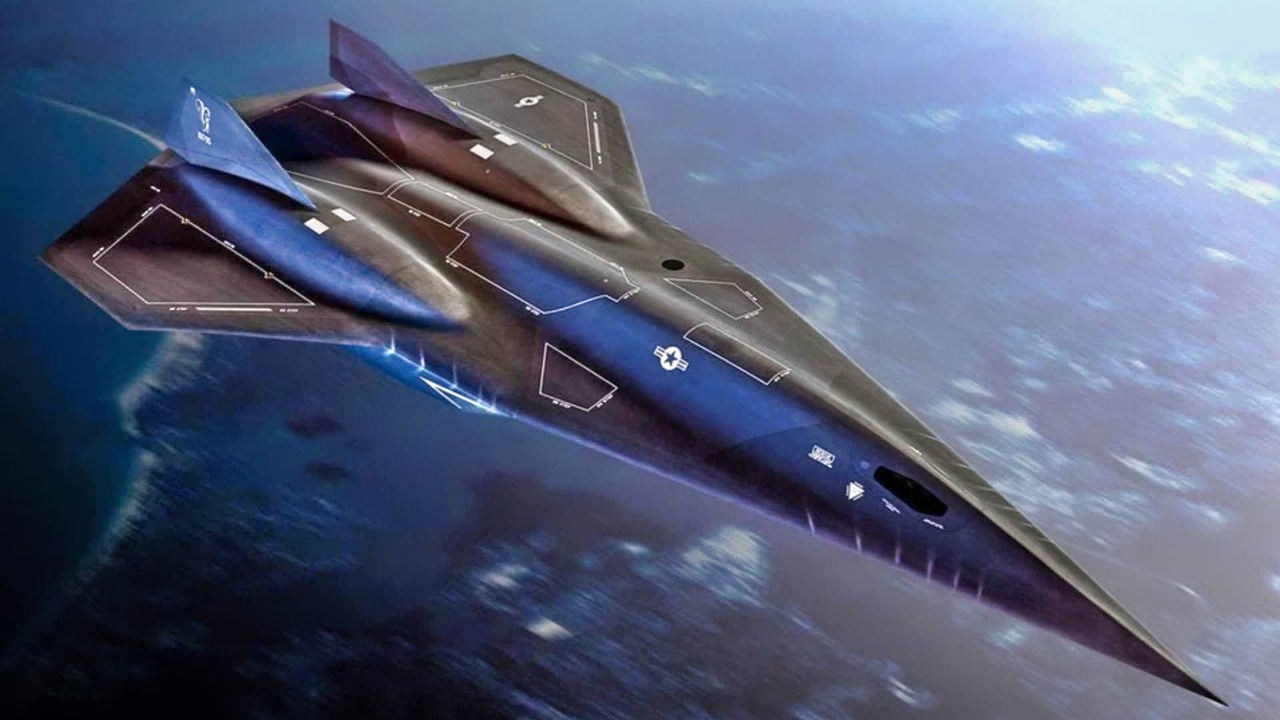
SR-72 artist image. Image Credit: Creative Commons.
This engine design is groundbreaking because it allows the aircraft to operate efficiently across a wide range of speeds from takeoff to hypersonic cruise.
The TBCC system integrates a conventional turbine engine, likely a turbojet or low-bypass turbofan, with a scramjet (supersonic combustion ramjet).
These two propulsion modes are housed within a single airframe, sharing a standard inlet and nozzle but operating through separate airflow paths.
The Engineering Behind TBCC Engines
TBCC engines are insane works of engineering that are still under development. During takeoff and initial acceleration, the aircraft uses its turbine engine to reach speeds of around Mach 3.
At this point, the airflow is redirected to bypass the turbine and enter the scramjet, which then takes over propulsion duties.
The scramjet allows combustion to occur in supersonic airflow, propelling the aircraft to Mach 6 or higher.
This seamless transition between propulsion modes is what makes the TBCC system so revolutionary.
It enables the SR-72 to operate from conventional runways and reach hypersonic speeds without the need for rocket boosters or external propulsion stages.
Scramjet technology offers several advantages over other engines. Unlike traditional jet engines, scramjets have no moving parts.
They rely on the aircraft’s high speed to compress incoming air before combustion. This makes them ideal for hypersonic flight but ineffective at low speeds, which is why they must be paired with a turbine engine in a TBCC configuration.
Scramjets have been tested in various experimental platforms, including NASA’s X-43 and the DARPA Falcon Project, which laid the groundwork for the SR-72’s engine development. Aerojet Rocketdyne, a key partner in the SR-72 program, has played a crucial role in adapting scramjet technology for operational use.
Obviously, developing and producing these engines is anything but easy. One of the most significant hurdles is thermal management.
At Mach 6, the aircraft’s skin can reach temperatures exceeding 1,000°F (540°C). Advanced materials and cooling systems are required to prevent structural failure. Another challenge is the design of the engine inlet, which must efficiently manage airflow across a wide range of speeds without causing shock waves that could disrupt combustion.
Transition control is also critical. Seamlessly switching from turbine to scramjet propulsion requires precise control of airflow and timing to avoid engine stall or flameout. Fuel efficiency is another concern. Hypersonic flight consumes enormous amounts of fuel, and the SR-72 likely uses JP-7 or JP-10, specialized fuels with high thermal stability.
What’s the Status of the SR-72?
Despite these challenges, Lockheed Martin’s Skunk Works has reportedly made significant progress in overcoming them, although much of the work remains classified. The SR-72’s speed and versatility offer several strategic advantages.
Its ability to reach any point on the globe in under two hours provides rapid global reach.
It can gather intelligence in real-time, outpacing satellite coverage and avoiding predictable orbital paths. Its speed also allows it to deliver weapons before adversaries can respond, making it a formidable first-strike platform. At Mach 6, interception becomes nearly impossible. Even advanced air defense systems struggle to track and engage targets moving at such speeds.
As of 2025, the SR-72 remains a design concept, with no confirmed flight tests.
However, multiple sources suggest that prototype testing may have occurred in secret, and Lockheed Martin has reportedly invested billions into the program.
The aircraft is expected to enter service sometime in the early 2030s, although this timeline is speculative.
The program went dark around 2018, coinciding with increased global interest in hypersonic weapons.
Since then, Lockheed Martin has faced significant cost overruns, with some estimates placing total development costs at over $11 billion, but estimates do vary.
About the Author: Isaac Seitz
Isaac Seitz, a Defense Columnist, graduated from Patrick Henry College’s Strategic Intelligence and National Security program. He has also studied Russian at Middlebury Language Schools and has worked as an intelligence Analyst in the private sector.
More Military
‘Long Way from Production’: China’s J-36 Might Be ‘Paper Tiger’ Stealth Fighter
‘Mach 2’ JAS 39 Gripen Is a Rocket Fighter Plane
New ‘Ferrari’ F-35 Stealth Fighter Is Aimed Right at Russia and China
Putin’s Poseidon Nuclear “Doomsday” Torpedo Looks Like a Bluff
The Air Force’s B-21 Raider Stealth Bomber Plan Doesn’t Make Any Sense