

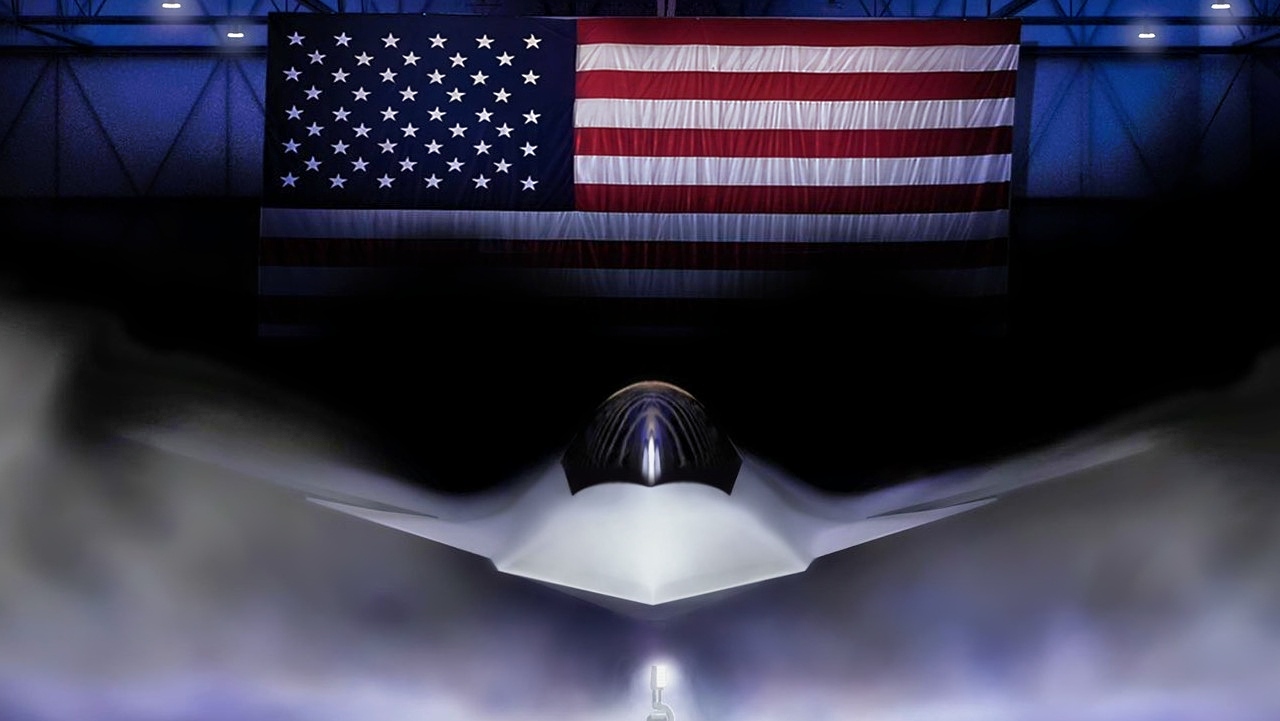
The wait is over; the Air Force will move forward with the acquisition of a new fighter jet, to be dubbed the F-47 and built by Boeing.
The choice of “F-47” to designate the fighter recalls the P-47 Thunderbolt, a very successful fighter flown by the US Army Air Force in World War II.

U.S. Air Force Staff Sgt. Christopher Graham, 3rd Wing crew chief, marshalls an F-22 Raptor on the flight line at Joint Base Elmendorf-Richardson, Alaska, during an elephant walk, May 5, 2020. The large show-of-force demonstrated the wings’ rapid mobility capabilities and response readiness during COVID-19 and also highlighted the ability to generate combat airpower at a moment’s notice to ensure regional stability throughout the North American Aerospace Defense Command Region and Indo-Pacific. (U.S. Air Force photo by Tech. Sgt. Westin Warburton)
The new fighter will replace the F-22 Raptor over the next two decades, and may represent the last manned fighter aircraft built and flown by the US Air Force.
And now, let the questions commence.
Is the F-47 NGAD Fighter Really Needed in 2025?
Questions about the need for a new manned fighter have plagued the NGAD project over the past year.
Experience in the Russia-Ukraine War has raised concerns over whether a crewed fighter can have much of an impact on the modern battlefield.
Both Russia and Ukraine have struggled to use manned aircraft in contested airspace, with both instead relying on standoff weaponry (such as glide bombs) to affect the battlefield.
Extensive wargaming, however, suggested that the NGAD could still play a critical role in a fight in the Western Pacific, now understood to be the central theater for strategic competition with China.
With China developing its own sixth generation fighter projects, the announcement of the F-47 thus comes as little surprise.
Much More That Just a Simple ‘Stealth’ Fighter
As others have noted, the F-47 will play a central role in an ensemble of systems that will also include the Collaborative Combat Aircraft (CCA), the B-21 Raider, and possibly other aircraft yet to be developed.
This family will likely include legacy aircraft such as the F-35 and the F-15EX Eagle II, each playing roles in the battlespace suited to their unique capabilities.
Given that the F-47 was developed out of a need for a penetrating counter-air platform (in English, an aircraft that can fight and kill other aircraft deep in enemy airspace) it will need to share information with and borrow weapons from other advanced aircraft.

Master Sgt. Tristan McIntire, 40th Flight Test Squadron, marshals the F-15EX, the Air Force’s newest fighter aircraft, to a stop at Eglin Air Force Base, Fla. March 11, 2021. The F-15EX will be the first Air Force aircraft to be tested and fielded from beginning to end through combined developmental and operational tests. (U.S. Air Force photo by Samuel King Jr.)
However, as the capabilities and role of partner aircraft (especially the CCA) remain underspecified at this point, the flexibility of the new project in its design phase is critical to its success.
More Than Just One Fighter?
Indeed, it is unclear whether the NGAD will even be a single jet in the sense that the F-15 or even the F-35 are a single, recognizable platform.
The project has long been associated with the “digital century series” concept, an idea that would transform the process through which aircraft are designed and constructed.
Using digital tools and eschewing traditional techniques of aircraft construction, the century series concept (harkening back to the family of jets built for the US Air Force in the 1950s) would allow for rapid modification of the basic platform in the production phase to incorporate innovations and adapt the aircraft for different needs.
It is not yet clear how far the Air Force intends to follow through with this concept, and recent discussions of the NGAD has tended to de-emphasize incorporating innovation in the process and design phase.
What We Know About Boeing’s F-47 NGAD Right Now
At this point, we know little about the characteristics of the new aircraft. Some version of the F-47 has been flying for years as the project moved through development, but images of the secretive aircraft reveal only hints about its structure and capabilities.
The announcement of the contract by President Donald Trump suggested that the new fighter will have performance parameters similar to the F-22 Raptor (in contrast with the multirole F-35), but specifics remain elusive.
It’s worth noting that while Boeing inherited fighter projects from its merger with McDonnell Douglas, this is the first time the company has won a tender for a straightforward fighter project.

F-15SE Silent Eagle. Image Credit: Creative Commons/Boeing.
The Shadow of the F-22 Raptor Remains
So, the United States is still in the fighter game. President Trump suggested in his announcement that the F-47 would enter the international market with a stripped-down export version, but given the continued export success of the F-35 and the current state of US relations with partners in Europe and Asia, success is all but ensured.
Indeed, if the F-47 is as technologically advanced as analysts suggest, it may find itself in the same predicament as the F-22; limited in export prospects and too expensive to build in great numbers.
Nevertheless, the selection of Boeing to build the new fighter is a step towards defining Air Force and airpower capabilities for the second half of the 21st century.
About the Author: Dr. Robert Farley
Dr. Robert Farley has taught security and diplomacy courses at the Patterson School since 2005. He received his BS from the University of Oregon in 1997, and his Ph. D. from the University of Washington in 2004. Dr. Farley is the author of Grounded: The Case for Abolishing the United States Air Force (University Press of Kentucky, 2014), the Battleship Book (Wildside, 2016), Patents for Power: Intellectual Property Law and the Diffusion of Military Technology (University of Chicago, 2020), and most recently Waging War with Gold: National Security and the Finance Domain Across the Ages (Lynne Rienner, 2023). He has contributed extensively to a number of journals and magazines, including the National Interest, the Diplomat: APAC, World Politics Review, and the American Prospect. Dr. Farley is also a founder and senior editor of Lawyers, Guns and Money.




JingleBells
March 30, 2025 at 6:59 am
Hum, Hum, Hum.
The F-47 will assuredly consign uncle sam to the poor house.
Reason being the f-47 jet will make the cost overruns for the f-35 project look like young child’s play in comparison.
F-35 program was and is still being funded by foreign buyers, but the f-47 will suck endless dollops of bucks from US taxpayers.
To keep the taxpayers’ contributions materially meaningful, the DoD will have to borrowed money and more money through t bills.
In the end, the whole massive scam will spiral out of control and money wasted on f-35 will merely be like pennies and nickels falling out of a small hole in the trouser pocket.
Pingback: A Giant Bluff: Trump Won't Quit NATO - National Security Journal