


Key Points and Summary – Born as a Navy fleet defender, the F-4 Phantom II evolved into a multi-service, multi-role icon.
-It answered a Cold War need for a fast, long-range fighter with heavy missiles and big radar, then adapted—adding a gun, new sensors, guided bombs, and SEAD gear.
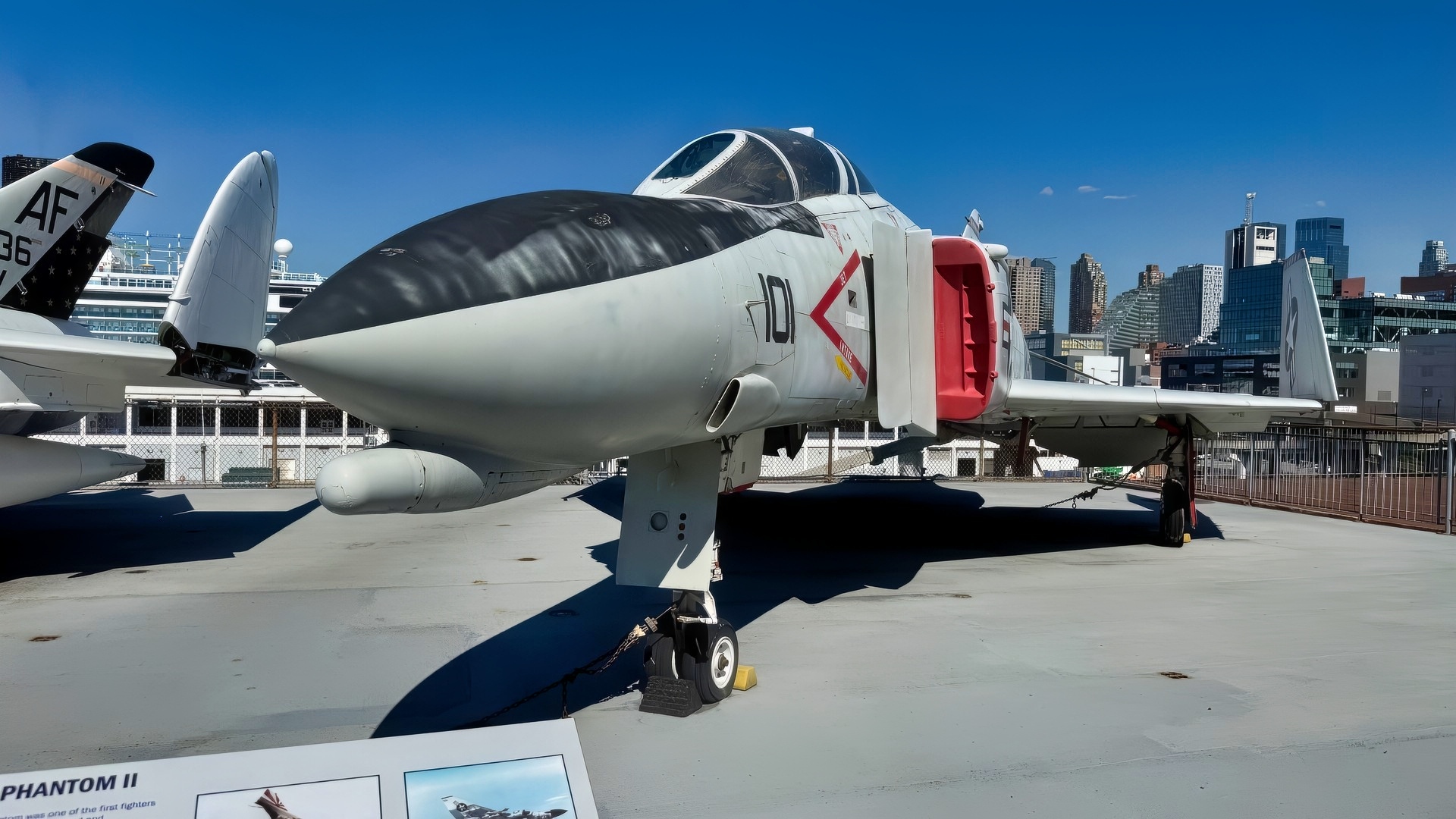
F-4 Phantom II Photo from National Security Journal. Taken on September 18, 2025.
-From Vietnam to Arab-Israeli wars, Iran-Iraq, Lebanon, and Desert Storm (as the F-4G Wild Weasel), the Phantom fought from carriers and land bases worldwide.
-Retired in U.S. combat service by the 1990s (later as QF-4 drones), it served abroad into the 21st century. Its legacy: joint adaptability, training revolutions, and the template for modern multi-role fighters.
–National Security Journal visited an F-4 Phantom II onboard the USS Intrepid back on September 18, 2025. The two pictures above are from that visit. We also have two other photos below from a recent visit to another F-4 Phantom we saw last month.
F-4 Phantom II: The American Fighter That Did Almost Everything
By the mid-1950s, two realities were colliding. At sea, the Navy’s fast carrier task forces faced longer-ranged bombers and anti-ship weapons; it needed a fleet air-defense fighter with serious legs, a powerful radar, and multiple radar-guided missiles to kill threats well beyond the carrier’s horizon. Ashore, the Air Force wanted speed, altitude, and payload to intercept bombers—and a platform that could later swing into strike when needed. The U.S. also expected its next fighter to work around the globe, in all weather, guided by radar and data links rather than clear-sky dogfighting alone.

F-4 Phantom Images Original National Security Journal.

F-4 Phantom Fighter National Security Journal. Image Taken on August 23, 2025.
McDonnell’s answer was the F-4 Phantom II: twin-engine security, a big nose to house a large pulse-Doppler radar, two crew to divide workload, and the ability to carry a bomber-class fuel and weapons load at fighter speeds. It was over-built for durability, adaptable by design, and—critically—good enough that the Air Force adopted a Navy fighter, a rarity in that era.
What Inspired It: The Airframes And Ideas Behind The F-4
The Phantom didn’t spring from thin air. It fused threads from multiple design lineages and operational lessons:
Carrier DNA. McDonnell’s earlier F3H Demon taught hard lessons about carrier suitability, systems packaging, and maintenance access on a pitching deck. The Phantom kept the Demon’s “big nose, big radar” logic and doubled down with two J79s for safety and thrust.
Century-Series Experience. Air Force jets like the F-101 Voodoo and F-106 Delta Dart validated high-speed interception with missile armament and radar command guidance. The Phantom borrowed the missiles-first mindset—but left room to evolve when real combat demanded more.
Navy Fighter Practice. The F-8 Crusader proved a carrier fighter could be agile and gun-relevant even in the missile age. The Phantom began as “missile-only,” but Crusader-era dogfight lessons would come roaring back in Vietnam, reshaping the F-4 mid-career.
The throughline was flexibility: a large, tough airframe with growth room, able to absorb new radars, pods, pylons, and mission computers.
Weapons And Avionics: From “Missiles-Only” To Multi-Role Workhorse
Early Loadouts. The initial Navy F-4B and Air Force F-4C/D centered on radar-guided AIM-7 Sparrow and heat-seeking AIM-9 Sidewinder. Four Sparrows lived semi-flush in the fuselage; Sidewinders rode the inboard pylons. The big AWG-10/APQ-series radars allowed long-range shots and bad-weather intercepts that earlier fighters simply couldn’t attempt.
Guns Return. Vietnam’s rules of engagement often required visual identification; when merges happened, early missiles suffered reliability and envelope issues. The Air Force bolted a centerline gun pod under Phantoms, then baked in a solution: the F-4E with an internal M61A1 Vulcan six-barrel 20 mm cannon. That single change transformed close-in credibility and gave pilots a weapon that always worked.
Smart Bombs And SEAD. As precision munitions matured, Phantoms added laser-guided bombs guided by pods like Pave Knife and Pave Spike, turning a big fighter into a credible strike jet. They also took on Suppression of Enemy Air Defenses: AGM-45 Shrike and AGM-78 Standard ARM anti-radiation missiles hunted radars, while the dedicated F-4G “Wild Weasel” variant paired a specialized receiver suite with tactics designed to bait SAM sites and kill them.
Survivability And Handling Upgrades. Leading-edge maneuvering slats (“Agile Eagle”) on later F-4E and Navy F-4S improved turn performance and docility at high angles of attack. Digital nav-attack updates (e.g., DMAS/ARN-101), helmet-sight and missile improvements, chaff/flare, RWRs, and a parade of ECM pods kept the jet relevant as threats evolved.
Export Specialties. The British fielded Spey-engined Phantoms (FG.1/FGR.2) with distinct intakes and systems; Germany’s F-4F later gained modern radar/missile fits; Israel’s Kurnass line and “Kurnass 2000” upgrades added glass cockpits and advanced weapons; Japan license-built F-4EJ/EJ Kai; Turkey’s F-4E 2020 modernization extended life with new sensors and precision weapons.
Operational History: A Global Combat Résumé
Few fighters have flown more varied missions from more locations.
Carrier And Coastal Skies. The Phantom debuted with the Navy and Marines as a fleet defender and day/night attack jet. High sortie rates from the Tonkin Gulf forged deck procedures and missile tactics under fire; Marine F-4s flew close air support and interdiction from both shore and sea.
Over Southeast Asia. Air Force F-4s replaced multiple single-purpose jets by doing air superiority, escort, strike, recce, and SEAD. Phantom crews learned the hard lessons that created Red Flag and institutionalized dissimilar air combat training. They also proved the value of two-crew teamwork—radar intercept officers and weapon systems officers became integral to winning beyond-visual-range and complex strike missions.
Middle East Wars. Israel’s Phantoms flew relentlessly in the War of Attrition and Yom Kippur War, striking deep, dueling MiGs, and absorbing intense SAM fire while pioneering SEAD tactics that would echo worldwide. Later, in Lebanon, they continued the strike/SEAD role as new systems arrived.
Iran-Iraq War. Iran’s F-4s, inherited before 1979, flew a grinding eight-year war—maritime strikes, interdiction, and air defense—often under sanctions and maintenance strain. Their endurance in harsh conditions testified to the airframe’s toughness and adaptability.
Europe And Beyond. British Phantoms guarded NATO airspace and carriers; German F-4F fleets patrolled the inner German border and later upgraded to modern missiles and radar. Recon RF-4C/E variants provided high-value imagery worldwide for decades.
Desert Storm’s Finale. The U.S. retired most combat Phantoms before 1991, but the F-4G Wild Weasel played a starring role in Desert Storm, leading SEAD packages that cracked open Iraq’s SAM networks. In parallel, allied Phantoms flew air defense, strike, and reconnaissance, closing the combat chapter of an airframe that had already seen more war than most types ever will.
The Wars They Served In
Vietnam War: The Phantom was the workhorse, serving in air superiority, escort, strike, reconnaissance, and as the crucible for missile and training reforms.
Arab-Israeli Conflicts: From the War of Attrition through 1973 and later Lebanon, Phantoms fought dense integrated air defenses and helped invent modern SEAD.
Iran-Iraq War: Long, unforgiving operations over land and sea lanes, demonstrating robustness under sanctions and supply challenges.
Cold War NATO Patrols: Daily readiness missions over Europe and the North Atlantic, shaping interception and quick-reaction doctrine.
Gulf War (1991): The U.S. F-4G led suppression campaigns; allied Phantoms contributed to air defense and strike roles.
Other Flashpoints: Phantoms served in regional crises and deterrence patrols from Asia to the Mediterranean, often without headlines but always central to force posture.
Retirements: A Long, Staggered Goodbye
The U.S. Navy bowed out first, retiring frontline Phantoms in the mid-1980s as F-14s and F/A-18s took over. The Marine Corps followed by the early 1990s, and the Air Force retired its last fighters earlier while keeping F-4G Wild Weasels through Desert Storm and RF-4 reconnaissance jets into the mid-1990s. The jet’s American epilogue continued as QF-4 full-scale aerial targets for missile testing and tactics development; even then, crews spoke of how well the old airframe still flew.
Abroad, retirements stretched well into the 21st century as upgrades extended life: the RAF in the early 1990s; Germany in the 2010s; Japan completed its final Phantom chapter in the early 2020s; others phased out on their own timelines. A handful remain in limited service outside NATO, proof of the design’s staying power when budgets and missions align.
What The F-4 Phantom II Taught—And Its Place In Aviation History
1) Multi-Role Before Multi-Role Was Fashionable. The F-4 proved a single airframe could credibly perform air superiority, strike, recce, and SEAD across multiple services and carriers/land bases. That logic underpins modern fighters from the F-15E to the F-35.

An F-35A Lightning II from Eglin Air Force Base flies with a KC-135 Stratotanker from the 121st Air Refueling Wing, June 16, 2024, before the Columbus Air Show. This year’s event featured more than 20 military and civilian planes, including a KC-135 Stratotanker from the 121st Air Refueling Wing, which served as the base of operations for military aircraft participating in the show. (U.S. Air National Guard photo by Staff Sgt. Mikayla Gibbs)
2) Sensors, Missiles—And A Gun. Vietnam validated big radars and guided weapons and re-validated guns. The Phantom’s arc—from missile-only to gun-plus-missiles—became doctrine: carry a diverse toolkit, because rules of engagement and real-world reliability rarely match brochure promises.
3) Training Revolutions. Phantom losses and victories birthed Topgun and Red Flag, institutionalizing dissimilar air combat training, realistic threat replication, and mission debrief culture. Those reforms are as much the Phantom’s legacy as any airframe.
4) Two-Crew Teamwork. The pilot/WSO or pilot/RIO pairing elevated radar employment, interception geometry, and complex strike execution. Modern two-crew aircraft (and even single-seat jets with sensor fusion) owe a debt to that human-machine teaming model.
5) Growth Margin Matters. The Phantom’s generous size, power, and structural margin let it absorb slats, guns, pods, new radars, better EW, and smarter weapons over three decades. Designers still chase that kind of headroom.
6) Durability And Global Logistics. From carrier landings to desert heat, the jet earned a reputation for taking punishment, flying with bullet holes, and returning home. Its worldwide sustainment trail taught allies and U.S. logisticians how to keep complex jets combat-ready over long wars and long distances.
Final Verdict: The F-4 Phantom II Jet That Refused To Be One Thing
Some fighters are perfect at one job and retire when that job fades. The F-4 Phantom II did not retire so much as transition—from fleet defender to bomber, to recce workhorse, to Wild Weasel—across five decades and dozens of air arms. It forced the United States to rewrite training and weapons playbooks; it gave allies a credible multi-role backbone; it taught adversaries to respect a big fighter that could still turn a fight when flown well.
Walk a museum ramp today and the Phantom looks large by modern standards. That size was its secret: room for people, power, and upgrades. It is hard to think of another jet that fought so many wars, from so many decks and bases, under so many flags—and still left its fingerprints on how air forces train and fight today. That is why the Phantom’s silhouette is more than nostalgia. It is a reminder that the best combat aircraft are not just fast or stealthy; they are adaptable, and they make their services smarter. The F-4 did all of that—and then some.
About the Author: Harry J. Kazianis
Harry J. Kazianis (@Grecianformula) is Editor-In-Chief and President of National Security Journal. He was the former Senior Director of National Security Affairs at the Center for the National Interest (CFTNI), a foreign policy think tank founded by Richard Nixon based in Washington, DC. Harry has over a decade of experience in think tanks and national security publishing. His ideas have been published in the NY Times, The Washington Post, The Wall Street Journal, CNN, and many other outlets worldwide. He has held positions at CSIS, the Heritage Foundation, the University of Nottingham, and several other institutions related to national security research and studies. He is the former Executive Editor of the National Interest and the Diplomat. He holds a Master’s degree focusing on international affairs from Harvard University.
More Military
Russia’s ‘New’ Kirov-Class Battlecrusier Is Like a ‘Death Star’
The U.S. Military’s Big X-44 Manta Stealth Fighter ‘Mistake’ Still Stings
China’s New Fujian Aircraft Carrier Looks Close to Fully Operational
The Air Force Could Soon Have 32 Additional F-22 Combat Ready ‘Raptor’ Stealth Fighters
China’s J-20 Mighty Dragon vs. Russia’s Su-35 Flanker Fighter: Who Wins Summed Up in 4 Words




RAYMOND LEE BETTS
September 23, 2025 at 7:58 am
The F4 was a flying brick that had a belly gun that often malfunctioned. What made the F4 so good wasn’t the plane itself. It was the pilots that understood the shortcomings of the F4, and made sure the fight always exploited what the F4 was good at.
Eric OCampo
September 23, 2025 at 1:43 pm
I would LOVE to see a upgraded F4Phantom comeback to the arsenal…I know I know I know,One can wish.
Terry McAllister
September 23, 2025 at 6:14 pm
Too bad he didn’t mention the records that the F4 set.
It was a phenomenal aircraft.
RichKid
September 24, 2025 at 8:42 am
What is “SEAD Gear” ? Toomany Acronims to kep track of.