


Article Summary – Northrop’s F-20 Tigershark was designed as the ideal American export fighter: affordable, easy to sustain, and potent enough to anchor partner air forces without handing them front-line U.S. capability.
-On the ramp it made real sense, routinely matching or beating the F-16 on cost, readiness, and simplicity.

F-20 Tigershark. Image Credit: Creative Commons.
-But it arrived just as Washington decided it wanted allies flying the same high-end jets as the U.S. Air Force.
-The F-16 became a political and industrial backbone for NATO, while the F-20, lacking a U.S. launch customer or coalition ecosystem, was quietly smothered by procurement and alliance politics.
The F-20 Tigershark Looked Like a Winner. So Why Did the F-16 Bury It?
The F-20 Tigershark was supposed to be the great American export fighter of its era: small, lethal, affordable, and almost absurdly easy to maintain.
It promised a high-performance alternative for allies who wanted U.S. technology without the cost, complexity, or political entanglement of the front-line fighters Washington reserved for itself.
For a moment in the early 1980s, it looked like the perfect aircraft for a world grappling with the diffusion of airpower, the rise of regional conflicts, and Allied air forces in need of credible capability on a budget. Yet the Tigershark never gained altitude.
Instead, the F-16 Fighting Falcon—its bigger, faster, more glamorous cousin—swept the field. Understanding what happened is more than a historical curiosity; it reveals something enduring about American procurement politics, alliance dynamics, and the limits of building a fighter around what U.S. policymakers say they want, rather than what they actually choose.
A Fighter Built for the World Washington Imagined
The Tigershark emerged from a strategic moment when the United States wanted to arm partners without handing out cutting-edge systems.
The idea was a lean export fighter—fast enough, modern enough, and reliable enough to give friendly air forces a backbone without tipping the regional balance or leaking sensitive technology. In many ways, the F-20 embodied this logic perfectly.

F-20 Tigershark in Red. Image Credit: Creative Commons.
It was simple to maintain, quick to scramble, and packed enough punch to take on the frontline fighters then in service across much of the Global South. Its core engine, avionics, and weapons integration were designed around the assumption that cost, sustainment, and pilot workload mattered more to U.S. partners than raw performance.
But even as the Tigershark took shape on Northrop’s drawing boards, American strategy was already shifting. The Reagan buildup, the resurgence of high-end competition with the Soviet Union, and Washington’s growing desire to standardize NATO equipment all pushed U.S. policymakers toward a different answer—one the Tigershark was never really designed to deliver.
The F-16 Became the Aircraft Washington Needed
The F-16 was not simply another option on the menu; it became the tool the United States used to bind alliances, deepen interoperability, and anchor multinational industrial programs.
As the Air Force began buying the jet in large numbers, foreign partners wanted the same aircraft the Americans were flying.
And Washington wanted them to have it. The Fighting Falcon, with its relaxed-stability aerodynamics, superb performance envelope, and blistering production tempo, became the centerpiece of a broader political and industrial ecosystem. Buying the F-16 became a way of plugging into the American way of war.
The Tigershark, by contrast, remained the fighter for a world in which allies bought “just enough” capability. But the actual world of the late Cold War was one in which Washington increasingly wanted partners to buy what the United States purchased.
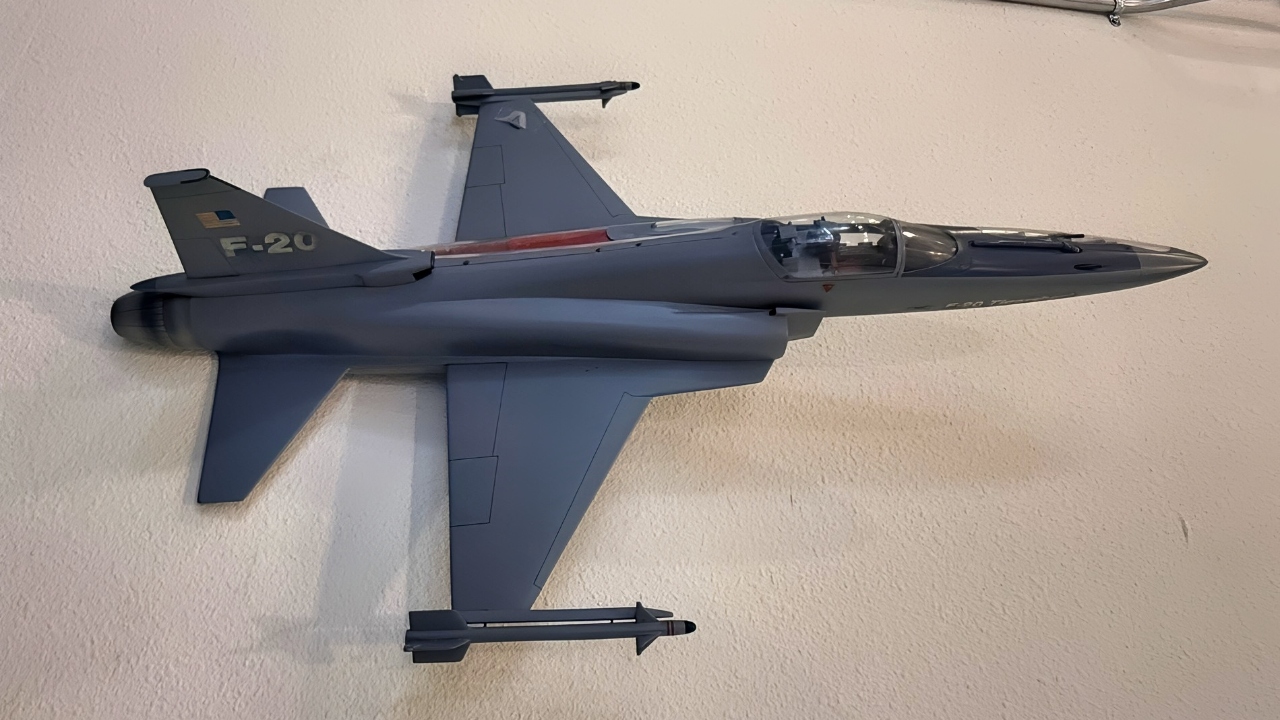
F-20 Tigershark Model at Western Museum of Flight. Image Credit: Harry J. Kazianis/National Security Journal Image Taken on August 16, 2025.
Once the political center of gravity shifted toward standardization and high-end coalition airpower, the F-20 was left without an anchor customer—and without a mission.
Northrop Built a Great Fighter. It Just Didn’t Build the One the System Would Choose.
The Tigershark’s failure was not about performance shortcomings. On paper—and often in practice—it beat the F-16 on reliability, sortie generation, cost, and even certain aspects of combat readiness.
It had blistering acceleration, exceptional climb rates, and modern avionics by the standards of its time. For countries that needed a credible air-defence fighter without the logistics tail of a heavyweight jet, the F-20 was ideal.
But export jets succeed only when Washington is genuinely committed to selling them. The Tigershark ran head-first into the reality that the United States does not merely export aircraft; it exports relationships. The F-16 was the aircraft that deepened those relationships. The F-20 was the aircraft that promised to preserve distance. In a world where the political imperative favored convergence, the choice was inevitable.
The Politics of Procurement Tilted the Field
The F-20 story also exposes a deeper truth about the way American defense acquisition works. Once a service commits to a platform, everything else orbits around it—industrial policy, congressional support, foreign military financing, and allied training pipelines.
The F-16 had all of this from the start. The Tigershark had none of it. Without a U.S. Air Force order, the aircraft lacked the institutional scaffolding that sustains a modern fighter program. Export customers, watching the Air Force decline to adopt the F-20, drew their own conclusions. If the Americans didn’t want it, why should they?
Northrop’s sales campaign kept running on fumes, but it couldn’t escape the gravitational pull of a procurement system that rewards deep political coalitions rather than clean sheet design. In the end, the Tigershark was simply outmatched—not by technology but by the machinery of American defense politics.
Lessons for an Era of Renewed Industrial Competition
The Tigershark’s story reverberates in today’s debates about lightweight fighters, drone-fighter teaming, and whether the United States can—or should—design aircraft primarily for export markets. The logic that doomed the F-20 is still with us.
Washington continues to talk about providing affordable, scalable options to partners, but when the moment of decision arrives, it still prefers platforms that tie allies more tightly into American operational concepts.
In an age of great-power competition and contested industrial supply chains, this instinct is only intensifying. The United States wants coalition airpower to look like U.S. airpower—networked, interoperable, and integrated. And that means the next Tigershark, whatever form it takes, will face the same structural headwinds unless Washington chooses a different path.
The F-20 failed not because it was the wrong fighter for the world, but because it was the right fighter for a world the United States never fully committed to building.
That tension still shapes American strategy today, and the next time Washington claims it wants “affordable capability for partners,” it would do well to remember what happened when a company tried to give it exactly that.
About the Author: Dr. Andrew Latham
Andrew Latham is a non-resident fellow at Defense Priorities and a professor of international relations and political theory at Macalester College in Saint Paul, MN. You can follow him on X: @aakatham. He writes a daily column for the National Security Journal.
More Military
The U.S. Military Is In ‘Crisis’
Canada’s F-35 Stealth Fighter Mistake Is Just Around the Corner
The Mach 2.23 F-4G Wild Weasel Has a Message for the U.S. Air Force