

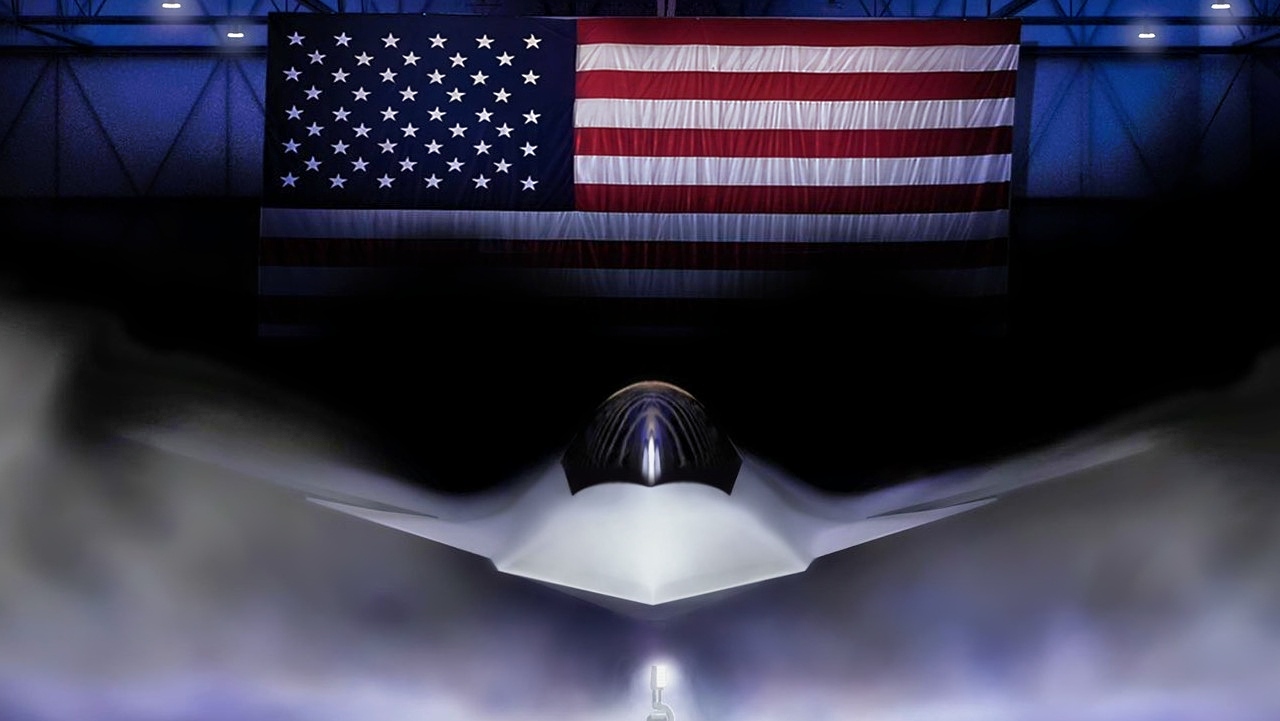
F-47 Key Points and Summary – The US Air Force’s new sixth-generation F-47 NGAD fighter jet will be judged on several key metrics, including its extended range, high speed, and advanced stealth.
-According to an infographic from the Air Force Chief of Staff, the F-47 will have a combat radius exceeding 1,000 nautical miles and a top speed over Mach 2.

NGAD F-47 Fighter. Image Credit: Creative Commons.
-Its “Stealth++” designation suggests a significantly smaller radar cross-section than even the F-22.
-This performance is enabled by new ceramic stealth coatings that are more durable and radar-absorbent. The F-47 will also act as a “drone quarterback” for multiple Collaborative Combat Aircraft (CCAs).
How Will We Judge The F-47 For It to Be Successful or Not?
The Pentagon’s proposed FY 2026 Budget shows that the Department of Defense (DoD) is all in on the new F-47 stealth fighter. And new details of the stealth fighter are now slightly clearer thanks to USAF Chief of Staff, General David Allvin.
Secretary of Defense Pete Hegseth revealed the $3.5 billion amount at a Congressional hearing in June.
However, what are the benchmarks for the new F-47 stealth fighter to be measured against in determining whether the NGAD is successful or not? Here are a few factors that may determine judgment.
The Air Force’s Next Generation Air Dominance (NGAD) sixth-generation fighter, the F-47, will feature a combat radius exceeding 1,000 nautical miles, a speed surpassing Mach 2, advanced stealth capabilities, and a cost potentially around $300 million per aircraft.
Some details of each include:
Range:
The F-47 will have a combat radius of over 1,000 nautical miles (1,150 miles, 1,850 kilometers), significantly further than the F-22’s range, according to an infographic posted Tuesday on X by Air Force Chief of Staff Gen. David Allvin.
Defense One reports that this extended range will allow tankers to stay further from the action, a key advantage in potential conflicts, especially in the Pacific theater.
Speed:
The F-47 is expected to exceed Mach 2 (1,500 mph, 2,400 km/h), indicating high supersonic speeds. The exact speed is classified, but reports suggest it could be Mach 2.25 (approximately 1,726.35 mph) or higher.
President Trump said, “Its speed is top, so ‘over two,’ which is something that you don’t hear very often.”
“It’s something the likes of which nobody has seen before,” Trump said. “In terms of all of the attributes of a fighter jet, there’s never been anything even close to it, from speed to maneuverability, to what it can have as a payload. The F-47 will be the most advanced, most capable, most lethal aircraft ever built.”
That speed is incredible for a stealth aircraft, but how can the F-47 maintain its stealth coatings at such a speed?
New Stealth Coatings:
Stealth coating materials can deteriorate due to both speed and temperature. High speeds, especially supersonic flight, generate significant heat, which can damage or degrade the radar-absorbing materials (RAMs) used in stealth technology. Additionally, the materials are susceptible to damage from abrasion, moisture, and other environmental factors.
Many radar-absorbent polymers used in stealth coatings rapidly decompose at temperatures above 250°C. The deterioration rate necessitates careful design considerations to manage heat and protect the coatings.
Scientists at NC State have been working on creating a tougher skin that also has more desirable stealth characteristics. Researchers believe that the new material will enable the aircraft to fly at higher speeds while maintaining its stealth capabilities.
Chengying “Cheryl” Xu, who leads the program at NC State, said that “the material we’ve engineered is not only more radar absorbent, it will also allow the next generation of stealth aircraft to be faster, more maneuverable and able to travel further.”
Xu and her team have developed a ceramic material with an impressive array of stealth attributes. During lab testing, it was found that the ceramic is more radar-absorbent than existing polymers, capable of absorbing 90% or more of the energy from radar.
The ceramic material is water-resistant and harder than sand. In other words, it can better withstand harsh conditions, such as flying in desert-like environments or the rain. More importantly, the ceramic material retains its radar-absorbent characteristics over a wide temperature range, from as high as 1,800 °C to as low as -100 °C.
The ceramic coating can be applied easily to the entire skin of the aircraft. The whole process, from using a liquid ceramic precursor to completion, takes one to two days, Xu said.
The liquid ceramic precursor is sprayed onto the aircraft’s surface. As the liquid precursor is exposed to ambient air, it undergoes a series of chemical reactions and is converted into the solid ceramic material.
Stealth Capabilities:
While the F-35 was described as a “stealth” aircraft, as were the CCAs, the F-22 was described as a “Stealth +” type. In contrast, the F-47 was described as “Stealth ++,” consistent with service comments that it would have to be substantially stealthier than the F-22 to survive anticipated adversary air defenses.

An F-35A Lightning II, flown by Maj. Kristin “Beo” Wolfe, F-35 A Lightning II Demonstration Team commander, performs aerial displays during the Joint Base Andrews 2022 Air & Space Expo, at JBA, Md., Sept. 18, 2022. Wolfe demonstrated several difficult maneuvers throughout her performance at the Air & Space Expo to provide an opportunity for people to see U.S. military air capabilities in action. (U.S. Air Force photo by Airman 1st Class Ben Cash)
Alex Hollings of Airpower and Sandboxx provides a detailed explanation of the complex calculations involved in radar cross sections and stealth.
“Radar cross sections are notoriously difficult to calculate and vary depending on radar frequency and angle of observation, but speaking in general terms, the F-35’s radar cross section is estimated to be .005 square meters – nearly half the size of the F-117 Nighthawk on radar scopes.
“But the larger and stealthier F-22 Raptor is said to have a frontal radar cross section of an incredible .0001 square meters – an astonishing 50 times smaller than the very stealthy F-35.
“If that difference is encapsulated in the distinction between ‘Stealth’ and ‘Stealth+’ on this graphic, then it suggests the F-47 that is designated as ‘Stealth++’ may be the stealthiest fighter ever designed by a wide margin.”
Cost:
Initial estimates place the cost of an individual F-47 at around $300 million. While this is significantly more than the F-35, it’s projected to be less expensive than the F-22.
The Air Force has requested $2.7 billion for the platform in its fiscal 2025 budget, indicating its commitment to the program, according to DefenseScoop.
The total cost of the F-47 program is expected to be high, with some estimates reaching $55.5 billion, including the initial development costs.
Collaborative Combat Aircraft:
According to the graphic by Gen. Allvin, the Air Force plans to acquire at least 185 F-47s; this could provide it with enough aircraft to replace the Raptor fleet on a one-to-one basis, but that figure can be somewhat misleading.
The F-47 is designed to operate as the quarterback of several drone wingmen, with initial assessments suggesting that each new fighter would be paired with at least two, and possibly as many as five, AI-enabled drone wingmen.
However, more recent tests by Lockheed Martin have shown that the final figure could be significantly higher, demonstrating the ability to control up to eight drones from a single F-35.
That means each of the 185 new F-47s should be thought of as a fighter formation unto itself, rather than as a single jet.
About the Author:
Steve Balestrieri is a National Security Columnist. He served as a US Army Special Forces NCO and Warrant Officer. In addition to writing on defense, he covers the NFL for PatsFans.com and is a member of the Pro Football Writers of America (PFWA). His work was regularly featured in many military publications.
More Fighters
China’s J-20 Stealth Fighter Looks Like a Powerhouse
China’s White Emperor Space Fighter Looks Fake
China’s Aircraft Carriers Have Arrived (Just Not Nuclear Carriers)