
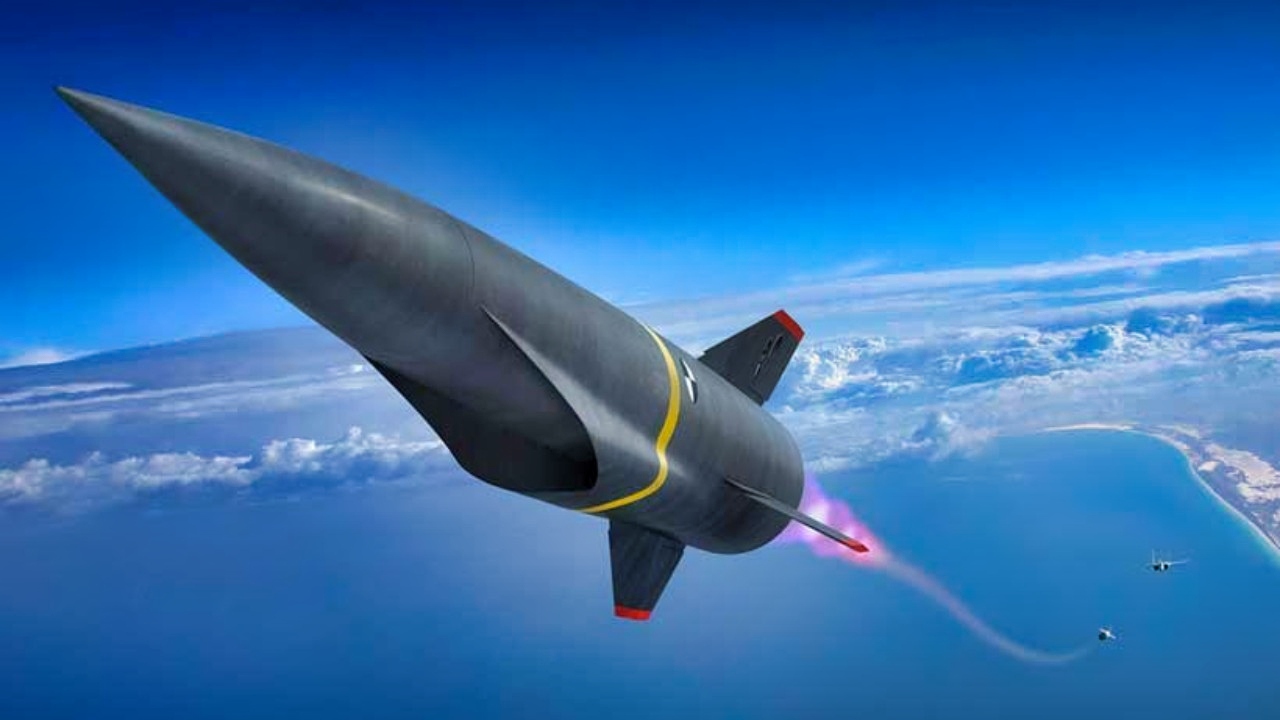
Key Points and Summary – Russia is escalating tensions with NATO by beginning production of its new Oreshnik hypersonic missile, with plans to deploy it to Belarus by the end of the year.
-This move is a direct response to recent U.S. pressure. The Mach 10 weapon is a powerful new system.
-Still, analysts suggest it may be a rebranded version of the RS-26 “Rubezh,” an intermediate-range missile previously shelved under the now-defunct INF Treaty.
-By forward-basing the Oreshnik in Belarus, Russia is reviving a Cold War-style strategy to reduce missile flight times to NATO capitals.
Is Russia Planting “Banned” Missile Tech In Belarus?
Russia has formally begun production of its newest hypersonic missile system, the Oreshnik, and plans to station the weapon in Belarus by the end of the year. The news comes in the wake of U.S. President Donald Trump’s announcement that he ordered two nuclear submarines “to be positioned in the appropriate regions” near Russia. Moscow’s response, while likely already in the works before Trump’s announcement, is likely to heighten tensions with NATO as the alliance faces growing concerns over its air defense infrastructure and overall military readiness.
President Vladimir Putin said on Friday, August 1, that production of its newest missiles is now underway and confirmed plans to deploy them to Belarus later in the year. Speaking during a meeting with Belarusian President Alexander Lukashenko at a monastery in northern Russia, Putin said that the launch sites for the Oreshnik system have been selected by Belarus, with the first batch of missiles having already officially entered Russian military service.
“Preparatory work is ongoing, and most likely we will be done with it before the year’s end,” Putin said.
The Kremlin first tested the missile in November 2024 during a strike on a Ukrainian defense facility in Dnipro. Since then, Russian officials have frequently touted the system’s hypersonic capabilities and revealed that its warheads will travel at speeds up to Mach 10.
The missiles are also said to be capable of evading interception and delivering destructive power that can rival some nuclear weapons – even when armed conventionally.
Russia Reworking Banned Tech?
While exact specifications of the missile remain classified, some analysts have suggested that it appears to be either a modified or rebranded variant of the RS-26 “Rubezh,” an intercontinental missile that was previously shelved amid international scrutiny.
Developed from around 2009, the Rubezh was conceived as a road-mobile solid-fueled intermediate-range ballistic missile (IRBM) armed with a nuclear warhead. The missile had a usable range of up to roughly 5,800 km, with some sources suggesting at the time that the missile conveniently straddled the line between intermediate-range and intercontinental-range missiles.
The missile was shelved amid growing enforcement of the now-defunct Intermediate-Range Nuclear Forces Treaty (INF Treaty). The agreement prohibited Russia and the United States from developing or possessing nuclear or conventional ground-launched ballistic missiles and cruise missiles with ranges of between 500 and 5,500 km. In 2018, the missile was removed from Russia’s national armament plan until at least 2027.
A Return to Cold War-Style Forward Basing?
By embedding Oreshnik in Belarus, Russia appears to be reviving a forward-basing strategy reminiscent of Cold War Soviet deployments.
From Belarus, with its 1,084 km border with Ukraine and shared proximity to NATO’s Suwałki Gap, Russia can rapidly project power into Eastern and Central Europe.
Belarus has already hosted Russian tactical nuclear weapons and military infrastructure, including Iskander systems, as part of bilateral basing agreements and joint exercises.
In the absence of an agreement from NATO not to continue its eastward expansion—a point of contention that predates the war in Ukraine—this new agreement with Belarus might be the best Putin can achieve.
Russia is entrenching its presence in Belarus and establishing a hardened buffer and staging ground, which could reduce missile flight times to NATO capitals and complicate alliance response planning.
The timing of the missile deployment announcement coincides with intensified Russian airstrikes on Ukrainian cities and a renewed summer offensive on the ground.
Taken together, these developments could be seen as a strategy to reinforce Moscow’s negotiating position ahead of the expiration of U.S. President Donald Trump’s peace deal deadline in just four days. But whether or not a deal is truly in the offing, the Kremlin’s latest moves will consolidate territorial and strategic leverage in the short to medium term.
Absent any immediate plans to suddenly return to the negotiating table, however, Putin has long viewed moves like this as necessary to strengthen Russia and its borders against what he sees as an increasingly aggressive or assertive NATO.
About the Author:
Jack Buckby is a British author, counter-extremism researcher, and journalist based in New York. Reporting on the U.K., Europe, and the U.S., he works to analyze and understand left-wing and right-wing radicalization, and reports on Western governments’ approaches to the pressing issues of today. His books and research papers explore these themes and propose pragmatic solutions to our increasingly polarized society. His latest book is The Truth Teller: RFK Jr. and the Case for a Post-Partisan Presidency.
More Military
Su-57 vs. J-20 Fighter: Who Wins?