

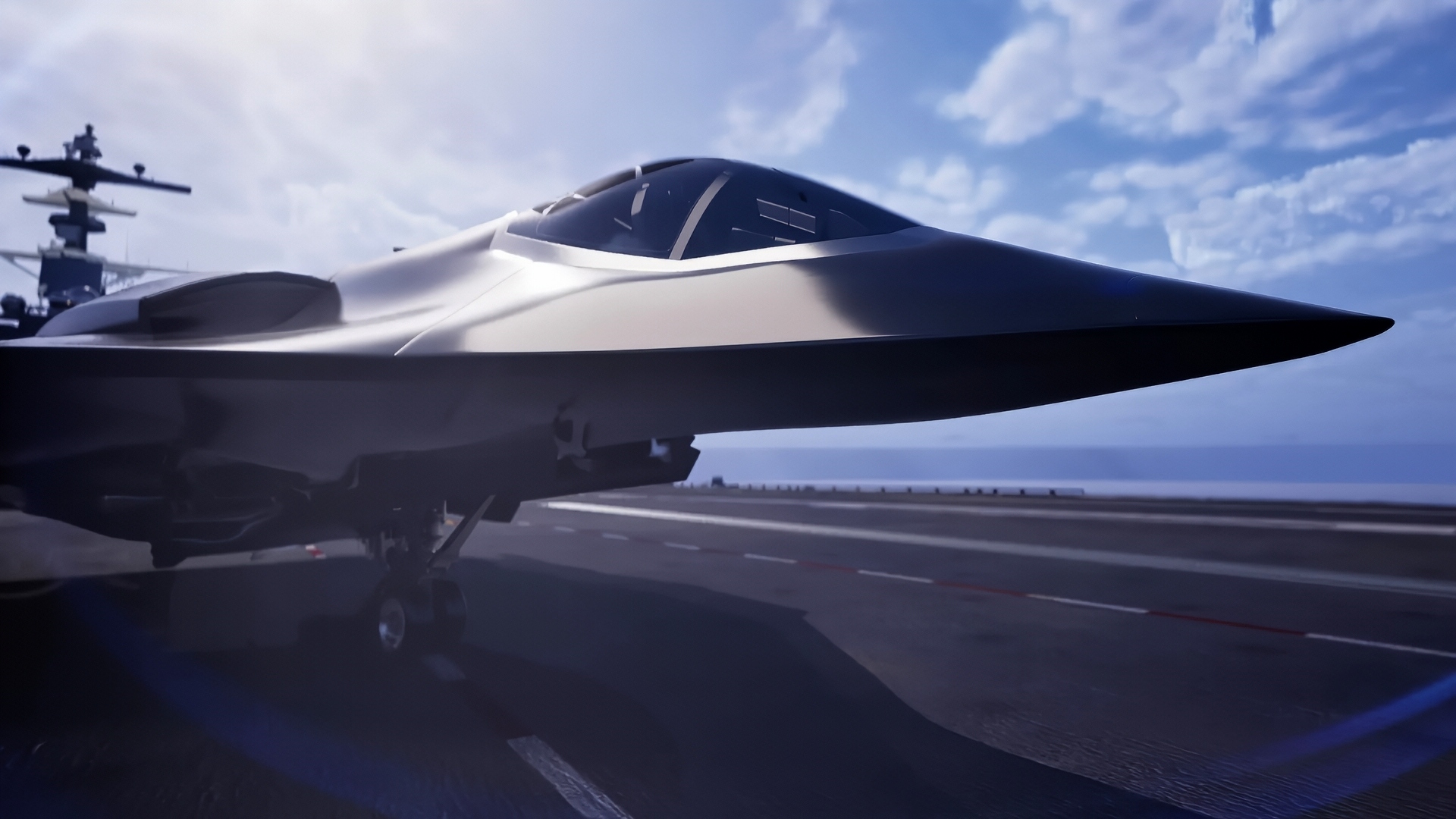
Key Points and Summary: Northrop Grumman’s new concept art for the Navy’s F/A-XX landed with a message: the program isn’t dead yet.
-The design’s clear echo of the YF-23 “Black Widow” signals maturity and continuity, not nostalgia—convergent engineering toward range, stealth, and survivability at sea.
-Unlike past winner-take-all fights, F/A-XX isn’t directly competing with the Air Force’s sixth-gen jet, but parallel programs strain budgets and the defense industrial base.
-The art is a bid to steady skittish lawmakers and show the Navy has a credible path if Congress protects funding. Whether F/A-XX becomes a footnote or a fleet cornerstone now hinges on Capitol Hill.
YF-23 Black Widow II: A Blueprint for the F/A-XX
Earlier in the month, Northrop Grumman released concept art of its candidate for the Navy’s F/A-XX sixth-generation fighter.
The introduction of the new art was surprising for two reasons. First, the F/A-XX is hanging on to life by a thread, with the administration evidently gunning for the program.
Second, the F/A-XX looked very much like the YF-23 “Black Widow,” the stealth fighter project that lost to what became the F-22 Raptor. What does this mean for the future of the Navy’s preferred fighter project?
Remembering the YF-23 Black Widow II
Nearly three decades ago, the Lockheed Martin F-22 Raptor beat out the Northrop Grumman YF-23 Black Widow in the competition for the US Air Force’s first stealth fighter (the F-117, despite its designation, is an attack aircraft). As with many competitions of this sort, recriminations over the decision continued long after the production run of the Raptor ended.
The F-22, being a real aircraft in the real world, suffered from teething problems, cost overruns, crashes, and all of the other issues that afflict real airplanes. The Black Widow suffered from none of these problems, and thus led a fruitful career as an imaginary alternative to the Raptor.
The YF-23 bears a superficial resemblance to the latest artistic depiction of the F/A-XX, not completely surprising given that the two aircraft share a designer and most mission requirements. There’s undoubtedly a touch of irony in two designs of such similar appearance facing what may be an identical fate. But convergent engineering is nothing new to aviation science.
Most famously, the YB-35 and YB-49 “flying wing” designs preceded the B-2 Spirit (and all of the follow-on stealthy flying wings) by half a century without sharing any direct lineage. That system worked because the design aspects that the early flying wings enjoyed (reduced drag, which incidentally reduced radar cross section) became relevant in a new technological environment. In contrast, the drawbacks of the design aspects (low speed) lost importance. The technology of stealth hasn’t changed so dramatically over the past three decades that the legacy of the YF-23 would be useful to the designers of the F/A-XX.
The situation facing the F/A-XX is rather different from the Raptor/Black Widow competition, and the differences may shed light on why Northrop Grumman decided to release the art. The F/A-XX is not in direct competition with the F-47, the Air Force’s sixth-generation fighter.
Instead, the Air Force and the Navy were each expected to build a fighter, in part to avoid the problems that beset the “one size fits all” F-35 program.
F/A-XX: What Happens Now?
The US could pursue both programs, although this could strain the defense industrial base (DIB) and take resources away from other projects. In this context, it makes sense for Northrop Grumman to portray the platform in a way that highlights its maturity.
Suggesting that the design team is borrowing from the experience with the YF-23 (in the same way that the B-21 Raider evidently borrowed from the B-2 Spirit) is a way of conveying that Northrop Grumman understands the nature of the path and is prepared to build a new jet.
Establishing this narrative could pay off in a Congress that is already wary of the administration’s intentions.
The story of the F/A-XX has yet to be fully written. While the Trump administration seems hostile to the aircraft (or at least to its expense), Congress may yet save the funding line. The Navy has a long history of relying upon Congress to prevent executive branch cuts, and has quietly mobilized around an effort to save the new jet.
It remains to be seen whether the F/A-XX will become a failed fighter project and a footnote in the history of American airpower or (like the YF-17 before it) an essential component of America’s enduring airpower advantage.
About the Author: Dr. Robert Farley, University of Kentucky
Dr. Robert Farley has taught security and diplomacy courses at the Patterson School since 2005. He received his BS from the University of Oregon in 1997, and his Ph. D. from the University of Washington in 2004. Dr. Farley is the author of Grounded: The Case for Abolishing the United States Air Force (University Press of Kentucky, 2014), the Battleship Book (Wildside, 2016), Patents for Power: Intellectual Property Law and the Diffusion of Military Technology (University of Chicago, 2020), and most recently Waging War with Gold: National Security and the Finance Domain Across the Ages (Lynne Rienner, 2023). He has contributed extensively to a number of journals and magazines, including the National Interest, the Diplomat: APAC, World Politics Review, and the American Prospect. Dr. Farley is also a founder and senior editor of Lawyers, Guns and Money. You can find him on X: @DrFarls.
Hypersonic Weapons In-Depth
Russia’s Hypersonic Missiles Summed Up in 4 Words




Bernard
August 20, 2025 at 7:54 am
The statement that the current administration is hostile to the FA-XX is proven nowhere. Cost seems to be the driver. Get one sixth generation in the air, then move to the next is just as likely. Money doesn’t grow on trees and with the current debt, printing more is not likely. Being retired Navy, I want them to get a new fleet defense fighter to replace the F-14. Right now the Navy needs to get it’s ship building on track. Not oh we’ll buy three, but a true 50 year build and replace plan that maintains a skilled workforce. My two cents.