

Key Points and Summary: Iran has significantly advanced its cruise missile program, developing a diverse arsenal that poses a substantial threat to regional and international maritime and land targets.
-A key system is the Abu Mahdi anti-ship and land-attack missile, with a range exceeding 1,000 km and AI-powered guidance.

Iran’s missile capabilities. Image Credit: Creative Commons.
-In early 2025, Iran also announced a new supersonic cruise missile with a reported range of 2,000 km, placing it in an elite group of nations with such technology.
-While these systems enhance Iran’s asymmetric warfare capabilities, particularly in the Persian Gulf, their ultimate effectiveness is challenged by advanced Western missile defense systems.
Iran’s Cruise Missile Threat in 4 Words: A ‘Problem’ Worth Fearing?
Iran currently maintains a large stock of both ballistic and cruise missiles. While its cruise missiles are slow and easier to detect and intercept, they still pose a substantial threat to both American and Israeli assets in the region.
Iran possesses mostly subsonic cruise missiles but has recently been able to domestically produce its first supersonic cruise missile in recent years. This signals not only the country’s growing technological prowess, but also the growing threat that Iran presents to the rest of the region.
Iran’s Advancing Cruise Missile Program
At the heart of Iran’s missile strategy is the desire to deter aggression and project power across the Middle East. Cruise missiles, with their ability to fly at low altitudes, evade radar detection, and strike with high accuracy, are ideal tools for this purpose. Iran’s military leadership, particularly the Islamic Revolutionary Guard Corps (IRGC), has prioritized the development of these systems, often through reverse engineering and domestic innovation. The result is a diverse and increasingly sophisticated missile inventory that includes both anti-ship and land-attack variants.
One of the most significant milestones in Iran’s cruise missile program is the development of the Abu Mahdi missile. First unveiled in 2020 and operationally deployed by 2025, the Abu Mahdi was developed to enhance Iran’s anti-ship capabilities. With a range exceeding 1,000 kilometers, it far surpasses earlier systems like the Raad and Qadir, which had ranges of 350 and 300 kilometers respectively.
The Abu Mahdi is equipped with advanced guidance systems, including artificial intelligence-powered navigation and dual-mode seekers that combine active and passive radar homing. These features enhance the missile’s precision and survivability in contested environments. Moreover, the missile’s deployment on mobile launchers allows for rapid repositioning and surprise attacks, making it a versatile asset in Iran’s strategic toolkit.
The Abu Mahdi is designed for both anti-ship and land-attack missions, capable of engaging heavily defended targets such as aircraft carriers and coastal infrastructure. Its long range enables Iran to threaten naval forces operating far from its shores, particularly in the Strait of Hormuz and the northern Indian Ocean.
This capability significantly complicates the operational planning of adversarial navies, especially those of the United States and its allies.

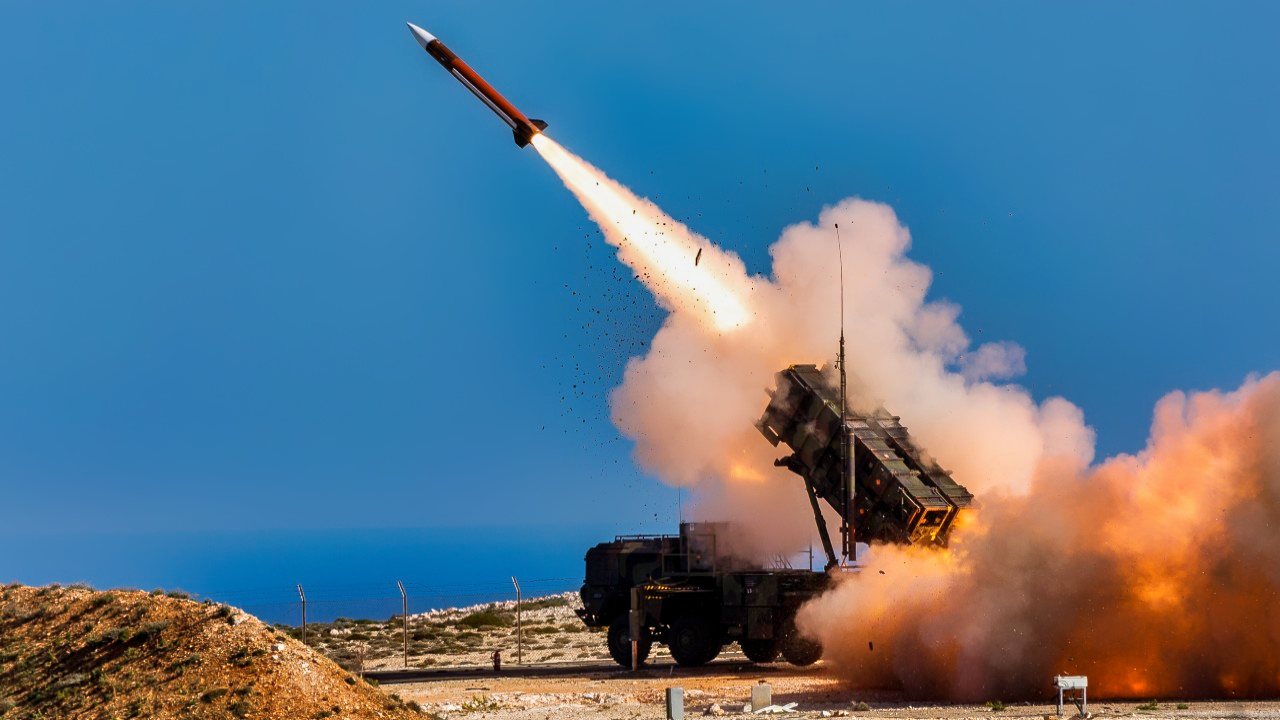
Patriot Missile. Image Credit: Creative Commons.
The IRGC’s Super Sonic Cruise Missile
In early 2025, Iran announced the development of a new supersonic cruise missile, marking another major advancement in its missile technology. Although the missile’s name has not been publicly disclosed, it is reported to have a range of approximately 2,000 kilometers and to travel at speeds exceeding Mach 2. This combination of speed and range allows Iran to strike deep into enemy territory from within its own borders, enhancing its strategic reach and deterrence posture.
Like the Abu Mahdi, this missile is expected to incorporate artificial intelligence for improved targeting and navigation, as well as features designed to resist electronic countermeasures.
The introduction of a supersonic cruise missile places Iran among a select group of countries with such capabilities, including Russia, China, and the United States. It also signals Iran’s intent to continue pushing the boundaries of indigenous missile development, despite international sanctions and economic constraints.
The implications of this development are profound, as it enables Iran to target critical infrastructure and military bases across the Middle East, including in Israel, Saudi Arabia, and U.S. installations.
Is Iran’s Cruise Missile Program Worth Fearing?
In addition to these flagship systems, Iran maintains a range of other cruise missiles that serve various tactical and strategic roles. The Qadir missile, based on the Chinese C-802, is a subsonic anti-ship missile with a range of 300 kilometers.
The Raad is an upgraded version of the Qadir with improved range and guidance. The Nasr missile, with a range of 35 kilometers, is designed for coastal defense and deployment on fast-attack craft. Iran has also been developing the Meshkat, a land-attack cruise missile with a projected range of 2,000 kilometers, although its operational status remains unclear.
These systems provide Iran with a layered and flexible missile force capable of engaging targets at different ranges and from various platforms. Iran has invested heavily in the infrastructure needed to support this force, including mobile launchers, underground missile bases, and naval platforms.
The use of mobile launchers enhances the survivability and responsiveness of Iran’s missile units, while underground facilities (often referred to as “missile cities”) protect missile assets from preemptive strikes and enable surprise launches. Iran’s naval forces have also integrated cruise missiles into a variety of platforms, including fast attack craft, corvettes, and potentially submarines, increasing the complexity of the maritime threat they pose.
MORE: Iran War Proves America Needs New Stealth Bombers
MORE: Iran War Proves F-35 Fighter Is No Mistake
With all that being said, Iran’s cruise missile program is not without its challenges. Despite notable improvements, Iranian missiles may still lag behind Western systems in terms of accuracy and reliability.
Iran’s enemies also possess advanced missile defense systems, such as Israel’s Iron Dome and the U.S. Aegis system, which are designed to intercept and neutralize cruise missile threats. Furthermore, economic constraints and international sanctions may limit Iran’s ability to mass-produce and deploy these systems at scale.
About the Author:
Isaac Seitz, a Defense Columnist, graduated from Patrick Henry College’s Strategic Intelligence and National Security program. He has also studied Russian at Middlebury Language Schools and has worked as an intelligence Analyst in the private sector.
Hypersonic Weapons In Depth
Russia’s Hypersonic Missiles Summed Up in 4 Words




Pingback: Iran Has 200 Knot 'Supercavitating' Torpedoes the US Navy Can't Match - National Security Journal
Pingback: China's J-10C Fighter Could Soon Fly for Iran - National Security Journal