


Four years ago, Admiral Philip Davidson, then commander of Indo-Pacific Command, warned that China was preparing to wage war over Taiwan by 2027. Four years later, world events make this prediction seem more prophetic than ever – but American statecraft seems not to have read the writing on the wall.
Today, America faces threats on multiple fronts – threats at least in part attributable to our own foreign policy failures.
In Europe, Russia’s invasion of Ukraine marks the largest war of aggression on the continent since World War Two. Yet this was an avoidable war – or at least, it would have been, if the U.S. hadn’t passed up opportunities to posture military forces, issued confusing diplomatic messages (like President Biden’s “minor incursion” remark), or demonstrated a persistent reluctance to arm Ukraine.

An M1A2 SEP v2 Abrams assigned to Bravo Company, 4th Battalion, 70th Armored Regiment, 1st Armored Brigade Combat Team, 1st Armored Division, fires at a target during a zero range at Rodriguez Live-Fire Complex, South Korea, Aug. 5, 2024. The unit is participating in a deployment readiness exercise in support of Operation Pacific Fortitude, which supports long-standing agreements to the Republic of Korea by deploying forces, drawing and transporting equipment to validate unit readiness and the U.S. commitment to the alliance. (U.S. Army photo by Cpl. David Poleski)
Together, these failures signaled a green light for invasion and enabled a predictable years-long war of attrition.
This opened the door for further conflicts in other arenas.
While the U.S. and Western allies provided munitions and weapons to Ukraine at an unsustainable rate, attention and resources shifted away from Middle Eastern affairs – leading Iranian leaders to sense an opening. This opening was made possible by the Biden administration’s sanctions relief in pursuit of an elusive Iranian nuclear deal, freeing more than $16 billion in Iranian assets.
Combined with a lack of response to attacks by Iranian proxies (of 83 attacks between January 2021 and March 2023, the U.S. responded to just four), the opportunity for Iran to attack could not have been clearer.
Iran seized the moment with both hands, supporting its proxy Hamas in its barbaric assault on Israel. Later, this attack expanded, with other Iranian proxies in Iraq, Syria, Hezbollah, and the Houthis all joining in.
This led to attacks in the Red Sea, which in turn further depleted critical stores of American munitions (which had already been drained by the conflict in Ukraine).
Meanwhile, China hasn’t exactly been sitting still. It tested a fractional orbital bombardment system, quadrupling its ICBM forces (from 100 to 400 missiles), and rapidly expanding its modern navy (which currently has over 370 warships, far surpassing our 295 warships).
All this has fueled increased Chinese confidence and military aggressiveness. Now, violent and dangerous confrontations – like one last summer in which several Filipino sailors were injured – have become the norm rather than the exception.
In all these instances, American failures have played a role – but so have those of our allies. The Ukraine war illustrates that allies unable to defend themselves pose a liability to our collective defense.

NLAW Missile. Image Credit: Creative Commons.
This is a lesson that all should heed. For our part, America should strengthen our defenses to better secure our economy. And our allies should work with us to bolster our long-neglected common defense.
Taiwan is the perfect place to apply this lesson. There, over $20 billion worth of arms sales have languished for years. This backlog results in part from diversion of munitions (like stingers and javelins) to Ukraine. But more fundamentally, it stems from a lackluster and inadequate defense industry.
This became abundantly clear in Ukraine, where our domestic artillery munition production (14,000 a month in 2022) failed to keep pace with battlefield expenditure (Ukraine alone expends upwards of 10,000 a day).
Thankfully, Taiwan is stepping up its efforts with increased defense spending. Over 2% of GDP has been spent annually since 2022, and the island’s new president is moving to increase spending still further.
Yet if we cannot secure our own supply chains, or if we lack the ability to sustain a wartime economy, we’ll remain vulnerable to coercion by China (which effectively controls the terms of trade via its network of ports and maritime dominance).
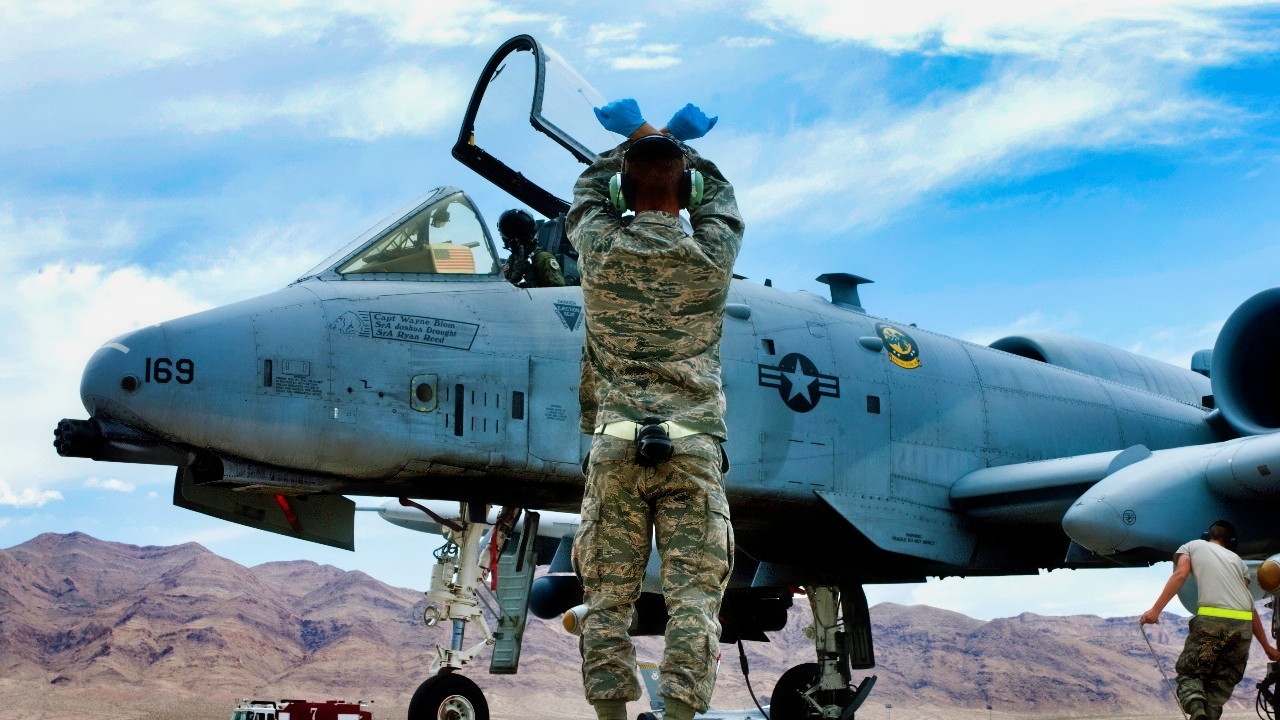
Airman Brandon Kempf, 757th Aircraft Maintenance Squadron assistant dedicated A-10 Thunderbolt II crew chief, watches as an aircraft taxis into position after landing May 9, 2013 at Nellis Air Force Base, Nev. Upon landing, the A-10 Thunderbolt receives numerous post-flight checks and maintenance including strut servicing and ammunition downloads. (U.S. Air Force photo by Airman 1st Class Joshua Kleinholz)
To be a good ally, the U.S. must strengthen its defenses and restore a vibrant maritime industry. After all, the past four years make it clear: we can only sustain peace if we strengthen our defenses.
About the Author: Brent Sadler
Brent Sadler is a Senior Research Fellow for Naval Warfare and Advanced Technology at The Heritage Foundation’s Allison Center for National Security.