


Key Point and Summary – Sonic booms are back on the political radar along California’s coast as frequent SpaceX launches from Vandenberg Space Force Base rattle homes, beaches, and wildlife.
-The California Coastal Commission wants the Space Force to better monitor and mitigate impacts, but military officials have pushed back, sharpening tensions between state and federal authorities.

SR-71 Blackbird. Image Credit: Creative Commons.
-At the same time, the Air Force is touting new research into rocket ascent sonic booms, arguing it will help manage community and environmental effects. The controversy echoes earlier disputes over fighter-jet noise and shows how the new space race is colliding with local life on the ground.
Are SpaceX and the Space Force Ignoring California’s Sonic Boom Backlash?
Some military weapons, including fighter jets, travel at fast speeds, which sometimes creates sonic booms. And because those weapons sometimes need to have tests, those sonic booms can bother the civilians who live below, while also having a possible effect on wildlife and the environment.
That happened in August of last year, along the California coast, with SpaceX rockets, whose booms were beginning to bother
Per the Los Angeles Times, military officials were “rejecting demands from a state agency to better monitor and mitigate the effects of rocket launches and sonic booms from Vandenberg Space Force Base.” This, the report said, has begun to bother local officials, while exacerbating tensions between the California Coastal Commission and the U.S. Space Force.
Part of the issue is the frequent sonic booms, which due to new technologies related to trajectories, have made inland booms more common.
“As part of those talks, the state commission asked Space Force to track and document more closely how the blasts affect wildlife and to consider ways to reduce the harm from sonic booms,” the newspaper reported in August of 2024.
SR-71. Image Credit: Creative Commons.
That summer, Space Force had admitted that “rocket launches at the base were regularly rattling residents and wildlife along roughly 100 miles of coast across Santa Barbara, Ventura and Los Angeles counties.”
“I’m beyond pissed,” Coastal California Commissioner Susan Lowenberg said, per the newspaper. “I don’t understand why our own government is thumbing their nose at another branch of our government.”
There was another pair of such sonic booms, also in Southern California, back in May, when the SpaceX Dragon spacecraft returned to the atmosphere. The sonic booms were caught on video.
“The boom was particularly noticeable to residents living near Vandenberg Space Force Base in Santa Barbara County,” the Times of India reported. “This area has become accustomed to such sonic events due to the increasing frequency of SpaceX operations.”
Last week, SpaceX was scheduled to launch another rocket from Vandenberg, its second such launch of the month. As part of the government shutdown that has since ended, the government announced a curfew that limited the hours under which space launches could take place.
A Sonic Boom Study
In June, the Air Force touted what it described as Vandenberg Space Force Base’s pioneering research on ascent sonic booms. In addition to the Space Force itself, the research is being done by Brigham Young University, California State University-Bakersfield, the Federal Aviation Administration, SpaceX, and NASA.
“While previous research on acoustic shock waves is substantial, it focused primarily on aircraft. Rocket launches create more complex sonic boom patterns than aircraft due to their unique flight path, rapid acceleration, and extreme altitude changes,” the Air Force says.

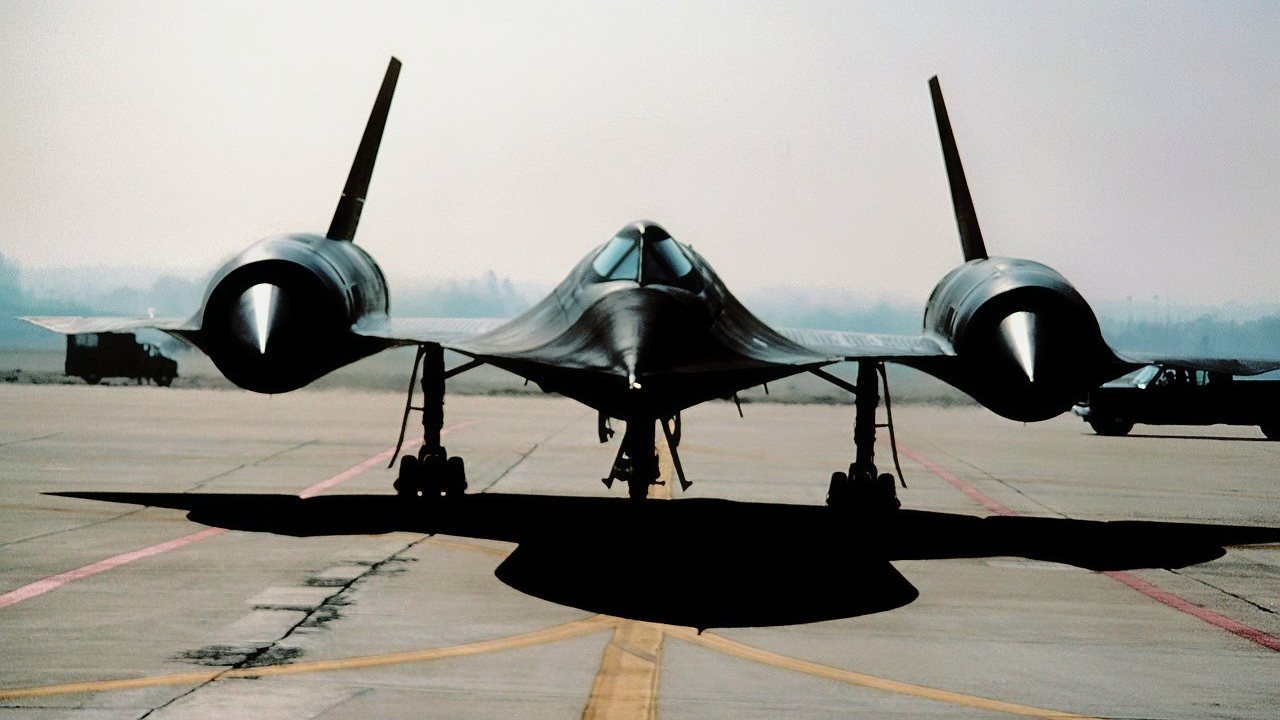
SR-71 Blackbird Rear Image. Credit: Taken on September 26, 2025 by National Security Journal.
The sonic boom research has so far studied 11 launches, with much more to come.
“Community and environmental considerations at Vandenberg remain consistent regardless of who is providing launch services from a U.S. Space Force installation,” U.S. Space Force Col. Mark Shoemaker, Space Launch Delta 30 commander and Vandenberg’s host installation commander, said in the Air Force’s announcement.
“As stewards of this base, we are working with our regulatory partners to evaluate processes to ensure consistency across the Vandenberg spaceport and test range and we are committed to doing so efficiently and with speed.”
Older Sonic Boom Disputes
Sonic booms bothering people below, especially within the continental U.S., is a problem almost as old as sonic booms themselves. One government report, going all the way back to 1965, looked at how such booms were received in Oklahoma.
Aviation Geek Club, this week, looked at the same phenomenon, even quoting one pilot who was flying the jet that caused it.
AGC quoted Jeff Loftin, a former US Air Force (USAF) F-15 Eagle pilot, on Quora, when asked if pilots are ever punished for causing sonic booms in areas where civilians might hear them. In his case, he was flying the F-15 over Texas, although he wasn’t clear exactly when it happened.
“‘Yes, but normally the punishment was light. I was the airspace manager at Holloman AFB in New Mexico when I flew the F-15,” Loftin wrote on the site. “As the airspace manager, I answered all complaints – about low flights above ranches (according to one complaint, low flights can cause cows to stop producing milk and caused one complainer to lose the use of his left arm), about contrails (ruined a Sante Fe painter’s sky), and about sonic booms.”
He shared one of the complaints he received.
“I got one sonic boom complaint that took up most of a week of my time. A man complained to us, and sent a copy of his complaint to one of the New Mexico senators,” he said. “He had the exact time when two sonic booms happened in rapid succession above his house. He said the booms were definitely caused by a plane below 30,000ft and asked how we could ask for more supersonic airspace when we were so undisciplined about our flying.”
Dealing with the complaint, he wrote, entailed talking to lots of agencies- “ the FAA, the seven squadron schedulers, the US Navy (a couple A-6s did a run on a low-level route near the farm), and finally the Strategic Air Command airspace liaison at the Pentagon.”
But it later turned out that his pilots didn’t actually break any rules.
“An Air Traffic Control guy I was working with asked me one day if the sonic boom could have been from a high-altitude flight,” the ex-pilot wrote on Quora.
“We’d been looking at low altitude tracks because of the complainer’s insistence it was a low altitude flight. When the FAA looked at their high-altitude tracks, they found one where an SR-71 did a turn over the guy’s house at the exact time he recorded the booms (the turn was actually over three states before it was completed because of the speed). When I tracked down the flight through the SAC liaison, he wouldn’t tell me the exact altitude of the SR-71, but he said it was well above 60,000 feet.”
About the Author: Stephen Silver
Stephen Silver is an award-winning journalist, essayist, and film critic, and contributor to the Philadelphia Inquirer, the Jewish Telegraphic Agency, Broad Street Review, and Splice Today. The co-founder of the Philadelphia Film Critics Circle, Stephen lives in suburban Philadelphia with his wife and two sons. For over a decade, Stephen has authored thousands of articles that focus on politics, national security, technology, and the economy. Follow him on X (formerly Twitter) at @StephenSilver, and subscribe to his Substack newsletter.
More Military
Could America Have Lost the Revolutionary War?
The Marines Don’t Have Tanks Anymore
The Essex-Class Aircraft Carriers Have An Embarrassing Message for the U.S. Navy
‘New’ Mach 4 MiG-41 6th Generation Stealth Fighter Has Warning for U.S. Air Force
Boeing’s F-47 NGAD 6th Generation Stealth Fighter Is No ‘Mission Impossible’