


Key Points and Summary – China’s CATOBAR carrier Fujian just flew the stealthy J-35B, sharpening questions about the U.S. Navy’s reliance on a 1970s-era F/A-18 lineage. Why didn’t the Navy field a stealthy successor—or navalize the F-22 to become the F-22N Sea Raptor?
-Because carrier aviation must be baked in from day one.

U.S. Air Force Maj. Josh Gunderson, F-22 Demo Team commander, enters into the Raptor Slide during the Millville Airshow, Sept. 3, 2021, at Millville Army Airfield, Millville, New Jersey. During the Raptor Slide the aircraft actually slides down and backwards under control before Gunderson adjusts the aircrafts position and powers out of the maneuver. (U.S. Air Force photo by Staff Sgt. Don Hudson)

Aircraft from the 1st Fighter Wing conducted an Elephant Walk at Langley Air Force Base, Jan. 31, 2025, showcasing the wing’s readiness and operational agility. This demonstration highlighted the wing’s capability to mobilize forces rapidly in high-stress scenarios. The wing’s fleet includes F-22 Raptors and T-38 Talons. As Air Combat Command’s lead wing, the 1 FW maintains unparalleled combat readiness to ensure national defense at a moment’s notice. (U.S. Air Force photo by SrA Ian Sullens)
-Arrested landings and catapult launches demand reinforced structures, beefed-up landing gear and nose struts, a different wingbox, robust tailhook integration, and deck-handling compromises—all while preserving low radar cross-section coatings in a harsh marine environment.
The F-22N Raptor Was Never Going to Happen: Here’s Why
WARSAW, POLAND – A mystery to the casual observer is why the US Navy’s main carrier fighter is a 1970s design, called the F/A-18. The question remains: why did the US Navy never develop or purchase a stealthy fighter to replace the F/A-18?
This has put the service in an increasingly vulnerable situation that is only becoming worse. The US Navy’s chief competitor on the high seas is China’s People’s Liberation Army Navy (PLAN), which just completed a set of trial flight operations with its third aircraft carrier, the CV-18 Fujian.
The CV-18 was also the PLAN’s first “flattop” carrier, equipped with a catapult. The previous two carriers were fitted with a ski ramp-style flight deck that relied on the angle of the deck to enable any aircraft to rotate up.
But more significantly, the flight operations of the Fujian revealed the ability of the PRC’s newest stealthy carrier-capable fighter aircraft, the Shenyang J-35B.
The aircraft is a derivative of the land-based J-35A, which is promoted as offering a level of stealth comparable to that of the US F-35 in terms of its radar cross-section (RCS).
Both aircraft were developed in parallel by Shenyang and the PLA, utilizing a standard structural configuration with modifications made to the forward fuselage and the nose gear.
This is to strengthen the aircraft against the stress of Fujian’s catapult launch and arrested landing.
F-22N Sea Raptor: Why The F-22 Never Ended Up On a Carrier
Only 11 years ago, the pre-production prototype for what became the J-35, the FC-31, flew at Air Show China in Zhuhai. The performance was underwhelming, with the aircraft powered by two variants of the same Klimov RD-33 engine, which was designed in the Soviet Union for the Mikoyan MiG-29.
Now, slightly more than a decade later, the PLAN has a completely redesigned carrier fighter with new, higher thrust Chinese-designed engines.
It is also reportedly equipped with a very low radar cross-section. It is a remarkable turnaround from the 2014 prototype, which was underpowered and often difficult for the pilot to keep the nose up.

F-22A Raptor in the Air Force Museum. Image Credit: National Security Journal Original Photo.
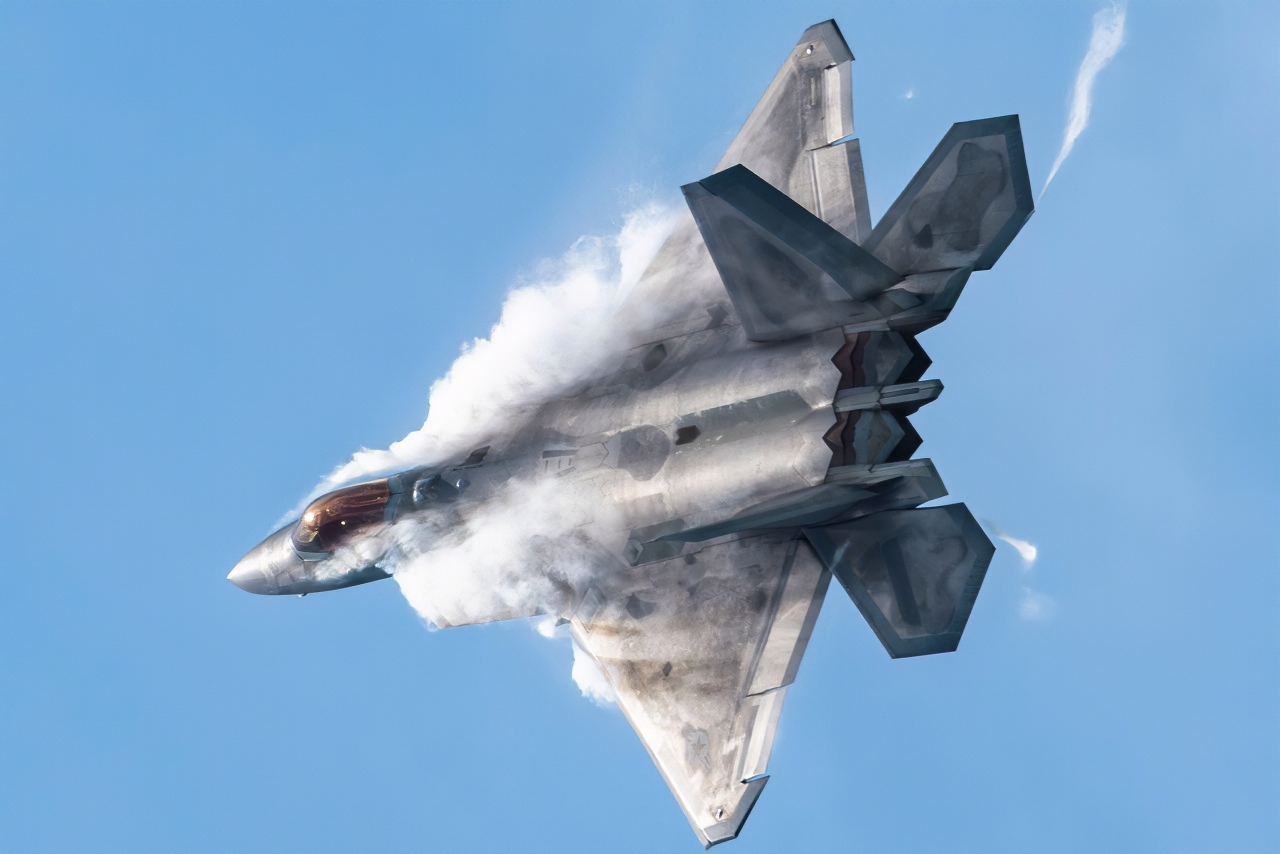
U.S. Air Force Capt. Nick “Laz” Le Tourneau, F-22 Raptor Aerial Demonstration Team commander, performs an aerial maneuver during the Cocoa Beach air show in Florida, July 12, 2025. The F-22 Aerial Demonstration Team highlights cutting-edge airpower, precision, skill, all while reinforcing public confidence in the Air Force’s ability to protect and defend. (U.S. Air Force photo by Staff Sgt. Lauren Cobin)
This raises the question for many as to why the F-22, which flew in prototype form 35 years ago, was never developed into a carrier variant, unlike the J-35B, which was created in one-third the time.
A carrier fighter that could offer an F-22 level of low radar cross section (RCS) and operate off the carrier deck would be the edge the US naval aviation needs against the PLAN.
The reason is that if an aircraft is going to be flown from both land-based airbases and the carrier, then it must be designed from the very beginning of the developmental process.
There are numerous decisions and techniques that must be incorporated into the initial configuration.
F-22N: The NATF That Never Was
The aspects of the design that have to be integrated into the aircraft structure that permit it to operate from the carrier are not “features” that can be retrofitted in after the aircraft is already in production or just bolted on.
In the early days of the F-22, there was an overall plan to develop a second variant of the aircraft, but that idea was never realized. There were two basic reasons for this.
One was that by the time the Navy considered the possibility of a navalized F-22, it was far too late.
The first change the carrier aviation community wanted made was to add hard points for weapons. However, the F-22 was designed to carry all its weaponry in an internal bay.
Externally carried weapons would be radar reflectors, and you would not be stealthy, which was the key requirement for the US Air Force (USAF), but the Navy had other priorities.
Additionally, the F-22’s internal structure would not accommodate the addition of external hardpoints, and there was no way to add them without being tied to the internal wing structure.
Lots of Work Needed and What the Experts Told Us
Additionally, since the F-22 was never designed to operate from a carrier, its airframe, landing gear, and wingbox were not capable of surviving a landing on a carrier, and the nose gear could never endure the shock of a catapult launch.
A carrier landing is also, as more than one aircraft designer has said to National Security Journal, “more like a controlled crash rather than just landing hard on a conventional runway.”
A carrier is also about 1000 feet long, but the standard USAF runway is nearly 10 times that distance.
This is where the tail hook comes in. It has to stop the aircraft in a very short distance, with the arrested landing putting a tremendous shock on the aircraft’s tail section and rear fuselage structure.
Another major obstacle is maintaining the integrity of the low RCS external coatings and surface materials. This is almost impossible in the marine environment, given the rigors of maintenance at sea.
Finally, stealthy or not, carrier and land-based airplanes are simply two very different breeds of a similar animal.
If an aircraft is going to perform both missions, it must be designed from the rivets up accordingly, as seen in the Dassault Rafale and Rafale M models.
Sea Raptor Was Never Going to Happen
If the F-22N was ever going to launch and then later trap back aboard the carrier, that was a decision that had to be made when it was still being developed on a CAD/CAM screen – years before anyone even started thinking about bending metal into an airframe.
About the Author: Reuben F. Johson
Reuben F. Johnson has thirty-six years of experience analyzing and reporting on foreign weapons systems, defense technologies, and international arms export policy. Johnson is the Director of Research at the Casimir Pulaski Foundation. He is also a survivor of the Russian invasion of Ukraine in February 2022. He worked for years in the American defense industry as a foreign technology analyst and later as a consultant for the U.S. Department of Defense, the Departments of the Navy and Air Force, and the governments of the United Kingdom and Australia. In 2022-2023, he won two awards in a row for his defense reporting. He holds a bachelor’s degree from DePauw University and a master’s degree from Miami University in Ohio, specializing in Soviet and Russian studies. He lives in Warsaw.
More Military
Canada Is ‘Full Steam Ahead’ on F-35 Stealth Fighter
Why Does Turkey Have So Many Main Battle Tanks?
‘Cracked Barrels’: The U.S. Navy’s Big Railgun Failure Explained in Just 2 Sad Words
‘Had No Chance’: The Montana-Class Was the 71,000-Ton Battleship Destined to Fail
‘Captain, We Smacked It Another Submarine’: British and French Nuclear Missile Subs Collided




John Roberts
October 13, 2025 at 12:20 pm
Sorry, I worked on the YF-22, and most of this story is way off the mark. A proposal was submitted for the Navy version of the F-22, at the same time as the F-22 proposal to the Air Force, not after. Many changes were needed to make it carrier capable, but the design submitted was up to the task. The unofficial 15th rule of Kelly Johnson stated he would “starve before doing business with the dammed Navy,” because he knew the Navy was indecisive and difficult to work with. And Kelly was right, the Navy just could not commit to the NATF Sea Raptor, including the swing wing variant. And today, the Navy is still procrastinating, building Ford-class aircraft carriers around 6th Gen aircraft, but they only have 4th and 5th gen in their inventory. And they F/A-XX is still on the drawing board, while the Air Force has fully committed to the F-47, howbeit from the most risky company, Boeing, who last built a fighter in 1938, the Peashooter.