

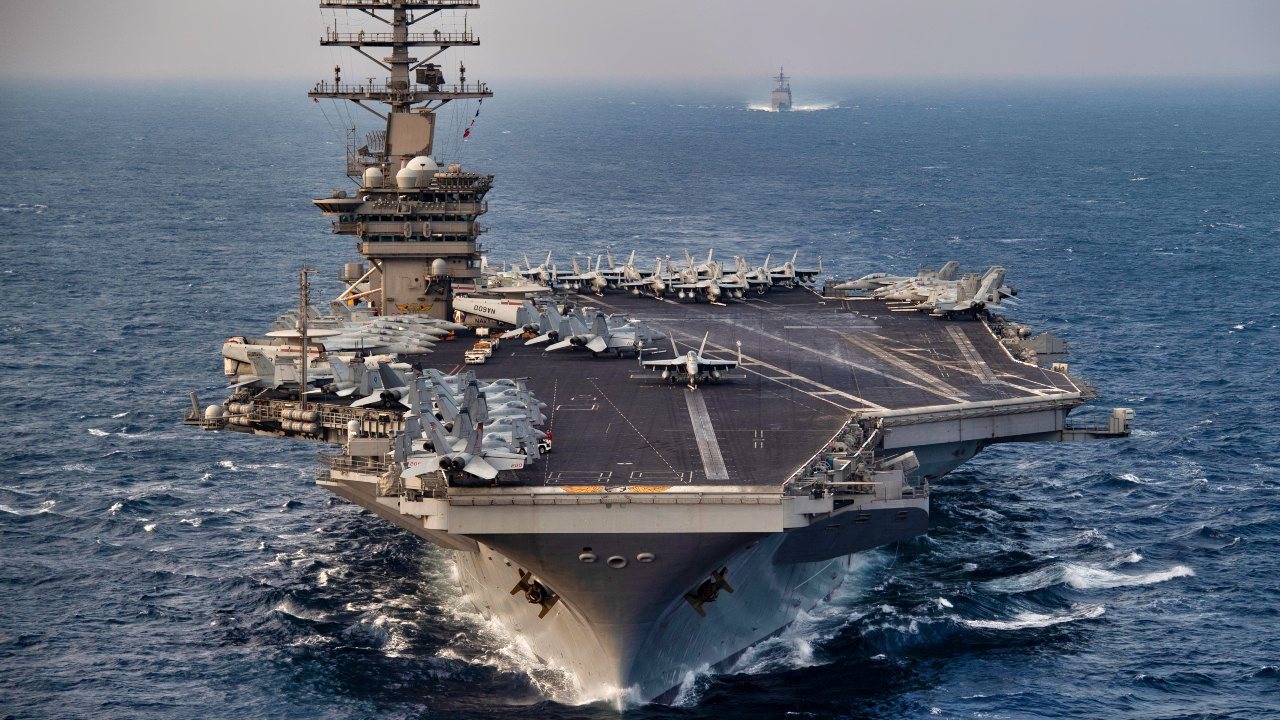
Does China Even Need Aircraft Carriers? One question that few are asking about the potential of war between the United States and China is this: Does the People’s Liberation Army Navy (PLAN) even need aircraft carriers to win the fight?
This is a curious question because most defense analysts take it for granted that rising powers need to match the United States tit for tat when it comes to arming themselves. This is what international relations theorists call “self-help.”
More International Relations Theory
There is also the “Thucydides Trap” concept which posits that a rising power obsessed with self-help will eventually fight an established power that has a bigger army, navy, and air force. This would explain why most people just assume that China has an “offensive realist” strategy (yet another international relations term).
Offensive realism means that China does not accept the current balance of power versus the United States – Beijing instead wants to change the balance of power to its clear advantage. Going on the offense is better than the defense, in this construct.
Winning Without Firing a Shot
This would explain why China has three aircraft carriers to project power and create military gain. However, there is also Sun Tzu to consider, and this Chinese sage still drives the country’s strategic culture. A critical tenet from Sun Tzu is winning without firing a shot. This would mean that any aircraft carrier for the Chinese is above and beyond what they should build, and it violates the principle of restraint in Chinese foreign policy.
Keep the Focus on Domestic Concerns
China also likes to focus on domestic concerns rather than foreign policy. I paraphrase the following Chinese mantra: “Stick to your homework before joining a party.” China has many domestic problems—demographic challenges, the need to grow the economy and create jobs, fighting pollution, importing energy, squelching democracy, maintaining order, fighting corruption, just to name a few. Foreign policy should be on the back burner. That means building expensive aircraft carriers should also be on the back burner.
Maintain the Status Quo
This raises the question concerning the mission of an aircraft carrier for China. Is it for offensive or defensive purposes? I talked about offensive realism already, but what about “defensive realism” in which China would want to simply maintain the existing military balance versus the United States. This assumes that China is not an aggressive global power but is merely sticking to its knitting in East Asia to keep the status quo.
Not Necessarily and Blue Water Navy
Many observers assume that since the Chinese have aircraft carriers and want more that they desire to have a global Blue Water navy instead of a regional Green Water navy, that they are aggressive when it comes to Taiwan, and that they even want to export their system of government to other lands and spread communism like the Soviet Union.
Even with the three carriers, I still posit that China will have a regional Green Water navy in the coming years. They have one overseas base in Djibouti and a fledgling port in Gwadar, Pakistan. That is not enough to maintain, fuel, supply, and feed a global navy.
Taiwan is China’s Biggest Strategic Concern
However, they are definitely aggressive about Taiwan. The Chinese look at Taiwan the same way the United States regards Hawaii. If the Americans would have lost Hawaii to Japan in World War Two and it still remained independent and friendly with the Japanese, the United States would be furious and do everything to reclaim it. But does China need more aircraft carriers to re-claim Taiwan? Three is probably enough.
No Yearning for World Domination or Exporting the Chinese System
That leaves the belief that China wants to export Communism and re-make the world order in its vision for a Marxist-Leninist system that has elements of authoritarian capitalism. That is not really a part of Chinese strategic culture either and most of Chinese military history has consisted of defending its borders, not attacking rival nations (except for an aborted conflict with Vietnam in 1979). The Chinese Communist Party is quite firm in its belief that the Chinese governmental system cannot be exported. The Middle Kingdom is unique and exceptional, and its government would not work in other countries.
So, if China has no plans to expand and take over other nations (except for Taiwan), it shouldn’t need aircraft carriers at all. Let’s not take it for granted that the PLAN wants to take over the world with its three flat-tops. If China is more concerned with domestic concerns rather than foreign policy, then it may decide to stop building carriers and remain satisfied with a regional navy.
Therefore, the United States and its allies can come to the realization that China’s three aircraft carriers do not necessarily mean a path to world domination by Beijing. Meanwhile, China may not even need an aircraft carrier in the first place.
About the Author: Dr. Brent M. Eastwood
Brent M. Eastwood, PhD, is the author of Don’t Turn Your Back On the World: a Conservative Foreign Policy and Humans, Machines, and Data: Future Trends in Warfare, plus two other books. Brent was the founder and CEO of a tech firm that predicted world events using artificial intelligence. He served as a legislative fellow for U.S. Senator Tim Scott and advised the senator on defense and foreign policy issues. He has taught at American University, George Washington University, and George Mason University. Brent is a former U.S. Army Infantry officer. He can be followed on X @BMEastwood.




Commentar
October 14, 2024 at 8:17 pm
The prc doesn’t NEED aircraft carriers. Fullstop.
In the 1990s china received its first su-27, then the most advanced jet. This long-ranged high-flying fighter put china almost on par with others like japan, korea & pacific forces.
But that never ever prevented pacific forces and their rubber-stamped allies like canada and australia from forever poking and snooping around china’s airspace.
To combat that particular trouble or problem, china had no other choice but to set up its own naval aviation forces.
Thus the first carrier or second-hand rust bucket the Liaoning CV 16.
CV 16 was refurbished and helped train the first naval aviators. To snap at the heels of prowling US, canadian and aussie spyplanes and recce aircraft and chase them off.
But now, china is building more carriers, deviating from the original task.
That’s stupid cuz carriers are just big fat sitting ducks for the pacific forces.
Won’t survive the first few hours of a US blitkrieg. Due to the super duper high tech power of its strike forces.
Carriers are monstrous money sucking assets and it’s Better to spend the cash on building humongous rocket arsenals (tactical needs) and fleets of spaceplanes/spacegliders/suborbital craft (strategic needs).
Carriers are dead-end assets and the only viable use for them now is to have them and dense defense or defensive units emplaced in the taiwan strait.
At the nearest cloest junction, the strait is just about 100 km wide, and china should now plonk an artificial island or reef right on the spot.
Do it now, before the pacific forces get hold of the b61-13 nuclear blunderbuster.
They now already have the b-21 invisible bomber !
Zhduny
October 14, 2024 at 8:25 pm
Aircraft carriers ruin military budgets and that’s why few countries have them.
Countries that have them either possess useless ones or ancient ones or floating rust buckets.
Some or a few nations have carriers due to rich dumb people always voluntarily buying their ever growing debts or allowing their tax departments to impose massive GST and/or VAT taxes.
There ya have it. By the way, toretsk has already fallen, but western media still carry no news of it. Heh, Heh.
Zhduny
October 14, 2024 at 9:07 pm
The gist of this commentary is sound and totally up to mark but unfortunately the current china leadership is exactly of the Mikhail Gorbachev type and so this useful commentary will fall on deaf ears.
Aircraft carriers are passe.
If you want an ocean-going vessel sailing on Christopher Columbus type missions, better to build a very large destroyer (VLD) or ultra large destroyer (ULD) for the task.
A VLD or ULD must have nuclear propulsion plus integrated electrical power systems, laser cannons, railguns and massive arrays of multiple types of CIWS and also vertical launch systems armed with some nuke IRBMs.
Not aircraft carriers. They are totally passe.