
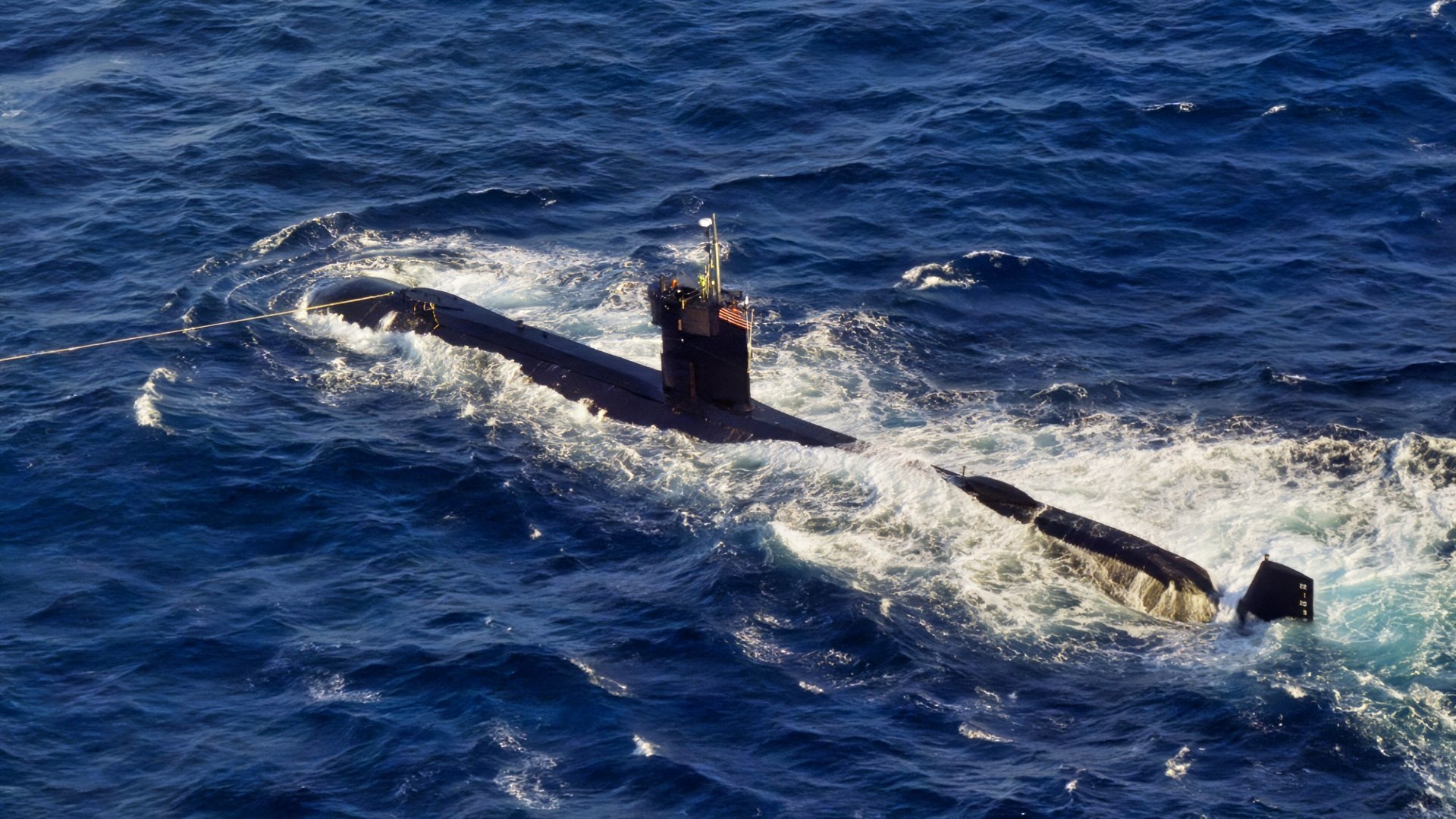
Key Points and Summary – The 2002 USS Dolphin incident serves as a stark reminder of the inherent dangers of submarine operations.
-While surfaced, the research submarine suffered a gasket failure, leading to catastrophic flooding and electrical fires that nearly sank the vessel.
-The crew’s disciplined response and the heroism of Chief Machinist’s Mate John D. Wise Jr., who dove into a flooded compartment to make critical repairs, saved the ship.
-All 43 personnel successfully abandoned the vessel and were rescued.
-The event is remembered within the U.S. Navy as a major damage control success, highlighting how proper training can mitigate disaster even amid cascading system failures.
How One Failed Gasket Caused a $50 Million Submarine Fire
The Novorossiysk, a Russian Kilo-class submarine, recently attracted NATO’s attention by traveling while partially surfaced in the north Atlantic.
The strange behavior attracted the attention of analysts who recognized a telltale sign of technical problems. In October 2025, NATO chief Mark Rutte mocked Russia over the incident.

Kilo-Class Submarine. Image Credit: Creative Commons.

Russian Kilo-Class Submarine. Image Credit: Creative Commons.
“Now, in effect, there is hardly any Russian naval presence in the Mediterranean left. There’s a lone and broken Russian submarine limping home from patrol,” Rutte said.
But whether or not Russia’s explanation that the submarine was adhering to navigation protocols was true, the incident reflects just how vulnerable submarines are to electrical, flooding, and propulsion failures. The incident should serve as a reminder.
After all, the U.S. has had its own share of submarine incidents, such as in May 2002, when the diesel-electric research submarine USS Dolphin (AGSS-555) caught fire and flooded.
The Dolphin Incident: What Happened
On the night of May 21 2002, approximately 100 miles off San Diego, the Dolphin was operating on the surface and recharging her batteries using diesel generators when disaster struck. At roughly 11:30 p.m., a torpedo shield gasket field, allowing seawater ingress.
Flooding into surrounding compartments was quick and substantial, with estimates putting the quantity of water that flooded into the vessel at 75 tons.
That sudden influx of saltwater quickly shorted electrical panels and triggered fires in multiple parts of the vessel. Over the years, the story of Chief Machinist’s Mate John D. Wise Jr. entered into American submarine lore. Wise received the Navy and Marine Corps Medal for his heroic efforts aboard the Dolphin, which saw him plunge into 57°F water within a flooded pump room that had less than 1 foot of breathable air.
He repaired seawater valve circuits and prevented pump clogging, standing watch for more than 90 minutes in harsh, extreme conditions. But even after his heroic work, the fire and flooding totally overwhelmed the vessel and overcame the crew’s capacity to control the damage.
The crew of 41 sailors and two civilian employees were ordered to abandon ship.
All were rescued by nearby naval and research vessels, as well as Coast Guard helicopters. The next day, the Dolphin was towed to San Diego, where it underwent significant repairs. After three and a half years, the ship was repaired and refitted at a cost of roughly $50 million before returning to sea. However, the ship was then decommissioned in January 2007.
Within Navy circles, the Dolphin incident is still remembered as a damage control success and an example of how good leadership under duress can save a valuable vessel and dozens of lives.
What the Dolphin Incident Revealed
The Dolphin incident offers a number of technical and procedural lessons that are still relevant. Even as technology improves, the risks of operating submarines remain largely the same. Even after the requirement of SUBSAFE certification dramatically lowered the risk of submarines sinking, cascading failures can still occur as a result of bad decisions and hardware vulnerabilities.
For example, the batteries and electrical systems onboard any submarine will always be vulnerable.
The link between seawater ingress and cascading electrical failure is arguably the most obvious and pressing risk for any submarine. In the Dolphin’s case, a relatively small gasket failure precipitated a chain reaction that nearly destroyed the ship.
Compartmentalization and valve control discipline are crucial, too, as proven by the Dolphin. The quick isolation of flooded rooms helped prevent the ship from becoming completely unrecoverable, and Wise’s intervention to maintain pump function was an essential part of that.
Human decisions matter, and there always comes a point at which systems fail faster than the problems can be mitigated.
The decision to abandon the ship, therefore, was not premature. The decision was made when the damage exceeded the ability to control the crisis, and every decision made up to that point ensured that the vessel could be recovered.
The Dolphin’s story proves that good training mitigates risk. The crew proved that it could not only take steps to protect the vessel as best they could, but that it could also execute an orderly and safe evacuation under fire and flooding conditions.
The recent Novorossiysk episode—whether it was the result of a fuel system failure or really was a matter of “surfacing protocol”—shows that problems with a submarine are hard to hide. Reports suggest that the Novorossiysk traveled while surfaced and under escort through the English Channel and North Sea, triggering speculation about fuel leaks or propulsion problems.
Submarine malfunctions are strategic vulnerabilities in this sense.
Every flooded compartment or propulsion failure offers a potential window into a navy’s readiness, its maintenance culture, and the resilience of its crews. For any fleet, the priority should not be just to protect lives beneath the surface, but also to preserve the perception of invulnerability.
A submarine forced to surface tells adversaries that something has gone wrong. But the ability to mitigate damage proves that a force is capable, modern, efficient, and disciplined.
About the Author:
Jack Buckby is a British author, counter-extremism researcher, and journalist based in New York. Reporting on the U.K., Europe, and the U.S., he works to analyze and understand left-wing and right-wing radicalization, and reports on Western governments’ approaches to the pressing issues of today. His books and research papers explore these themes and propose pragmatic solutions to our increasingly polarized society. His latest book is The Truth Teller: RFK Jr. and the Case for a Post-Partisan Presidency.
More Military
The U.S. Army’s Big M10 Booker ‘Light Tank’ Mistake Still Stings
The U.S. Navy Built Two Versions of the Littoral Combat Ship. Both Were a Mess.
The EA-18G Growler Has A Message for the U.S. Navy
Warship Goes Down Below the Waves: Navy F/A-18F Fighter Fires A Stealth Munition