

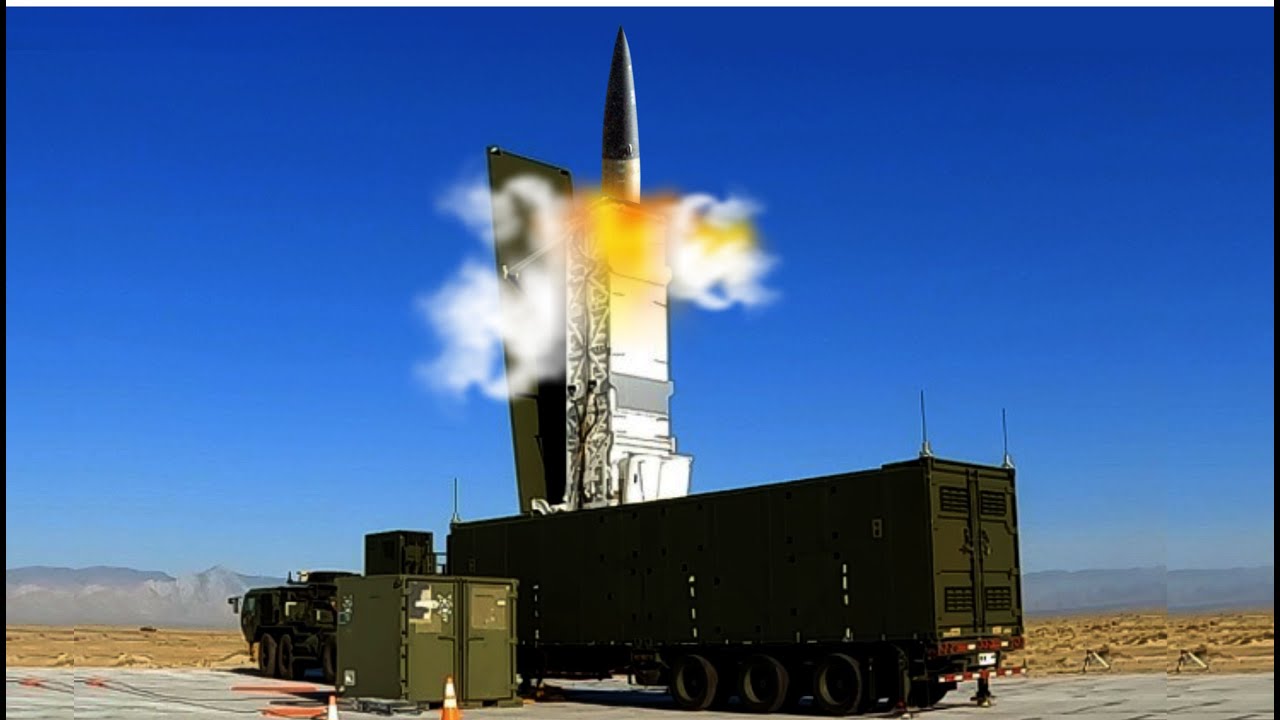
The US Army’s Hypersonic Presence in the Indo-Pacific : The investment in mid-range missile capabilities dovetails with the Marine Corps’ initiative to press their newer anti-ship weaponry advantage in the Indo-Pacific.
Typhon: The U.S. Military Is Going All in on Hypersonic Missiles
The US Army’s Typhon, also known as the Strategic Mid-Range Fires system, is a missile system that bridges the gap between short-range tactical missiles and long-range hypersonic weapons. Typhon is a crucial part of the US Army’s Long Range Precision Fires project to modernize its offensive firepower, and the missile system can fire several distinct types of missiles.
One Typhon missile pairing is the US Navy’s SM-6 air defense missile. Originally deployed on Navy ships as a key component of the Aegis Combat System, the SM-6 can be used against enemy aircraft, cruise missiles, and ballistic missiles at ranges of up to 500 kilometers, or about 310 miles.
For use with Typhon, modifications to the SM-6 allow it for use against ground targets.
Typhon can also fire Tomahawk cruise missiles, designed to target high-value nodes like command centers and critical infrastructure at ranges of up to 2,500 kilometers, or nearly 1,600 miles. In either case, the Typhon’s missiles are packed into the US Army’s Mk 70 Mod 1 Payload Delivery system, a containerized launcher that combines elements of the Mark 41 Vertical Launching System.
However, in a recent interview, US Army Major General Gavin Gardner explained that Typhon can also launch hypersonic missiles, giving the US Army a mobile hypersonic asset that can be used against targets on land and at sea.
Of Strategic Importance for the US Army and Marine Corps
The Typhon deployment to the Indo-Pacific is particularly significant, where its mid-range targeting distances serve as a countermeasure to China’s robust anti-access/area denial strategy of long-range fires. The first operational Typhon deployment to the Philippines came in April 2024. The Typhon’s position at Northern Luzon was strategically very significant—from Luzon, the US Army’s Typhon batteries covered the Luzon Strait in its entirety.
In the Philippines, the Typhon allows the US Army to strike targets at sea very quickly. From Luzon, the Typhon’s umbrella extends about 1,200 miles and compresses the distance that Chinese ships sailing from the Chinese mainland would have to operate freely.
And it is not just the United States Army that is quietly strengthening its hand in the Indo-Pacific—the United States Marine Corps is, too, also in the Philippines, thanks to a recent NMESIS deployment.
“The NMESIS will be employed during the Maritime Key Terrain Security Operations in Northern Luzon and the Batanes Islands. During this event, U.S. Marines… [moved] several NMESIS launchers from Northern Luzon to multiple islands in the Batanes island chain. Once on the islands, US and Philippine Marines will work together to establish a Fires Expeditionary Advanced Base.”
The Marine Corps NMESIS anti-ship missile system is essentially a pair of containerized Naval Strike Missiles, primarily anti-ship but also land-attack missiles built by Kongsberg, a Norwegian aerospace company, mated to a remotely controlled Joint Light Tactical Vehicle.
“In Northern Luzon, the AN/TPS-80 Ground/Air Task-Oriented Radar, operated by 3d Littoral Anti-Air Battalion’s Tactical Air Control Element – will surveil the surrounding airspace in 3d MLR’s area of operations in support of maritime strike and airspace deconfliction,” the USMC press release covering the exercises explained.
“Through various communication means and methods, the sensing data collected by the G/ATOR will be sent to the Fires and Air Direction Element via tactical data links in support of the commander’s information exchange requirements. That sensing data will then transfer to the Battery Operations Center, where it will be processed into tracks and targeting data before making its way back to the Fires EAB.”
Practice Makes Progress on Hypersonic Missiles
Though the NMESIS battery did not fire during the Balikatan exercises, the 3rd Marine Littoral Regiment did conduct simulated fire missions. The Marine Corps’ 3rd MRL is the first Marine unit in the Indo-Pacific combat command to field anti-ship capabilities.
“The NMESIS provides 3d MLR with enhanced sea denial capability, deepens naval integration, and strengthens deterrence by extending the Joint Force’s ability to target and engage from both land and sea. In the Philippines, the NMESIS will also aid in shaping defensive capabilities in accordance with the AFP’s coastal defense strategy,” the Marine Corps’ 3rd Marine Littoral Regiment said in their April press release.
It is unclear how the recent Joint Light Tactical Vehicle divestment decision by the US Army will change the Marine Corps’ JLTV program, though per-unit JLTV costs for the Marine Corps are almost certain to increase.
What Happens Now?
Given the incredible distances separating pieces of land throughout the Indo-Pacific and the region’s incredible importance to global trade and prosperity, a rapid-fire hypersonic missile capability like Typhon, as well as a robust anti-ship capability from the Marine Corps NMESIS and other platforms, complicates adversaries’ decision-making processes in the region. Adding a hypersonic arrow into the Typhon quiver holds promise for the offensive capabilities of US Army commanders in the Indo-Pacific.
About the Author: Caleb Larson
Caleb Larson is an American multiformat journalist based in Berlin, Germany. His work covers the intersection of conflict and society, focusing on American foreign policy and European security. He has reported from Germany, Russia, and the United States. Most recently, he covered the war in Ukraine, reporting extensively on the war’s shifting battle lines from Donbas and writing on the war’s civilian and humanitarian toll. Previously, he worked as a Defense Reporter for POLITICO Europe. You can follow his latest work on X.
What Are Europe’s Best Weapons of War?




Pingback: Global Military Spending Surges As Arms Control Mechanisms Collapse - Biz Trend Digest