


Key Points and Summary – NATO’s reputation for cutting-edge airpower masks a roster of troubled jets that stumbled through the jet age’s steep learning curve.
-The F-104 Starfighter excelled at speed yet suffered lethal handling quirks, especially in West German service.
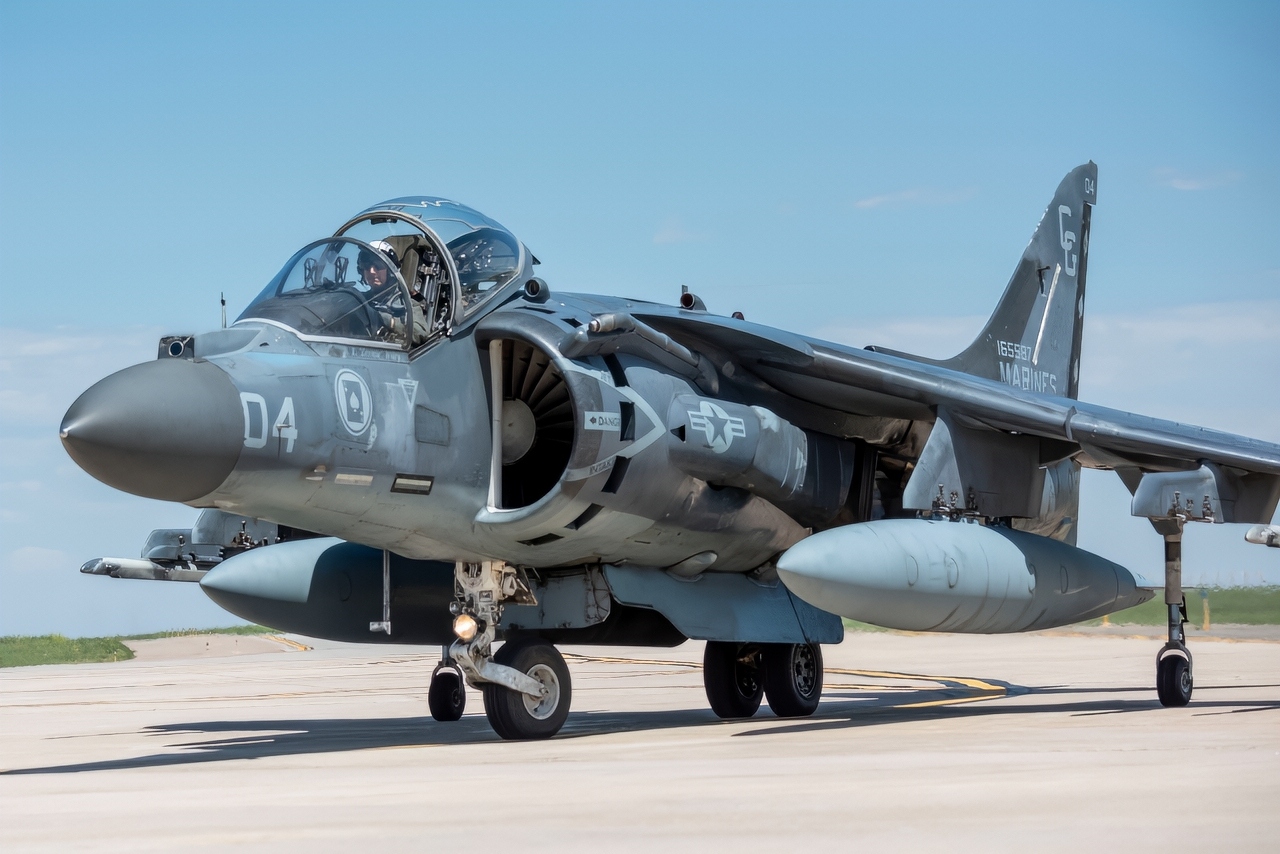
An AV-8B Harrier aircraft, known for its vertical/short takeoff and landing capabilities, utilizes the airfield at the 140th Wing, Buckley Space Force Base, Aurora, Colorado June 10, 2025. Piloted by U.S. Marine Corps Capt. Ryan Gettinger, the aircraft was demilitarized and delivered to Wings Over the Rockies Air and Space Museum in Aurora. (Photo by U.S. Air National Guard Tech. Sgt. Chance Johnson)
-Britain’s Swift endured engine and stability woes, while Italy’s G.91 met NATO’s light-fighter brief but lacked range and punch.
-The Buccaneer began underpowered before later fixes redeemed it.
-Most infamous, early Harriers saw high accident rates as pilots mastered VTOL transitions—only to prove themselves in later combat.
-Together, these “lemons” chart how rushed innovation, operational demands, and redesigns forged today’s safer, smarter fighters.
Flying Lemons: NATO’s 5 Problem Fighter Jets
Though NATO alliance members are generally considered to be on the higher end of capabilities and technical sophistication—just look at the multinational F-35 stealth fighter project—there have been many lemons in NATO hangars.
The aircraft that did not perform well, sometimes catastrophically and sometimes fatally, saw service throughout the Cold War era. The most egregious offenders came of age during transitional phases in aerospace.
The transition to the jet age and the shift away from piston-driven aircraft were a revolutionary era characterized by significant teething issues as designers mastered the technology.
Likewise, the initial NATO forays into jump-jet technology were initially so problematic that some considered abandoning the efforts altogether.
Some of these aircraft required extensive redesign to address their initial shortcomings—others would be relegated to reserve hangars and ultimately removed from service.
Starfighter Takes to the Skies
One of the most troubled aircraft to fly in NATO service was the F-104 Starfighter.

F-104. Image Credit: Creative Commons.
Originally conceived of as a high-speed interceptor, the F-104 made its service debut with the United States Air Force in 1958. West Germany, Italy, Belgium, the Netherlands, Japan, and several other countries followed suit.
Thanks in part to the Starfighter’s thin, low-drag wings and very favorable thrust-to-weight ratio, the F-104 was particularly stable at high speeds, even at lower, more turbulent altitudes. These characteristics gave the jet a low-level bombing capability, though one that was limited by its modest payload capacity.
At low speed, the Starfighter’s wings afforded it only modest stability, and thanks to the jet’s poor handling characteristics, including an extremely wide turning radius, a number of accidents wracked the Starfighter program. In West German service, the jet was more dangerous to its pilots than to the Warsaw Pact: over 100 pilots lost their lives along with more than 270 Starfighters.
Swift Action in the Air
One of the United Kingdom’s more problematic post-war fighters was the Swift, an early jet fighter built by Supermarine, the aerospace firm behind the Spitfire, one of the most successful British fighters of the Second World War.
Pushed quickly into Royal Air Force service in the early 1950s, during the early years of the Cold War, the Swift was seen as a stopgap aircraft—a placeholder until more sophisticated jet aircraft could be developed.
Though acknowledged as a temporary aircraft, the Swift was plagued by multiple issues. Engine flameouts and compression irregularities were responsible for several failures. Combined with flight instability at high speeds, the fleet was grounded on numerous occasions. Ultimately, the Supermarine Swift was in British service for a relatively short period, making it one of the shortest-lived fighters in RAF history.
The Fiat of NATO’s Fleet
Italy’s Fiat built the G.91, a lightweight fighter-bomber developed in response to NATO Basic Military Requirement 1 (NBMR-1), which specified a requirement for a lightweight tactical strike fighter that could carry both conventional and nuclear weapons from improvised or rough airfields with relatively straightforward maintenance requirements.
The rather awkward-looking G.91 was a success to some degree. It outlasted the Cold War, despite its 1950s vintage. The air forces of Italy, Portugal, and West Germany adopted the airframe.
But the jet’s payload and range limits, as well as its modest armament and underpowered engine, limited its penetration into other air forces within the NATO alliance, which declined to adopt the fighter despite its selection as NATO’s NBMR-1 aircraft. Instead, the modest jet played a more symbolic role.
The Blackburn Buccaneer
The United Kingdom’s Blackburn Buccaneer was another problem-ridden aircraft. Conceived initially to address the threat posed by the Soviet Navy’s Sverdlov-class cruisers, the Buccaneer was to approach enemy warships at high speed and low altitude, below the ship’s radar horizon.
However, in their initial iteration, the carrier-capable Buccaneers were underpowered, which limited their weapon loadout and fuel capacity. Engine issues and structural weaknesses caused several accidents. Later, with the introduction of new engines, the early jet had enough thrust to take off from carriers under full combat load and improved reliability. Still, the Blackburn Buccaneer, as it originally stood, nearly derailed the program.
The Harrier Endured Early Issues
Although the Harrier enjoys a positive reputation with the United States and the United Kingdom today, the jet’s early years were decidedly problematic, partly due to its vertical/short takeoff and landing system—a revolutionary capability that was, however, difficult to master.

A flight deck crewman directs the pilot of a U.S. Marine Corp AV-8B Harrier as it touches down on the flight deck of the USS Kearsarge (LHD 3) during flight operations at sea on Sept. 24, 2013. The Harrier is assigned to Marine Medium Tiltrotor Squadron 266 (Reinforced) and is embarked on board the Kearsarge as part of the 26th Marine Expeditionary Unit.
(DoD photo by Sgt. Christopher Q. Stone, U.S. Marine Corps. (Released))
Compared to accident rates of similar conventional fighters, the early Harrier’s accident rates were several times higher, with most accidents occurring during landings or flight transitions to hover.
Although the Harrier experienced a significant number of teething issues, the jet ultimately became a successful jump-jet, albeit in a modified form, flying numerous sorties during the Gulf War, which validated the jet’s capabilities.
However, the Harrier’s early years were nearly catastrophic for the program’s future.
About the Author: Caleb Larson
Caleb Larson is an American multiformat journalist based in Berlin, Germany. His work covers the intersection of conflict and society, focusing on American foreign policy and European security. He has reported from Germany, Russia, and the United States. Most recently, he covered the war in Ukraine, reporting extensively on the war’s shifting battle lines from Donbas and writing on the war’s civilian and humanitarian toll. Previously, he worked as a Defense Reporter for POLITICO Europe. You can follow his latest work on X.
More Military
China Has the Missiles to Sink U.S. Navy Aircraft Carriers, But Questions Remain
The P-51 Mustang Was the Best WWII Fighter
The U.S. Navy’s Great Aircraft Carrier Shortage of 2025 Won’t End
The Navy Isn’t Prepared For What’s Coming
Not Made in USA: The Vanguard-Class Missile Submarine Has Just 1 Mission