

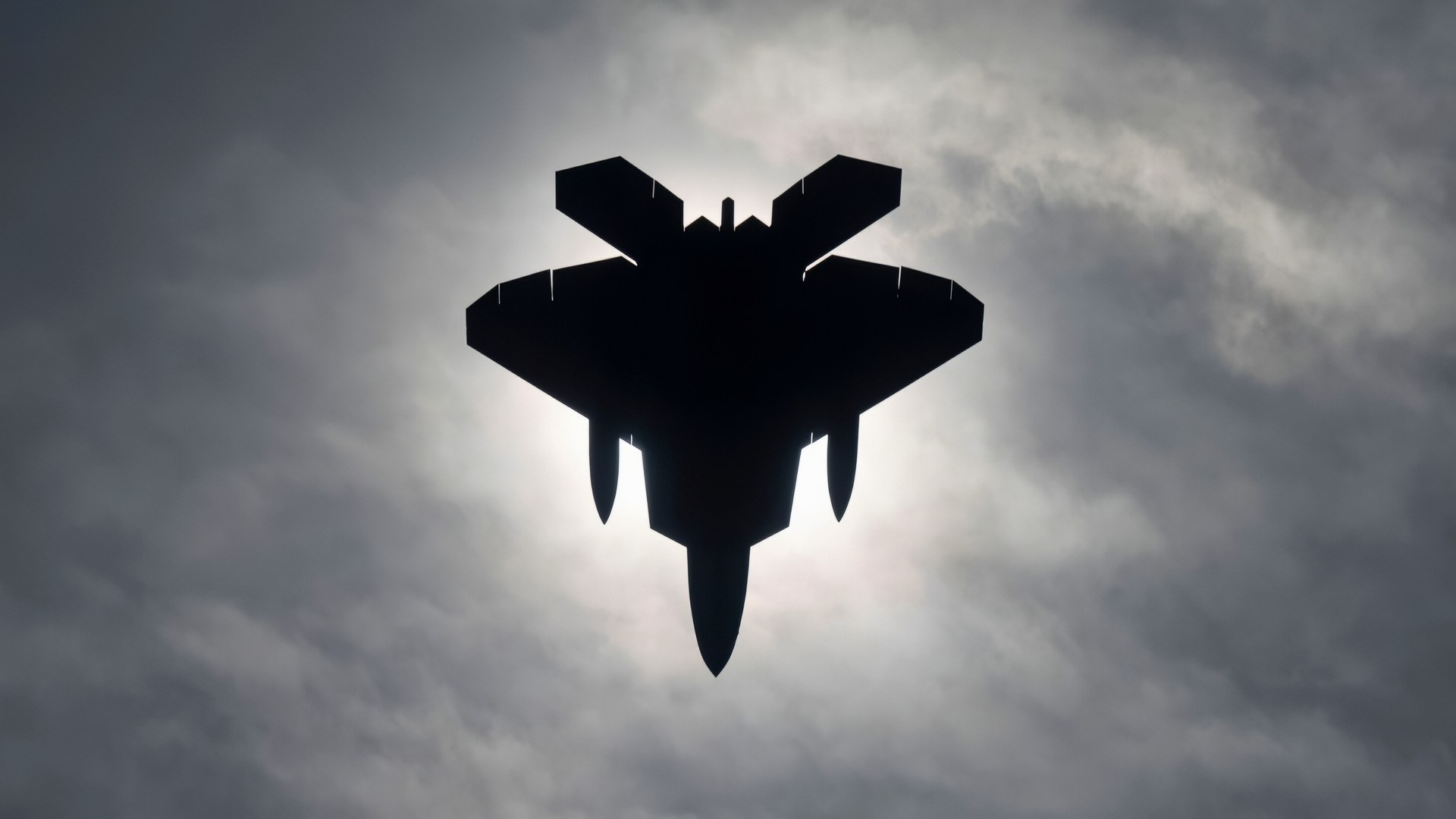
Key Points and Summary – The U.S. Air Force prefers upgrades over clean-sheet designs because they’re faster, cheaper, and preserve fleet size—think B-52J engines/radar, F-22 sensors/EW, and F-35 software.
-Open architectures (B-21, NGAD) aim to make future refreshes routine. But “keep or kill” hinges on threat shifts, sustainment cost, schedule risk, and politics.

F-22 Raptor Firing Flares. Image Credit: Creative Commons.

Maj. Paul Lopez, F-22 Raptor Demonstration Team commander, performs during the Chicago Air and Water Show, Aug. 17, 2019. Founded in 2007, the F-22 Demo Team showcases the unique capabilities of the world’s premier fifth-generation fighter aircraft. (U.S. Air Force photo by 2nd Lt. Samuel Eckholm)
-The A-10’s close-air-support niche fades in a standoff, drone-heavy fight; the B-52 survives as a missile truck. Congress, jobs, and parochial interests complicate choices, as do troubled programs and delays.
-Bottom line: retirements or extensions should map to strategy and mission need—blending old and new to win in great-power air combat.
Retirement or Upgrade: How to Determine the Future of a Warplane
The U.S. Air Force prefers upgrading its aircraft rather than retiring them or building entirely new ones.
Take the B-52, the B-2, the B-1B, and the F-22 as examples.
This is a “secret weapon” for the Air Force.
It is much easier to upgrade than to conduct expensive new research and development and to conjure up fresh designs.
Defense contractors of existing airplanes typically have manufacturing lines ready to go and efficiencies and economies of scale that allow workers to fashion upgrades and enhancements. This saves significant Department of Defense funding.
It also allows the Air Force to keep a large number of aircraft in the fleet to counter countries like China, which builds new warplanes quickly and efficiently.
Upgrades Can Be Driven By the Availability of New Technology
As time goes by, technology becomes more advanced and cheaper. The defense contractors can use more artificial intelligence in the cockpit, for example, or new software for advanced data processing.

F-22 Raptor Super. Image Credit: U.S. Air Force.
Modern weapons like hypersonic missiles and lasers are coming online, giving older airplanes a new lease on life. Better stealth coatings become possible.
Manned and unmanned teaming relationships are created. Engines are improved to enable higher speeds and better maneuverability.
Diversity of the fleet is then assured. New airplanes become interoperable with existing ones. Older airplanes can be sold on the export market. More aviators can be trained on newer platforms and continue their pilot ratings on the existing ones.
A good example is how countries that buy F-35s can update them to handle newer missions against different opposing forces in a particular area of operations.
Transition Bridges to New Aircraft
Also, the B-52 is going through an upgrade program that includes new engines and radars. These enhancements allow the airplanes to serve for many more decades until the B-21 Raider comes online.
Thus, airplanes can serve as “bridges” until they are retired. Or retirement can be delayed even further.
Look at how the F-22 is improving its stealth, sensors, and electronic warfare capabilities, and running autonomous drones. This will give the Air Force time to build its F-47 NGAD while the F-22 continues to improve over time.
The new airplanes, such as the B-21 and F-47 NGAD, have an open mission system architecture that enables easier upgrades, allowing them to serve for decades, even into the 2080s. The F-35 is upgradable in this manner, too.

NGAD Artist Photo. Image Credit: Creative Commons.
The Future of Warfare Is Now
But all of the advantages of updating airplanes raise an essential question.
When is it time to retire an aircraft? Money, time, and resources drive this decision, and geopolitical events can affect the calculus on whether the Air Force pulls the trigger on retirement.
Take the A-10 Warthog, for example. The nature of warfare is changing due to diminished needs for force-on-force ground battles. The future fight will be determined by the efficacy of long-range missiles and drones from stand-off attacks. Ground troops may not be conducting close-in battles that would need the services of the A-10.
The B-52, on the other hand, is still relevant because it can fire stand-off cruise missiles as a missile truck after enemy air defenses are suppressed.
The F-35 and F-22 can go into “beast mode” when more munitions are needed. The F-35 can also conduct the close air support mission that was associated with the A-10.

A-10 Warthog NSJ Photos. Image taken on 7/20/2025.

A-10 Warthog National Security Journal Photo Essay Picture.
Sometimes the threat landscape changes altogether. After the Soviet Union broke apart, a defense buildup was no longer needed.
The Air Force simply had fewer targets without the Soviet threat. It allowed the DOD to save money during this era of the “Peace Dividend.” It made more sense to upgrade the F-15 and F-16.
Then the Global War on Terror emphasized ground strike rather than air-to-air combat. The insurgents and terrorists did not have airplanes, so the Air Force was guaranteed air dominance.
Dogfights Are Back
Now the threat environment has changed again.
Dogfighting is a fundamental aspect of warfare in the 2030s. The rise of Russia and China, and their huge military-industrial complexes, mean the Air Force must bring on new sixth-generation fighters while upgrading its fifth-generation models. China and Russia are doing the same thing.
Large dogfights are still possible. An example would be the last engagement between Pakistan and India. This featured more than 100 airplanes aggressively pursuing each other. Or use the example of the upgraded F-35I that Israel deployed against Iran in the 12-day war. Warfare is constantly evolving, and air forces around the world must keep up.
Economic Development, Job Growth, and Sustainability Are Considerations
When does a defense force decide to throw in the towel and retire an airplane? Sometimes this creates economic issues, including saving jobs and maintaining economic development. In the United States, any Air Force warplane may have parts and components suppliers from almost every state in the union.
It is challenging to eliminate an airplane due to parochial interests in Congress. Each member wants to save jobs in their districts.
Maintaining older aircraft becomes too expensive or time-consuming. For instance, there have been delays with the B-52 refurbishment program.
Bombers like the B-1B are not stealthy, which causes problems that make them obsolete.
There are times when acquisition programs are cursed and ineffective. The A-12 Avenger II airplane was canceled in 1991.

A-12 Avenger II Flying Dorito. Image Credit: Creative Commons.
This was a nightmare of epic proportions. Over $5 billion was spent on the program.
The airframe became overweight, and this caused delays. New technological features were failing.
Whether to cancel or retire an airplane is often controversial because of how funding for research and development is allocated.
Political considerations are always present. President Donald Trump is firmly behind the F-47 NGAD, and it is supposed to fly in 2028. But a new president may not wish to pursue it and focus more on upgrading existing fighters like the F-35 and F-22 to save money.
There is pressure from Congress to either keep an airplane active or retire it.
New airplanes have Congressional champions. For example, Senator Mike Rounds of South Dakota is a big fan of the B-21 because it will be based in his state.
Deciding whether to update or retire an airplane is difficult.
There is the changing nature of warfare, geopolitical shifts in the threat landscape, events that drive conflict, political and economic development considerations, and perhaps even nostalgia for older aircraft that have served so well over the years. Could the well-loved F-14 Tomcat have been upgraded instead of retired? What if the Air Force keeps the trusty A-10 Warthog?

F-14 Tomcat. Image Credit: Jack Buckby/National Security Journal.
The Air Force has the secret weapon of older airplanes being upgraded for decades of service. But the choice to do so is fraught with risk.
Retiring a warbird is not easy, and updates can take longer and cost more. It is time for the Trump national security team to release the National Defense Strategy to ensure acquisition efforts align with long-term strategic objectives.
Congress should not play politics with older platforms, and the decision to upgrade or retire should be based on national security needs, not just saving jobs.
The drivers of retirement or the decision to upgrade are many factors. Hindsight is 20/20, and some airplanes survive while others do not.
It is time to ensure that these decisions are based on sound strategic principles and military necessity, or the mix of old and new airplanes will not deliver a winning combat outcome.
About the Author: Brent M. Eastwood
Brent M. Eastwood, PhD is the author of Don’t Turn Your Back On the World: a Conservative Foreign Policy and Humans, Machines, and Data: Future Trends in Warfare plus two other books. Brent was the founder and CEO of a tech firm that predicted world events using artificial intelligence. He served as a legislative fellow for US Senator Tim Scott and advised the senator on defense and foreign policy issues. He has taught at American University, George Washington University, and George Mason University. Brent is a former US Army Infantry officer. He can be followed on X @BMEastwood.
More Military
The British Army’s Big Challenger 3 Tank Mistake Still Stings
F-35 Stealth Fighter Program Has Passed the Point of No Return
The Iowa-Class Battleships Have A Message for Any Navy on Earth
Canada Has a Big Message for the Eurofighter Typhoon
The Mach 2 F-16 Fighting Falcon Fighter Has a Message for the U.S. Air Force




Krystal cane
November 3, 2025 at 4:48 pm
Is it starving the poor children who are not getting there nutrition I need to survive. We need to make sure that the billionaire class never has to pay taxes.
Weaponhead
November 8, 2025 at 1:29 pm
Older aircraft that are being retired should be turned into 1 way attack drones.