

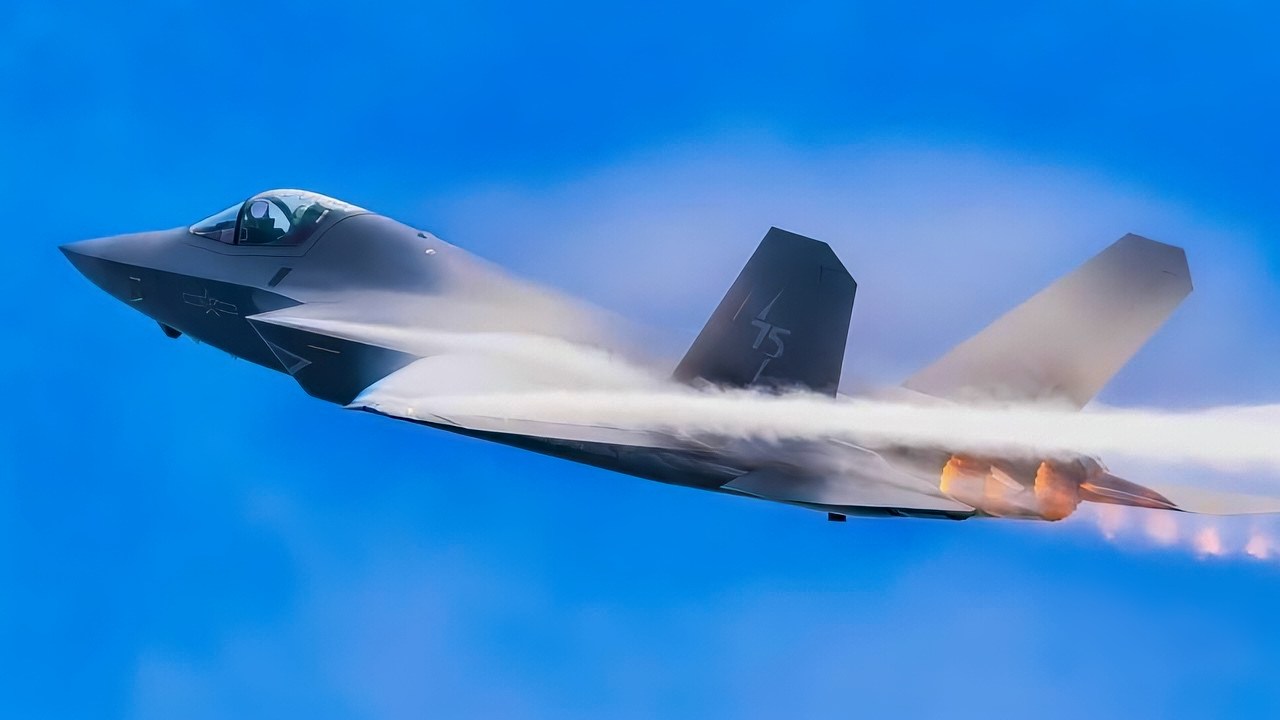
Key Points and Summary – Western debates obsess over radar shapes and engine rumors. The advantage many miss is simpler: China is building stealth fighters fast—and can concentrate nearly all of them at home. In a Taiwan or South China Sea fight, Beijing can stage J-20s and emerging J-35As under dense air defenses, short supply lines, and ample runways, while the United States spreads F-22s and F-35s across global commitments and must fight through distance and missiles to get close.
Quantity with proximity multiplies sortie rates, resiliency, and pilot seasoning. Quality still matters—but mass on home turf can bend outcomes unless Washington adapts force design and logistics.

China J-20 Fighter in Camo 2021. Image Credit: Creative Commons.

J-20 Stealth Fighter in China. Image Credit: PLAAF.
The J-20 and J-35A Stealth Fighters Might Have a Big Advantage
When analysts compare China’s J-20 to America’s F-22 or F-35, the conversation usually spirals into radar cross-section estimates, engine thrust, or the exact range of missiles. All useful, but incomplete. The decisive edge in a regional war may be far less glamorous: China is fielding a lot of airframes and can concentrate almost all of them at the fight’s edge. The United States, by design, spreads high-end jets across a globe of treaty obligations, while any Pacific surge must travel thousands of miles and operate under the shadow of Chinese missiles.
That asymmetry is not a footnote. It’s the table stakes.
Home Field Isn’t A Slogan—It’s A Physics Problem
China does not need to parcel out J-20s to Europe or the Middle East. If the crisis is Taiwan or the South China Sea, every flyable jet can be pointed east and launched from a dense web of mainland bases. Shorter transit means more sorties per day, less tanker demand, and faster battle-damage repair if a jet limps home. Supply lines are measured in truck hours, not ocean weeks.
By contrast, U.S. stealth squadrons start far away. To get into the fight, they must either stage from islands within missile range or operate from more distant locations and drink from tankers that are themselves high-value targets. That tyranny of distance bleeds time, fuel, and options.
Quantity Plus “Good Enough” Quality Beats Perfection In A Knife Fight
No one is arguing the J-20 is a clone of the F-22 or that a first-lot J-35A will instantly match a mature F-35C. The point is different: stealth plus modern sensors and long-range missiles—in volume—changes the engagement math. If you can put more shooters into the same patch of air, guided by robust early-warning and ground-based radars on your own soil, you can:
-keep combat air patrols continuously topped up;
absorb attrition without losing airspace control windows;
-rotate pilots and maintainers without collapsing your daily sortie count.

J-35A Fighter at Le Bourget Air Show. Image Credit: Author/National Security Journal.

J-35 Fighter Screenshot. Image Credit: YouTube Screenshot.
War rarely rewards the airplane with the best brochure. It rewards the force that can show up more often, with enough quality to land the first good shots and the logistics to keep showing up tomorrow.
Learning Curves Are Weapons Too
Production ramps aren’t just numbers; they are learning machines. Each block upgrade of the J-20 tightens tolerances, consolidates parts, and improves reliability. Every additional plant added to the J-35A’s supply chain (for land-based or carrier-capable variants) builds industrial muscle memory: faster wiring harnesses, smoother composite layups, cleaner software loads. The faster you build, the faster you learn—and the cheaper and more maintainable each tail becomes.
That matters in combat because readiness is king. A 70% mission-capable rate on 300 jets beats a 60% rate on 150, especially if your jets sleep under your own SAM umbrella and your spare parts arrive by rail, not roll-on/roll-off ship.
The Kill Chain Lives Mostly On The Ground
Another home-field dividend: sensors and shooters you don’t have to fly. China’s airborne early-warning aircraft, ground-based long-range radars, electronic-warfare nodes, and surface-to-air missile belts can all feed targeting data to J-20s and J-35As.
If a stealth fighter can keep its own radar off more often and ride network cues to a firing solution, it becomes harder to detect and jam. Even imperfect networks boost the probability of the first accurate shot, particularly with long-reach air-to-air missiles designed to threaten tankers, patrol aircraft, and adversary fighters before a merge.
For the United States, much of that sensing web must be imported into theater—carried on tankers, AWACS replacements, and ships—each with its own vulnerability and logistics tail.
Concentration Creates Time, And Time Creates Experience
There’s a softer advantage quantity buys: pilot seasoning. If a crisis drags on for months, the side that can surge more jets in one theater can also rotate more crews through real intercepts, refueling under pressure, and dynamic targeting. Training at home is valuable; hours in the actual contested airspace are irreplaceable. If Beijing can keep a high density of stealth fighters in the fight, it can grow a larger cohort of pilots who have “seen the elephant” in the exact geography that matters.

China J-35 Fighter on Aircraft Carrier. Image Credit: Chinese Navy.
That’s an experience bank. And it compounds.
The U.S. Isn’t Standing Still—But It’s Playing An Away Game
None of this erases American strengths. U.S. stealth aircraft still set the global standard in sensor fusion and electronic warfare. U.S. aircrews train relentlessly in complex, multi-domain tactics and have combat experience in unforgiving conditions. The Navy and Air Force are re-learning dispersed operations, hardening Pacific airfields, and pushing fuel, munitions, and spares forward in smaller, harder-to-target slices. Loyal-wingman drones, longer-range missiles, and better decoys are arriving to stretch reach and complicate Chinese targeting.
But the away-game realities remain. Every additional mile from Kadena, Andersen, or a carrier deck is an extra refuel, an extra risk, and an extra hour an airplane isn’t on station. When you must guard Europe and the Middle East while surging to the Pacific, you inevitably triage tails and pilots. China does not.
What A Massed J-20/J-35A Force Could Try To Do
In a Taiwan or South China Sea crisis, expect a simple, ruthless plan:
Flood the local sky with stealth-equipped combat air patrols backed by airborne early-warning aircraft and ground radars, creating a moving picket that hunts tankers, patrol planes, and exposed fighters.
Lean on interior lines to keep rotations short, swaps fast, and maintenance synchronized.
Use numbers to force errors, accepting that not every intercept will be clean, but enough will be—especially early—to open windows for ballistic- and cruise-missile salvos at airfields and ports.
Exploit standoff weapons from home-base safety while pushing select stealth flights forward to finish wounded targets and blunt U.S. counterpunches.

J-20 Fighter CCTV Screen Pull. Imave Credit: Creative Commons.
You don’t need every J-20 to be the world’s best jet if enough of them are good, close, and constant.
The Counterpoint—And Why It Doesn’t Neutralize The Risk
Reasonable objections deserve airtime:
Engines and avionics maturity. Accelerating production can expose reliability gaps that hobble readiness.
Pilot quality. Mass without elite training risks tactical blunders in complex fights.
Networks under fire. Data links and sensors can be jammed or deceived; stealth jets may be forced to emit more than they’d like.
J-35A timeline. The land-based variant is newer; early blocks will have teething issues.
All true, and all exploitable. But none erase the central risk that mass plus proximity creates. Even if some new tails underperform, the aggregate effect—more jets, closer to the fight, backed by terrestrial sensors and missiles—is still dangerous. The United States can’t comfort itself with the idea that technology will glide past numbers. Numbers with enough technology bend fights.
What Washington Should Do Now—Before The Math Bites
If the threat is concentration, the answer is resilience and reach:
Accelerate ready mass. Keep F-35 production healthy; fast-track software drops and electronic-warfare upgrades that raise mission-capable rates and lethality without waiting for new airframes.

An F-35 Lightning II taxis on the runway during the “Maple Thunder” exercise, at North Auxiliary Airfield, Joint Base Charleston, North, South Carolina, January 30, 2024. Airman with the 158th FW are participating in Maple Thunder to implement the Agile Combat Employment concept. (U.S. Air Force photo by Dr. Sandeep Mulgund)
Harden and disperse. Invest in runway repair kits, camouflage, decoys, and expeditionary fuel/munitions packages so a single missile volley doesn’t paralyze a hub.
Protect the gas. Tankers are the oxygen of Pacific air power; field long-range, stealthier refuelers and better defenses for legacy fleets.
Stock the right weapons. Buy air-to-air missiles in quantities that match the likely daily burn, not the peacetime training plan.
Field attritable teammates. Loyal-wingman drones that carry sensors or extra missiles let each F-22 or F-35 control more sky without exposing another pilot.
Practice the hard parts. Rehearse the first 72 hours: base dispersal, battle-damage repair under fire, long tanker drags, and sustainment when ships are dodging missiles.
Quantity can only be countered by our own form of mass—not necessarily more crewed fighters, but more ready effects per day, sustained longer than an adversary expects.
The Quiet Warning In The Production Lines
There is a reason Beijing is pouring resources into stealth fighters—and not because it wants air shows.
Factory tempo is a policy signal. It says the leadership wants a larger, steadier stream of survivable airframes under an umbrella of home-field sensors and missiles. We should take the signal at face value. China does not have to match U.S. stealth fleets worldwide. It only has to outweigh them where it plans to fight.

J-35A Stealth Fighter from China. Image Credit: Chinese Military.
If we keep grading the J-20 and J-35A on individual specs while ignoring how many will be parked on well-swept ramps two hundred miles from the battlespace, we’ll miss the point—and risk the war game.
Bottom Line on the J-20 and J-35A
In a regionally focused fight, quantity and proximity are force multipliers. China’s sprint to build J-20s—and mature the J-35A—creates a dense, home-based stealth fleet that can stay in the air, day after day, close to the targets that matter.
The United States retains advantages in training, software, and joint integration. But if we discount the power of mass at the point of contact, we set ourselves up to be right on the specs and wrong on the outcome.
Numbers are not everything. In a tight geography, with short supply lines and interior bases, they’re a lot.
About the Author: Harry J. Kazianis
Harry J. Kazianis (@Grecianformula) is Editor-In-Chief and President of National Security Journal. He was the former Senior Director of National Security Affairs at the Center for the National Interest (CFTNI), a foreign policy think tank founded by Richard Nixon based in Washington, DC. Harry has over a decade of experience in think tanks and national security publishing. His ideas have been published in the NY Times, The Washington Post, The Wall Street Journal, CNN, and many other outlets worldwide. He has held positions at CSIS, the Heritage Foundation, the University of Nottingham, and several other institutions related to national security research and studies. He is the former Executive Editor of the National Interest and the Diplomat. He holds a Master’s degree focusing on international affairs from Harvard University.
More Military
The British Army’s Big Challenger 3 Tank Mistake Still Stings
F-35 Stealth Fighter Program Has Passed the Point of No Return
The Iowa-Class Battleships Have A Message for Any Navy on Earth
Canada Has a Big Message for the Eurofighter Typhoon
The Mach 2 F-16 Fighting Falcon Fighter Has a Message for the U.S. Air Force