

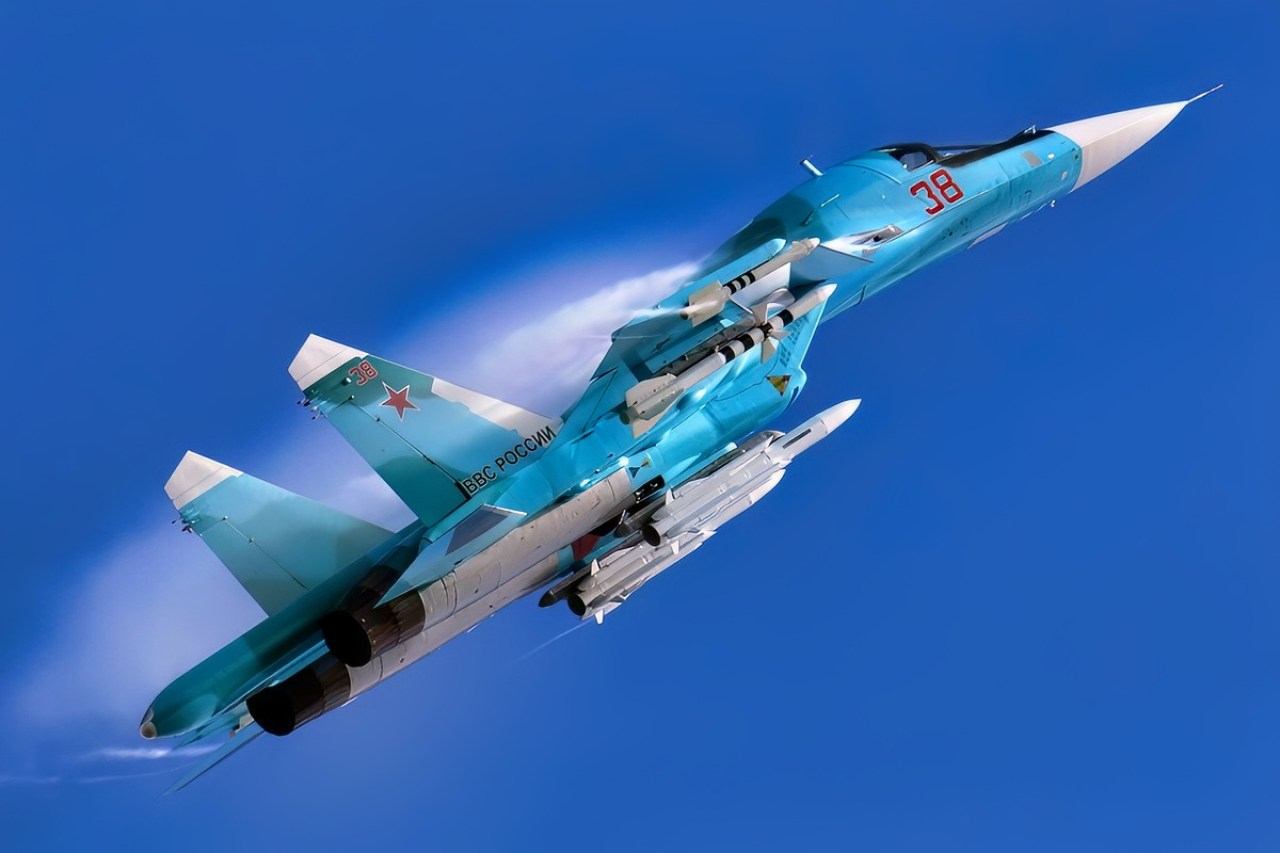
Key Points and Summary – The Su-34 has been pivotal and punished in Ukraine. Open-source visuals indicate 37–41 airframes lost—about 30% of Russia’s pre-war inventory—largely to layered Ukrainian air defenses.
-After a brutal 2022, losses appear to have eased as tactics shifted and UMPK glide-kits let Su-34s release heavy FAB munitions from standoff range.

Su-34 Fullback from Russia. Image Credit: Creative Commons.

Sukhoi Su-34 Heading Into the Sky. Image Credit: Creative Commons.
-The type’s versatility—precision strike, ISR via Sych pods, and SEAD—keeps it in constant use, with long missions enabled by aerial refueling.
-Russia’s answer to attrition is production: regular Su-34M handovers, plausibly totaling ~50 since 2022, aim to offset losses.
-Net effect: the Su-34 endures—less exposed than early in the war, but still at risk if forced inside modern SAM envelopes.
Su-34 in Ukraine: How Russia Lost 30%—and Kept Flying
The Sukhoi Su-34 is a unique aircraft in the Russian Air Force.
With the speed and maneuverability of a fighter and the payload capacity of a frontline bomber, this “fighterbomber” occupies a very unique role in the Russian Military.
Like most military platforms, combat experience in Ukraine has not been kind to the aircraft.
As of writing this, it is estimated that around 37-41 aircraft have been shot down since February 2022, which is roughly 30% of Russia’s pre-war fleet.
is it that Russia managed to lose 30% of its fighter-bomber fleet, and can its industry cope with the losses?
Russia’s Fighter-Bomber in Ukraine
The Su-34 has been used extensively throughout the war in Ukraine. They have mainly been used to conduct precision strikes or bombing runs against Ukrainian positions.
These strikes vary in their degrees of success, but the Su-34 has demonstrated its effectiveness against hardened targets.
In 2023, Russia introduced its GPS-guided UMPK (Unified Gliding and Correction Module) bomb kits, which are similar to the American JDAMs.
This addition significantly improved the range, survivability, and lethality
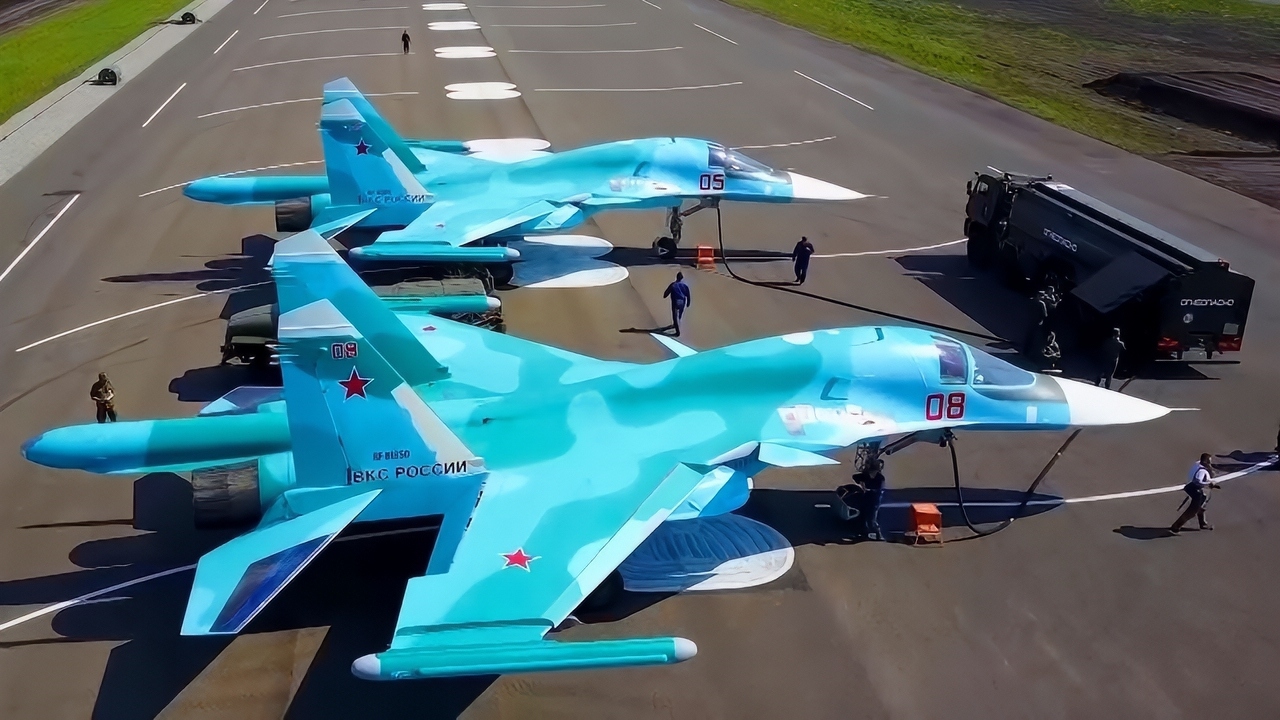
Su-34 Fullback Fighter-Bomber. Image Credit: Creative Commons.

Sukhoi Su-34 Fullback. Image Credit: Creative Commons.
Russia’s fighter-bombers, enabling them to engage targets from much greater distances, are usually free from enemy fire. The UMPK kits allow the Su-34 to drop larger bombs like the FAB-1000 and the FAB-3000, adding a greater level of firepower to Russia’s tactical aviation
The aircraft has also shown versatility in its mission profile. Beyond its primary strike role, the Su-34 has been adapted for reconnaissance missions using the Sych pod system, allowing it to perform intelligence, surveillance, and reconnaissance (ISR) tasks without sacrificing its strike capabilities.
Additionally, it has been employed in suppression of enemy air defenses (SEAD) operations, leveraging its electronic warfare systems and anti-radiation missiles to degrade Ukrainian radar and missile sites. Its endurance has also been notable, with some missions reportedly lasting up to ten hours thanks to in-flight refueling, demonstrating its strategic reach and operational flexibility.
Analyzing Su-34 Losses
Throughout the war, a significant number of Su-34s have been shot down or destroyed. As of January 2025, 37 aircraft of various types have been visually confirmed as killed, with some sources claiming that around 41 have been destroyed or damaged.
Before the war, Russia possessed a fleet of around 153 units, including prototypes. This means, assuming the higher numbers are accurate, Russia has lost around 30% of its pre-war fleet of Su-34s.
Ukrainian air defenses have been the primary cause of Su-34 losses.
Unfortunately, it is nearly impossible to confirm the type of systems used in each case. However, according to reports, MANPADs and surface-to-air systems, such as NASAMS and Patriot systems, have contributed to the vast majority of Su-34 losses.
In some cases, it was reported that drone strikes on Russian airbases damaged some fighter-bombers, although the extent of the damage from attacks like this can vary.
Russia’s Losses are Decreasing?
Unsurprisingly, the majority of confirmed losses occurred in 2022, when Ukraine’s air-defenses were arguably at their strongest.
14 Su-34s were visibly confirmed destroyed, at least one of which was due to friendly fire. In 2023, however, the casualties decreased significantly, with only six fighters claimed damaged. In 2024, a sabotage attempt was carried out, which aimed to set fire to a Su-34; however, the attack failed to cause any severe damage.
Ukraine reported that 10 fighter bombers were shot down over the course of a month, not one of which was independently confirmed.
As of 2025, Ukraine has claimed that five Su-34s have been shot down, not one of which has been visually confirmed.
Su-34 Lessons Learned in War
The takeaway here is that, despite acquiring more advanced fighter jets and air defenses, Su-34 casualties are actually decreasing.
This is likely due to Russia adjusting its tactics throughout the war. The introduction of UMPKs coincides almost directly with the decrease in the number of aviation casualties. The introduction of systems like NASAMS and the Patriot has also likely forced Russia to keep its fighter bombers further back, limiting the depth of their strikes.
Russian Industry to the Rescue
Since the outbreak of the war, Russia has been attempting to ramp up production of all of its aircraft, especially the Su-34. There have been many deliveries of new Su-34M fighter-bombers from the United Aircraft Corporation, Russia’s premier fighter manufacturer, to the Russian Air Force (the most recent one occurred yesterday as of writing this).
The number of each delivery is unspecified, but it’s safe to assume that each batch consists of four fighters.
Under this assumption, Russia has received around 50 brand-new Su-34 aircraft since 2022 (note that this figure should be taken with a grain of salt, however), more than the number of claimed destroyed aircraft.
Unlike the Su-57, Russia has maintained a constant and consistent delivery rate of its fighter-bombers, ensuring that its fleet is always at full readiness.
Unfortunately for Ukraine, there will likely be no shortages of Su-34s anytime soon.
About the Author: Isaac Seitz
Isaac Seitz, a Defense Columnist, graduated from Patrick Henry College’s Strategic Intelligence and National Security program. He has also studied Russian at Middlebury Language Schools and has worked as an intelligence Analyst in the private sector.
More Military
America Bought A Massive Fleet of MiG-29 Fighters
Russia’s MiG-41 6th-Generation Mach 4.3 ‘NGAD’ Fighter Nightmare Begins
A U.S. Navy Nuclear Attack Submarine Sank Due to an ‘Uncovered Manhole’ Mishap
The U.S. Navy’s Nuclear Aircraft Carrier Nightmares are Just Beginning
Why It Feels Like Nothing Can Stop the AH-64 Apache Helicopter