

Ford-Class: The Aircraft Carriers the U.S. Navy Must Build?
Key Points and Summary
-The Ford-class carriers were built to increase sortie generation, reduce crew and life-cycle costs, and add massive electrical power for future systems.
-The lead ship, USS Gerald R. Ford, finally completed an extended first deployment in 2023–24 after years of tech teething in EMALS, AAG, and weapons elevators.
-Critics argue supercarriers are obsolete against long-range precision weapons and better targeting, while delays and cost growth fuel skepticism.
-The counter is an evolved air wing—MQ-25 tankers, longer-range weapons, and manned-unmanned teaming—plus layered defenses.
-The program’s fate hinges on reliable tempo, air-wing reach, and industrial cadence across CVN-79/80/81.
Ford-Class Aircraft Carriers: Costly, Contested—And Still the Center of the American Way of War
If you want to start a bar fight at a naval conference, say five words: “aircraft carriers are obsolete—discuss.”
Critics point to hypersonics, long-range anti-ship missiles, space-enabled targeting, and swarming drones and say the age of the 100,000-ton flattop is over.
The U.S. Navy answers with something simpler: look at where they go when it truly matters.
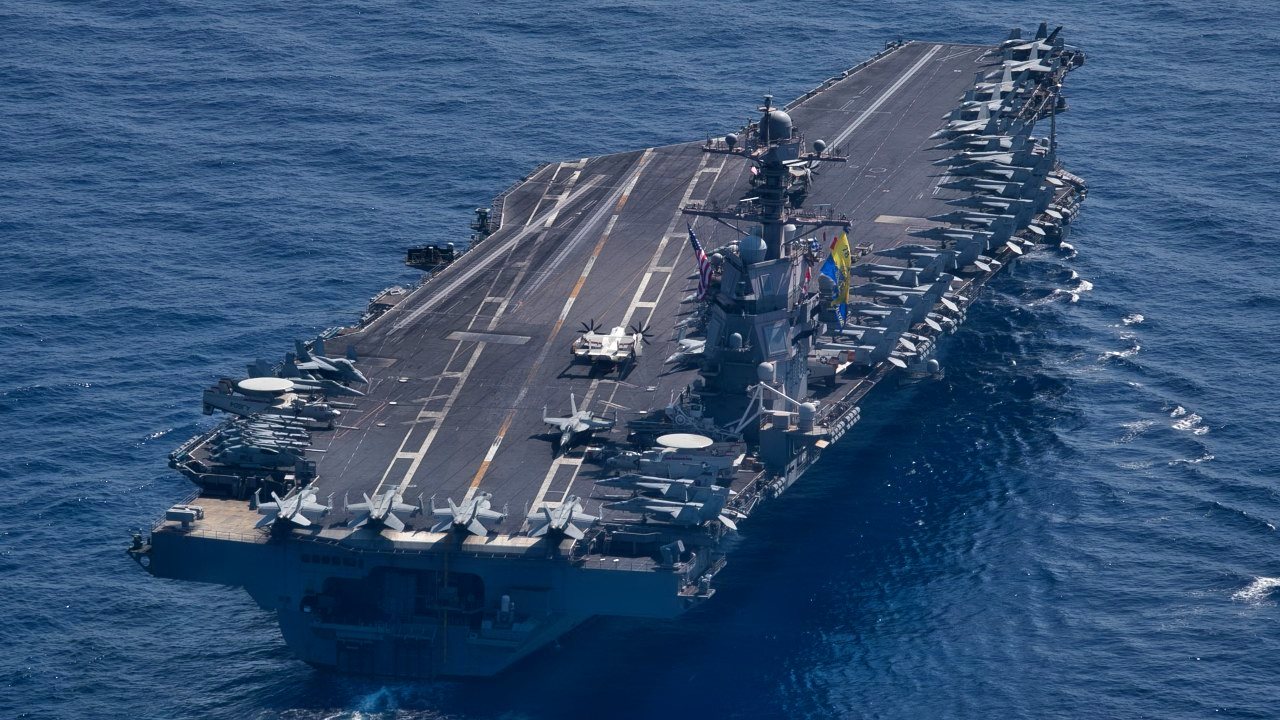
Ford-Class. Image Credit: Creative Commons
From the High North to the Eastern Med, when Washington needs a mobile, sovereign airfield that doesn’t ask anyone’s permission and can stay on station for months, a carrier strike group sails.
The Ford-class is the Navy’s expensive bet that the carrier is not just relevant, but central—if you evolve the air wing, harden the logistics, and buy back the one thing a peer fight devours fastest: sortie capacity.
Why the Navy Needs Them
Start with geography. The Indo-Pacific is vast; the Middle East still burns; Europe’s periphery is no longer quiet. Land bases are political, finite, and increasingly vulnerable to precision strike. A carrier brings airpower without a basing debate. It packs command-and-control, electronic warfare, airborne early warning, tanking, and strike under one roof—then moves 700 nautical miles overnight.
Second, deterrence is theater. A carrier shows up with visible capability and an implicit invitation: test us. That signaling matters to allies as much as adversaries. It creates space for diplomacy by making the military balance obvious.
Third, the carrier is a flexible logistics node. In an era of contested ports and runways, a nuclear-powered ship with deep magazines and its own fuel, water, and repair capacity is a self-contained airbase you can park near the problem—and move before the enemy plots the next salvo.
What Ford Tried to Fix
The Ford-class program was sold with a blunt promise: more combat power per day, for less money over a life of 50 years.

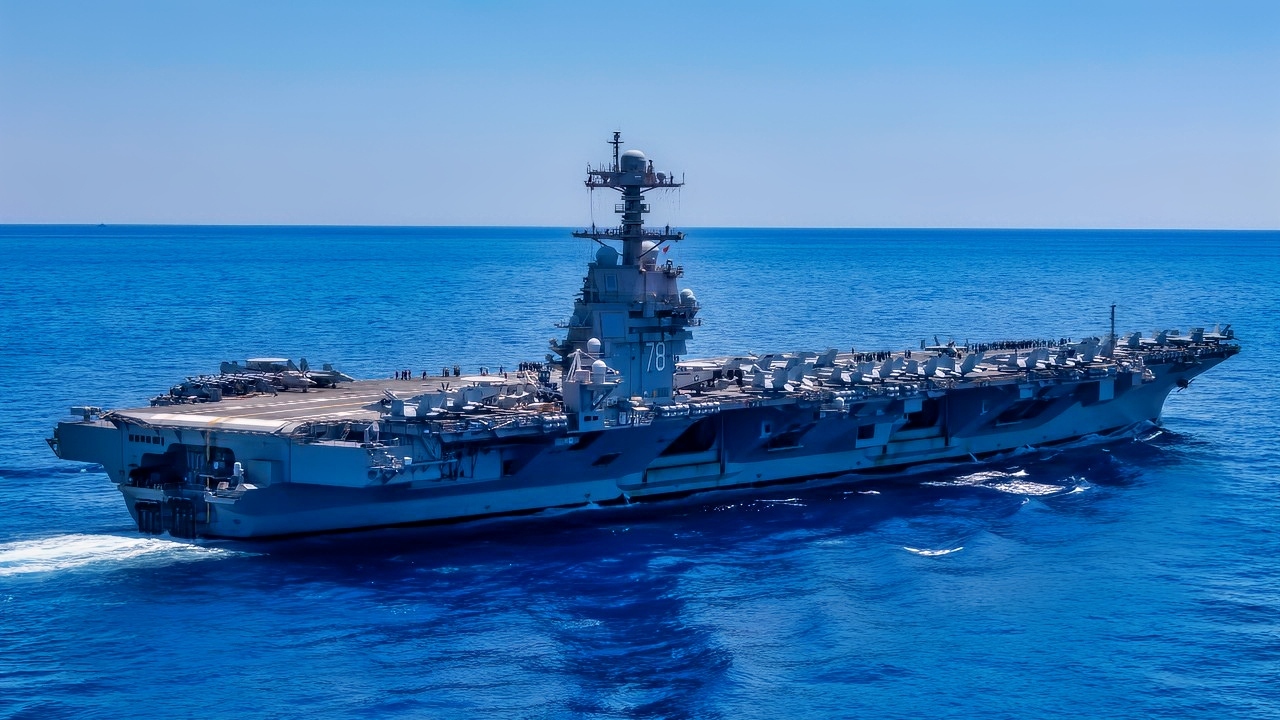
The world’s largest aircraft carrier, USS Gerald R. Ford (CVN 78), sails in the Atlantic Ocean, July 4, 2025. Gerald R. Ford, a first-in-class aircraft carrier and deployed flagship of Carrier Strike Group Twelve, incorporates modern technology, innovative shipbuilding designs, and best practices from legacy aircraft
carriers to increase the U.S. Navy’s capacity to underpin American security and economic prosperity, deter adversaries, and project power on a global scale through sustained operations at sea. (U.S. Navy photo by Mass Communication Specialist 2nd Class Tajh Payne)
The design goals were threefold:
Increase flight deck throughput. Electromagnetic Aircraft Launch System (EMALS) and Advanced Arresting Gear (AAG) replace steam and hydraulics with precise electric control. In theory, that means smoother launches, gentler stress on airframes, and higher sortie generation when it counts.
Reduce sailors and maintenance. Automation and smarter layout cut the ship’s force by hundreds compared to Nimitz-class carriers, with knock-on savings in food, berthing, training pipelines, and life-cycle maintenance.
Create a huge power margin. New A1B reactors provide far more electrical capacity than legacy plants, leaving room for directed-energy weapons, advanced sensors, and whatever the 2030s and 2040s demand.
Add in smaller but meaningful changes—an island moved aft to clear the deck, a redesigned weapons flow with Advanced Weapons Elevators that take ordnance straight to where it’s needed, and a refreshed combat system—and you have the rough blueprint: a faster-moving flight deck with fewer sailors and more growth headroom.
The Challenges—Real Ones, Not Talking Points
Big leaps mean big stumbles. Ford has had them.
Launch and recovery reliability. EMALS and AAG promised exquisite control and faster cycles. In early testing, their reliability lagged requirements, constraining the very sortie generation the ship was built to deliver. The trend line is up—but the system has been the pacing risk for declaring full operational effectiveness.

Ford-Class Aircraft Carrier. Image Credit: Creative Commons.
Weapons elevators. The eleven electromagnetic elevators were late and painful to certify on the lead ship. Ford now has the full set working; the challenge is building them consistently on follow-on ships without schedule hits.
Cost growth and schedule churn. Lead ships are always expensive, but Ford’s price tag and multi-year delays gave critics a hook. Follow-on carriers have seen their own schedule slips as the yard and suppliers relearn high-end shipbuilding under post-pandemic strain.
Combat-system swaps. The original Dual Band Radar proved too complex and costly; later ships shift to the Enterprise Air Surveillance Radar family. It’s the right call—but midcourse corrections ripple through testing, training, and integration.
None of this is fatal. All of it is real. And all of it has to be fixed at production speed, not in bespoke, one-off fashion, or the class will remain a boutique capability in a world that demands capacity.
Ford Goes to Sea: First Deployment, Real Missions
After years of headlines about tech teething, USS Gerald R. Ford (CVN-78) finally did the thing carriers are built to do: she left the pier and stayed gone.
In May 2023, Ford sailed on her first full deployment, operating across the Atlantic and into the Mediterranean amid the most volatile European security climate in decades. When the Israel–Hamas war erupted, the Pentagon extended Ford on station in the Eastern Med as a visible deterrent while other ships peeled off to intercept missiles and drones in the Red Sea fight. When she returned to Norfolk in mid-January 2024, Ford’s crew had stacked up months of deck cycles and international exercises, and the ship had finally proved a point her critics doubted: she can do the job.

An F/A-18F Super Hornet, attached to the “Blacklions” of Strike Fighter Squadron (VFA) 213 and a F/A-18E Super Hornet, attached to the “Golden Warriors” of Strike Fighter Squadron (VFA) 87 fly over the world’s largest aircraft carrier, USS Gerald R. Ford (CVN 78), the Arleigh Burke-class guided-missile destroyer USS Mahan (DDG 72), April 11, 2025. The Gerald R. Ford Carrier Strike Group is underway in the Atlantic Ocean completing integrated naval warfighting training. Composite Training Unit Exercise (COMPTUEX) is the Joint Force’s most complex integrated training event and prepares naval task forces for sustained high-end Joint and combined combat. Integrated naval training provides America’s civilian leaders and commanders highly-capable forces that deter adversaries, underpin American security and economic prosperity, and reassure Allies and partners. (U.S. Navy photo by Mass Communication Specialist 2nd Class Maxwell Orlosky
Why So Many Experts Still Call Carriers Obsolete
The critique isn’t silly and I have made it many times. It’s physics and economics:
Long-range targeting has gotten better. Satellites, over-the-horizon radars, and high-end ISR make it harder for a 100,000-ton ship to hide. “Left of launch” deception is harder when the enemy’s kill chain is global.
The weapons got faster and smarter. Anti-ship ballistic missiles, long-range cruise missiles, and hypersonic glide vehicles compress decision times and punish predictable patterns.
Cost curves favor the defender—sometimes. A few dozen multi-million-dollar interceptors to swat a cheap drone volley is not a sustainable exchange rate. When every day is a protection drill, your magazine depth becomes the war.
Air wing range shrank over time. The 1990s-era air wing could routinely hit far inland; today’s strike fighters need tanking to reach deep. If you can’t stand in close—and you can’t—then you must extend the air wing.
This is the substance behind the “obsolete” tag: the fear that a carrier is an exquisite target whose cost and crew count give adversaries a high-leverage way to hurt the United States.
The Counterargument: Evolve the Air Wing, Change the Fight
Carriers don’t have to sprint into the thickest missile envelopes. They can sit outside and project power through longer-range aircraft and weapons:
Refuel at range. The MQ-25 Stingray unmanned tanker will add hundreds of miles to strike and CAP radius when it reaches the deck in meaningful numbers, changing the geometry of a Pacific fight.
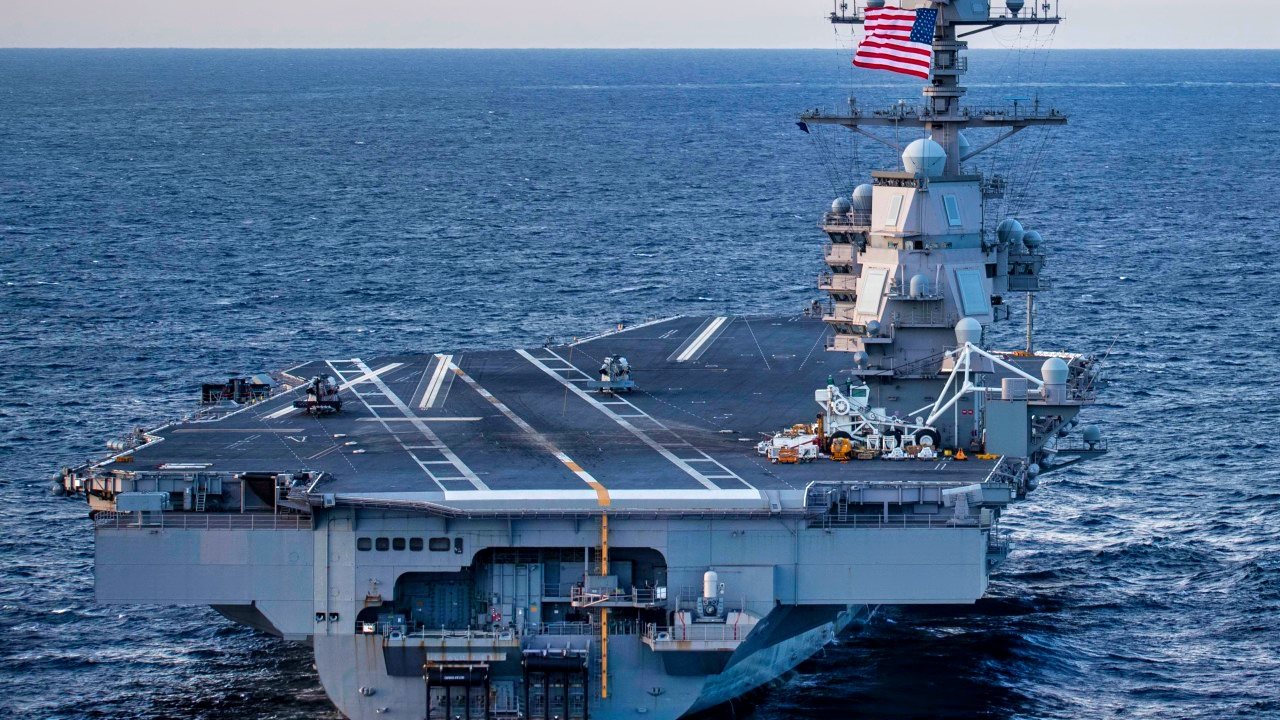
The Ford-class aircraft carrier USS Gerald R. Ford (CVN 78) and the Italian aircraft carrier ITS Cavour (CVH 550) transit the Atlantic Ocean March 20, 2021, marking the first time a Ford-class and Italian carrier have operated together underway. As part of the Italian Navy’s Ready for Operations (RFO) campaign for its flagship, Cavour is conducting sea trials in coordination with the F-35 Lightning II Joint Program Office’s Patuxent River Integrated Test Force to obtain official certification to safely operate the F-35B. Gerald R. Ford is conducting integrated carrier strike group operations during independent steaming event 17 as part of her post-delivery test and trials phase of operations. (U.S. Navy photo by Mass Communication Specialist 3rd Class Riley McDowell)
Shoot farther. The air wing’s standoff quiver—long-range anti-ship and land-attack missiles—keeps growing. If you can launch at range, you force the enemy to defend everywhere, not just near the coastline.
Blend manned and unmanned. Collaborative platforms let a stealthy spearhead sense and target while larger, non-stealthy aircraft act as magazines—including, yes, from the carrier.
Defense in depth. A modern strike group is a layered porcupine—Aegis cruisers and destroyers, E-2D for early warning, electronic attack, decoys, and, in the Ford era, the electrical power margin for directed-energy systems down the line. You don’t chase invulnerability; you make it costly to land a punch.
If those pieces arrive on time and at real scale, the carrier remains the most adaptable airfield on Earth—and the only one that can redeploy 700 miles before breakfast.
Follow-On Ships and a Future That Keeps Slipping Right
The class doesn’t live or die on one hull. John F. Kennedy (CVN-79) is the first follow-on—and she’s now tracking a 2027 delivery as the yard finishes AAG certification and elevator work. Enterprise (CVN-80) has slid into 2030 on supply-chain and workforce realities. Doris Miller (CVN-81) is marching through construction with a target in the early 2030s.
The message is mixed: the Navy and yard are learning, but learning while building big ships in a tight labor market is slow, and every delay echoes through the fleet plan.

The Ford-class aircraft carrier USS Gerald R. Ford (CVN 78) and the Italian aircraft carrier ITS Cavour (CVH 550) transit the Atlantic Ocean March 20, 2021, marking the first time a Ford-class and Italian carrier have operated together underway. As part of the Italian Navy’s Ready for Operations (RFO) campaign for its flagship, Cavour is conducting sea trials in coordination with the F-35 Lightning II Joint Program Office’s Patuxent River Integrated Test Force to obtain official certification to safely operate the F-35B. Gerald R. Ford is conducting integrated carrier strike group operations during independent steaming event 17 as part of her post-delivery test and trials phase of operations.
The Bill: Why “$13 Billion” Became a Punchline
Sticker shock matters in democracies. The lead ship’s procurement cost cleared $13 billion in then-year dollars, and that’s before you count billions more in R&D. Even with projected operations-and-support savings—fewer sailors, less maintenance—the near-term math invites questions: how many fewer destroyers, submarines, or aircraft did we buy to fund this?
Without a credible path to more on-time deliveries at lower marginal cost, the Ford argument is vulnerable on Capitol Hill.
A Day in the Life: Wargaming a Carrier in the Pacific
Picture an early-crisis week. A Ford-class carrier sits outside the densest threat rings, hundreds of miles east of the main fight. The air plan starts before dawn. E-2Ds build the picture; EA-18Gs press the edges and thicken the shield; strike fighters orbit in a layered counter-air posture while a tanker orbit extends reach. At H-hour, a mixed package pushes on a maritime target set: uncrewed decoys first, then long-range standoff shots cued by offboard sensors, followed by a smaller manned package to assess effects. The carrier never crosses an adversary’s optimal engagement zones, but it floods the battlespace with problems—and does it again tonight, and again tomorrow. That’s what the Ford bet buys: not a single cinematic strike, but repeatable pressure.

The world’s largest aircraft carrier USS Gerald R. Ford (CVN) 78 and the USNS Laramie (T-AO-203) conduct a refueling-at-sea in the Eastern Mediterranean Sea, Oct. 11, 2023. USS Gerald R. Ford is the Navy’s newest and most advanced aircraft carrier, representing a generational leap in the U.S. Navy’s capacity to project power on a global scale. The Gerald R. Ford Carrier Strike Group is currently operating in the Eastern Mediterranean Sea, at direction of the Secretary of Defense. The U.S. maintains forward deployed ready and postured forces to deter aggression and support security and stability around the world.(U.S. Navy photo by Mass Communication Specialist 2nd Class Jackson Adkins)
Where the Program Must Prove Itself
Three tests will decide whether the Ford class is a triumph or a cautionary tale:
Sorties at scale, reliably. It’s not the brochure number; it’s the nightly plan during a long war. EMALS and AAG must support sustained tempo without maintenance meltdowns. Advanced Weapons Elevators must be boringly reliable across hulls—so ordnance flow never becomes the bottleneck.
Air wing reach. MQ-25 has to get to the fleet and the weapons have to keep growing in range and survivability. If the air wing can’t reach, the ship can’t either.
Industrial cadence. The yard and vendors need a predictable drumbeat—which means stable budgets, trained labor, and sane engineering changes. A carrier every few years at a known price is how you turn a controversial program into a fleet you can plan around.
So—Obsolescence or Overmatch?
Neither extreme is honest. Carriers are more vulnerable than they were; they are also more necessary in a world where fixed bases are exposed. And to be honest, as I have written for over a decade now, I have my doubts about the future of aircraft carriers.
However, I have to give credit where credit is due. The Ford class is the Navy’s attempt to square that circle: higher daily output, lower crew burden, more power for what’s next. If the technology works at scale and the follow-on ships show schedule discipline, carriers remain the center of American joint power. If not, skeptics will have their case: we paid a premium for a platform that cannot go where it needs to when it matters.
Will the Ford-Class Survive?
The Ford-class is the most expensive admission ticket in modern warfare, and it buys something no one else has: a sovereign, mobile, adaptable airfield that can move faster than the enemy’s political system and stay longer than their pundits predicted.
It is not invulnerable; it is not cheap. But in a world where presence, pressure, and persistence win campaigns, the question isn’t whether the carrier is obsolete—it’s whether we will finish the job of evolving the air wing, the defenses, and the industrial base so this class can do what it was designed to do: deliver decisive airpower every day of a long war.
I have my doubts, but I am for sure willing to give the Ford-class the benefit of the doubt.
About the Author: Harry J. Kazianis
Harry J. Kazianis (@Grecianformula) is Editor-In-Chief and President of National Security Journal. He was the former Senior Director of National Security Affairs at the Center for the National Interest (CFTNI), a foreign policy think tank founded by Richard Nixon based in Washington, DC. Harry has over a decade of experience in think tanks and national security publishing. His ideas have been published in the NY Times, The Washington Post, The Wall Street Journal, CNN, and many other outlets worldwide. He has held positions at CSIS, the Heritage Foundation, the University of Nottingham, and several other institutions related to national security research and studies. He is the former Executive Editor of the National Interest and the Diplomat. He holds a Master’s degree focusing on international affairs from Harvard University.
More Military
America Bought a Fleet of Russian MiG-29 Fulcrum Fighters
The Virginia-Class Block III Submarine Is Almost Unstoppable
China’s J-20S Stealth Fighter Breaks Cover
The British Army’s Challenger 3 Tank Mistake Still Stings
The Bradley Fighting Vehicle has a Message for the U.S. Army




Krystal cane
September 3, 2025 at 11:38 am
Wasn’t the message by your leader to remove the electric catapult to put steam ones back on there because you know Donald knows so much about everything 😂😂😂😂 any veteran who voted for Trump is a disgrace the United States that should leave this country immediately for treason.
USN Veteran
September 3, 2025 at 6:56 pm
In times of national emergency one of the very first questions from the President is “Where are the carriers”. FLY NAVY!!!
Joseph K
September 4, 2025 at 12:48 am
The only country that matters to the US is China. And the cowardice yanks would never sail this piece of junk over there.