
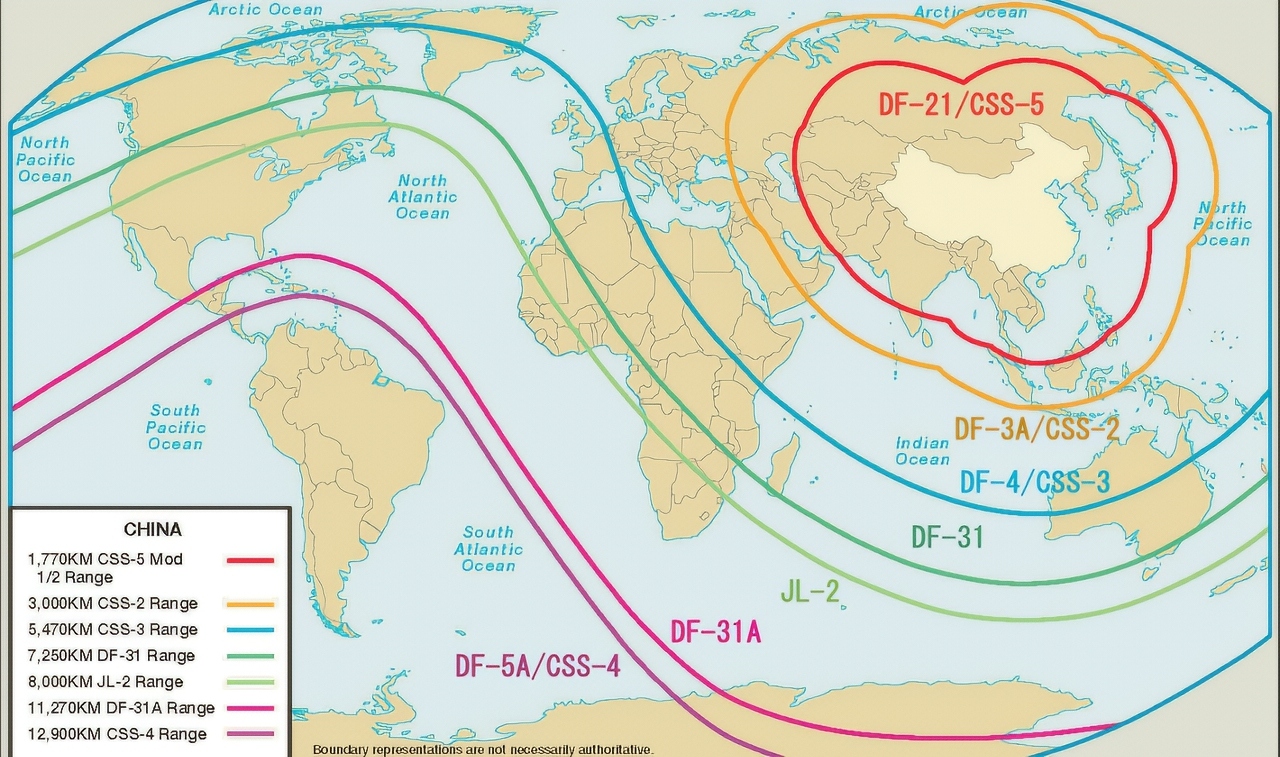
Key Points and Summary – Ahead of its massive Victory Day Parade, Chinese state media is prominently featuring the DF-31, one of its older, road-mobile intercontinental ballistic missiles.
-The media push touts the aging missile as an “effective” deterrent that can “still reach the US mainland,” highlighting a recent and rare full-range trans-Pacific test.
-While China is actively developing newer and more advanced nuclear systems like the DF-41, this public focus on the proven DF-31 is likely a deliberate strategic signal to the United States, showcasing the continued credibility of its second-strike nuclear capability.
Chinese Media Touts “Effective” DF-31 Ahead of Victory Day Parade
Ahead of China’s upcoming Victory Day Parade 2025, which will mark the 80th anniversary end of World War II in Asia, the state-controlled South China Morning Post published a piece touting the DF-31 missile as an “effective” deterrent.
As leaked images shared on social media give the world a look at the military hardware expected to be seen in Tiananmen Square on September 3, the report doubles down on how this aging missile system can “still reach the US mainland” and provide the People’s Liberation Army (PLA) with a “credible nuclear counterstrike force.”
The piece, published on August 23, recounts a story from September 25, 2024, during which China conducted its first full-range, trans-Pacific intercontinental ballistic missile (ICBM) test for over 45 years. It was the second time China had ever conducted a test like this, with the first taking place in 1980.
“The rare ICBM test also illustrated a credible second-strike nuclear capability for China, sending a strong geopolitical signal to the United States and its allies,” the piece reads.
What is the DF-31?
The Dong Feng 31 missile is a third-generation, road-mobile, and long-range ICBM that entered development in 1985 and was ultimately entered into service in 2006.
The missile was first displayed to the public in 1999 during the National Day Parade, and on August 2 that year, it successfully underwent its first test.
The DF-31 underwent three tests by November 2000.
New variations of the missile have emerged since. The DF-31A, for example, can travel much farther than the original design, with a range of 13,200 kilometers – allowing the missile to reach most of the continental United States.
That same missile is designed to accommodate between three and five warheads. The DF-31AG system, meanwhile, is designed for use with mobile launchers – and was officially unveiled to the public during a military parade for the 90th Anniversary of the founding of the People’s Liberation Army in 2017.
A three-stage missile, the DF-31 measures roughly 49 feet in length and 2 meters in diameter. It weighs 42 tonnes, and is guided by a stellar-inertial navigation system.
The original model is capable of carrying one thermonuclear warhead, and can deliver a yield of 1 megaton.
Yet even as China leans on the proven DF-31, its nuclear modernization continues. With newer systems like the DF-41 and sea- and air-based platforms inching toward operational status, the decision to showcase the DF-31 in national reporting – and likely at the upcoming Victory Day parade – may prove to be little more than signaling.
About the Author:
Jack Buckby is a British author, counter-extremism researcher, and journalist based in New York who writes frequently for National Security Journal. Reporting on the U.K., Europe, and the U.S., he works to analyze and understand left-wing and right-wing radicalization, and reports on Western governments’ approaches to the pressing issues of today. His books and research papers explore these themes and propose pragmatic solutions to our increasingly polarized society. His latest book is The Truth Teller: RFK Jr. and the Case for a Post-Partisan Presidency.
More Military
The F-117 Stealth Fighter Won’t Stay Retired