

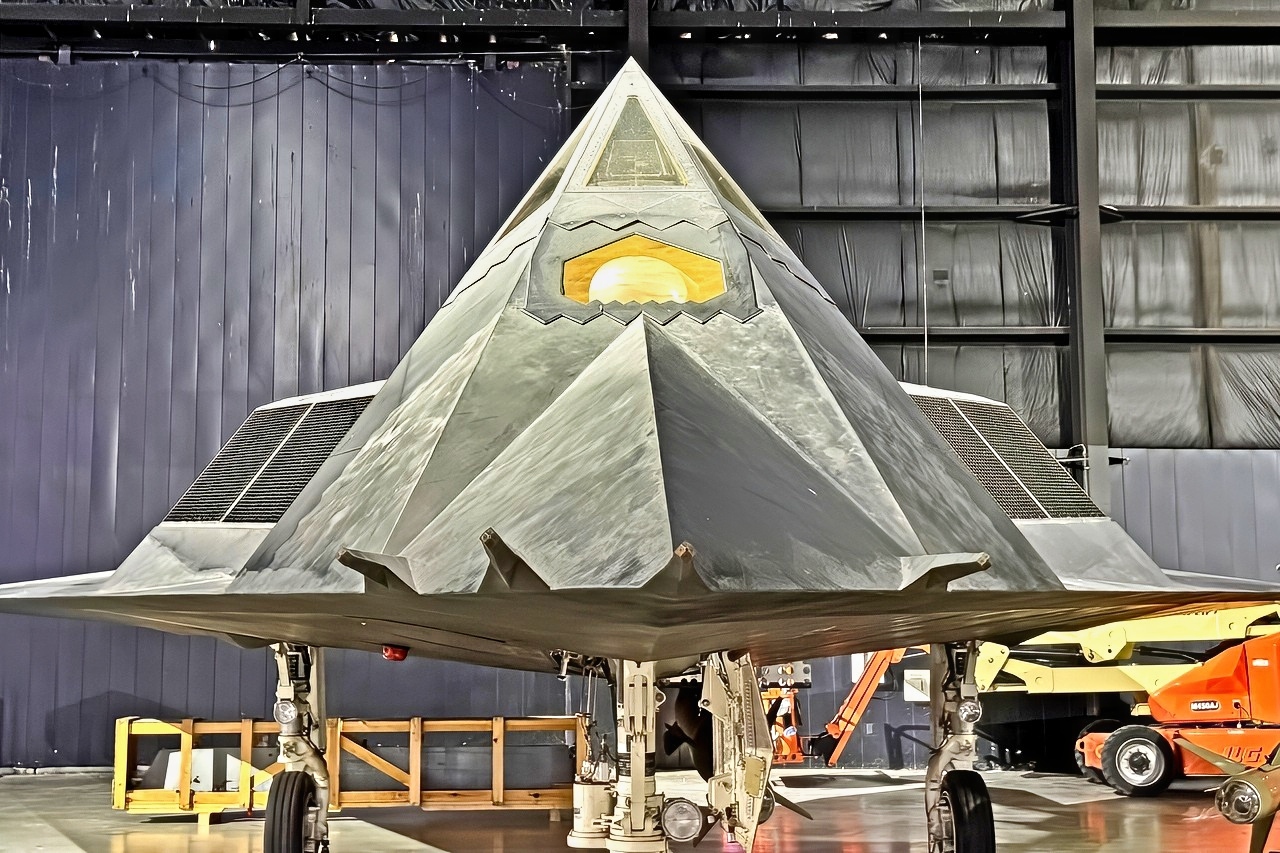
PUBLISHED on August 11, 2025, 7:29 PM EDT – Key Points and Summary – The F-117A Nighthawk was a revolutionary aircraft that ushered in the age of stealth and precision warfare.
-Developed in secret under the “Have Blue” program, its radical, faceted design prioritized radar evasion over speed and agility.
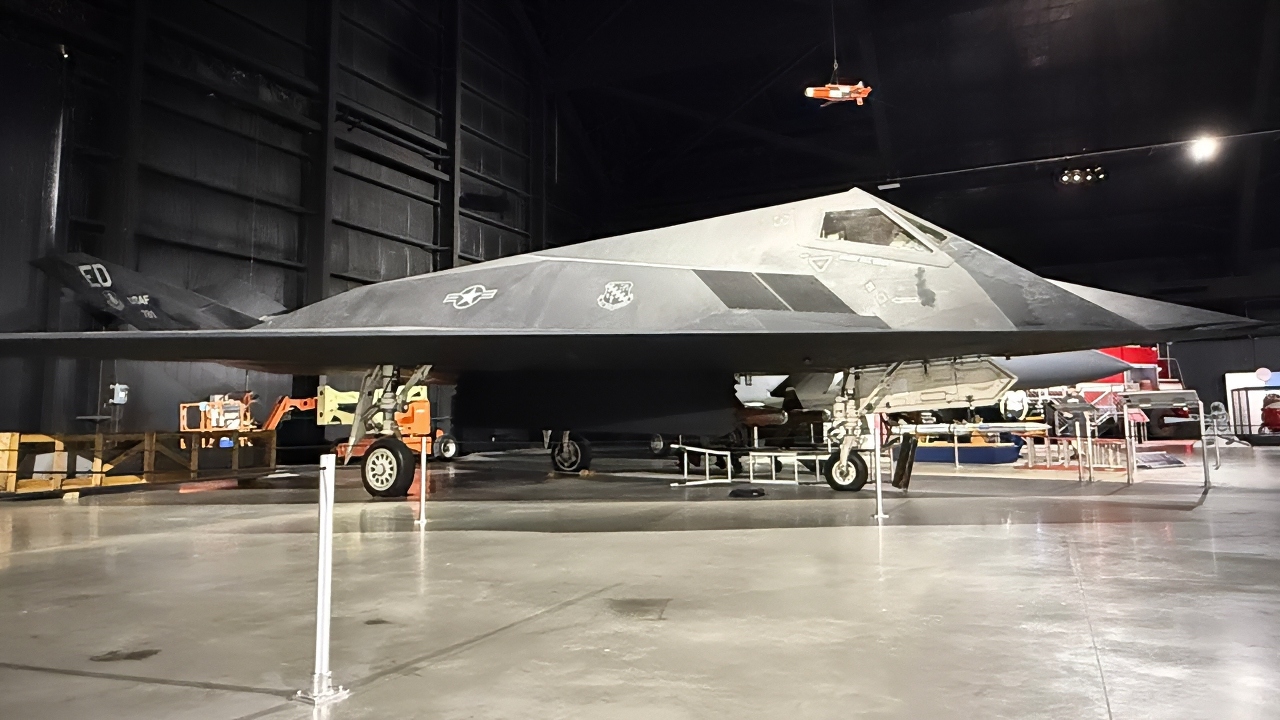
F-117 Nighthawk in the Air Force Museum. Image Credit: National Security Journal.
-Its legendary combat performance, particularly in the 1991 Gulf War where it flew over 1,300 missions without a single loss, proved the viability of stealth technology.
-This success fundamentally changed U.S. military doctrine, creating a new paradigm of surgical strikes that directly influenced the development of all subsequent stealth aircraft, including the F-22, F-35, and the next-generation F-47.
The F-117A Nighthawk Stealth Fighter Is Historic
The F-117A Nighthawk, the semi-retired first-generation stealth fighter of the United States Air Force (USAF), is undoubtedly one of the most important aircraft in the history of air warfare.
Retired in 2008, but continued to serve in some capacity in a support and test role since then, its impact has been truly historic, both in terms of American strategic thought and the form and function of the United States fighter and bomber communities for the 21st century.
The F-117A’s technical performance and capabilities, as well as its combat performance in terms of service record, changed not only the nature of waging war but also the evolutionary path for the future of fighters and bombers in the U.S. inventory.
As such, the F-117A not only defined the fifth-generation fighter and bomber aircraft, notably the F-22 and F-35, but also their sixth-generation successors, currently in development, the F-47 and F/A-XX, as well.

F-117 Stealth Fighter Static Display. Image Credit: National Security Journal.
The F-117A’s legacy will not be limited to technical and doctrinal aspects, as the Nighthawk is widely credited with being a force multiplier that drove a radical change in how wars are fought during the 21st century.
Stealth operations in denied airspaces and the promise of delivering long-range, air-delivered precision strikes from an airframe as inconspicuous as the F-117A presaged a radically new war-fighting paradigm, the tenets of which were—and remain—stealth, lethality, and minimal collateral damage.
The F-117A Origin Story
Developed in response to an exponential increase in surface-to-air missile (SAM) systems and airborne radar capabilities that became a more and more pronounced feature of Cold War–era battlespaces, the F-117A was in part a realization on the part of the U.S. military that high-value aircraft such as bombers and multirole strike fighters were doomed to irrelevance if they could not escape detection by these air defenses.
Thus, from within the USAF came an increasing demand for an aircraft that could be truly undetectable. So was born the F-117A, a truly unique airframe that was developed as part of a classified program with the code name “Have Blue.”
That Crazy Looking Shape
The Nighthawk was distinctive due to its unique shape.
The faceted airframe with its angular surfaces and “shiny” airframe deflected radar waves away from their source rather than back to it, drastically reducing the radar cross-section (RCS) of the aircraft. This feature was augmented by the use of radar-absorbent material (RAM) on the inside of the plane, as well as a certain eschewal of external antennas, to reduce the overall electronic signature of the aircraft and avoid detection by radar warning receivers (RWRs) or similar systems.

U.S. Air Force Museum Display of F-117 Nighthawk. Image Credit: National Security Journal.
It was so unusual and a departure from traditional aerodynamic shapes that it even appeared to defy the laws of flight.
However, it was effective, and its asymmetrical, flat surfaces baffled potential adversaries and observers alike. The resulting stealthy profile took precedence over many traditional fighter aircraft characteristics, such as speed, agility, and rate of climb.
The Nighthawk Made History
As a result, the F-117A was a technically advanced ground attack aircraft designed to carry a substantial bomb load and strike high-value, time-sensitive targets deep in enemy territory with pinpoint accuracy.
But its most significant contribution, truly, was that it was the first fighter aircraft to enable true stealth and precision strike warfare. Extremely sophisticated targeting and navigation systems made it possible for the F-117A to unleash air-to-ground ordnance with great precision from highly defended airspace and still evade return fire, truly an airborne sensor on legs.
The F-117 Goes to War
In practice, the F-117A soon proved its value. Used for the first time in combat in 1989 during the United States invasion of Panama, the Nighthawk was armed with an extensive array of advanced EW and sensors and used to conduct attack runs against high-value targets as needed and, as would be proven later, in a manner that enemy forces failed to detect.
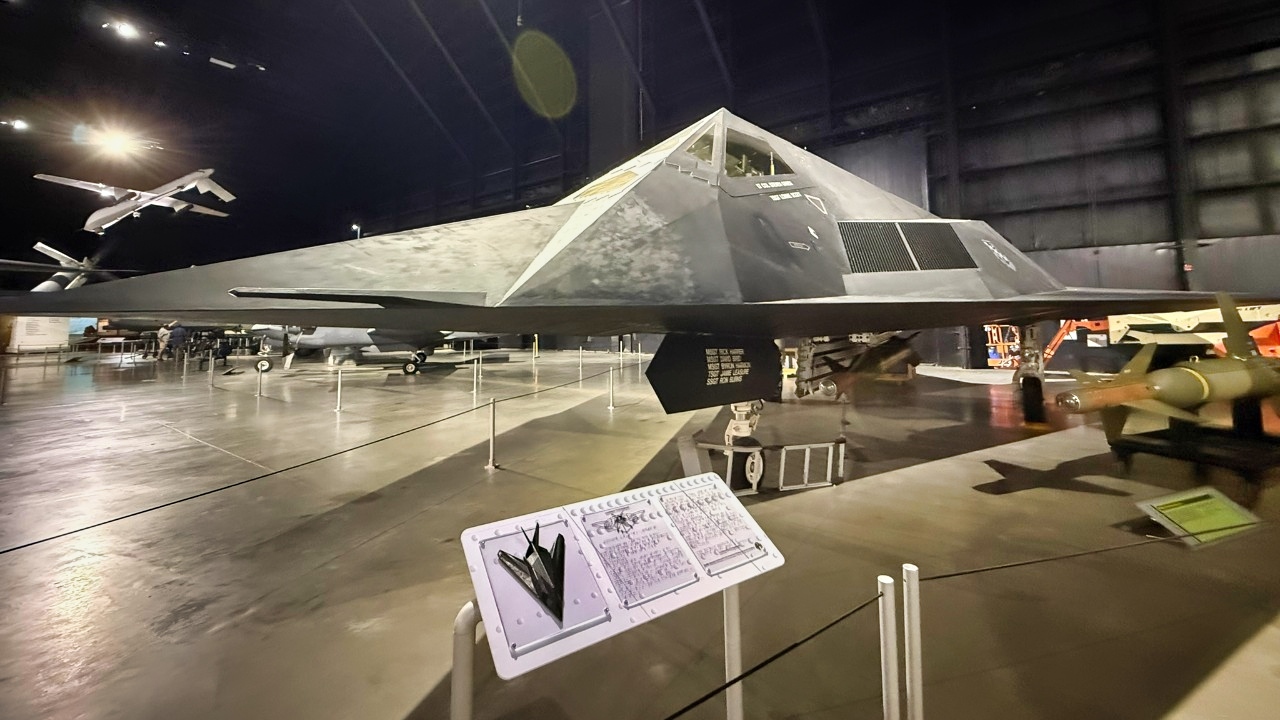
F-117 National Security Journal Photo Taken at U.S. Air Force Museum.
The 1991 Gulf War, however, was where the F-117A truly rose to fame and adulation as a truly revolutionary step in American air power. It was used to fly the riskiest of missions against the highest-value of targets deep in enemy territory and in the most heavily defended airspace, where it performed precision strikes with historically unmatched results.
Flying over 1,300 combat missions, not a single F-117A was lost to enemy action during the conflict. The F-117A’s ability to find and strike enemy air defense positions, command and control nodes, and high-value targets deep in enemy territory with high accuracy was its most significant legacy in terms of warfighting.
The F-117 in 2 Words: Made History
But the F-117A’s actual impact on the character of warfare is a different matter altogether.
The F-117A ushered in an age of war where massive bombing campaigns and their attendant civilian casualties became a relic of the past.
Warfare in the 21st century would become more specialized, with airpower becoming increasingly capable of conducting surgical, high-precision attacks on well-defined targets, resulting in far less collateral damage.
It was an expensive capability, without a doubt, but even from its earliest days, it was clear that only a small number of specialized stealthy platforms were needed in the U.S. Air Force arsenal to deliver pinpoint, high-precision munitions with a high degree of accuracy in even the most dangerous and contested areas on the battlefield.
A Window Into the Future
It was with this understanding in mind that the F-117A Nighthawk would become not only the first of its kind in the U.S. Air Force but also a significant stepping stone for future airframes in development and design.
The direct successor to the F-117A in terms of stealth technology, if not in terms of actual stealth warfighting capability, was to become the world’s first fifth-generation fighter, the F-22 Raptor.
Born from the lessons learned from the F-117A but with an array of new capabilities added on, including supercruise, enhanced maneuverability, and state-of-the-art avionics, the F-22 has since become the air dominance platform for the United States, able to operate even in some of the most challenging airspaces on the planet, including those that, in the past, were deemed completely off-limits even for the F-117A.
A similar conclusion could be drawn from the other fifth-generation multirole fighter, the F-35 Lightning II. The F-35 not only absorbed the precision strike lessons of the F-117A but was also designed with different domains of warfare in mind: air, land, and sea.
But it is in the future, however, that the F-117A’s most important effect on future generations of fighters would be seen. In the form of next-generation aircraft in development, notably the sixth-generation F-47 fighter that will succeed the F-22 and F-35 in the decades to come, the F-47 will be able to absorb the lessons of the F-117A and its fifth-generation progeny in a form designed with next-generation stealth technology, autonomy, and artificial intelligence baked into its airframe.

F-117A Nighthawk Sign Image Taken at USAF Museum. Image Credit: National Security Journal.
These are the aircraft that will take on the burden of high-precision, long-range strike and all that it entails. As such, with the advent of increasingly capable adversaries that now boast effective air defenses and the need to deliver high-precision airpower with the old methods being less and less effective, there are no doubt many lessons that future airframes will incorporate as the U.S. Air Force continues to look to its past as it seeks to invent the airframes of the future.
But while the F-117A’s impact on American airpower and airpower in general is incontestable, its legacy also looms large in the American military strategy for the 21st century.
With its ability to strike with incredible precision from highly defended airspace and in a more surgical manner, using a small number of aircraft, the need to win air superiority traditionally became far less pressing for mission planning.
The result was the initiation of a doctrinal shift towards the type of posture and strategy that the U.S. military finds itself in today. Airpower, now no longer characterized by brute force and overwhelming lethality, is all about remaining under the radar and attacking only when and where necessary.
A small number of specialized airframes could do what large strategic bombing campaigns of the World War II, Korea, and Vietnam eras could not.
These conclusions have since defined the U.S. military. Stealth, precision, and data fusion became its new watchwords.
Aviation Will Never Be the Same
The place of the F-117A Nighthawk in the history of air warfare and airpower is assured, and it is a place that will be remembered for a long time to come as the aircraft that changed the character of war.
Although it may have been retired from the frontline of service, its contributions to warfighting, aircraft design, and military strategy have endured.
The same stealth-first, data-centric mentality that the F-117A instilled will be the litmus test for future airframes going forward, whether it be the F-22, the F-35, or the F-47 of the future.
As the airpower environment of the 21st century becomes increasingly competitive and new aerial threats from peer and near-peer adversaries emerge, the F-117A will continue to play a significant role in informing and developing future U.S. Air Force airpower platforms for generations to come.
About the Author: Dr. Andrew Latham
Andrew Latham is a non-resident fellow at Defense Priorities and a professor of international relations and political theory at Macalester College in Saint Paul, MN. You can follow him on X: @aakatham. He writes a daily column for National Security Journal.
Editor’s Note: All photos and video in this article were taken on a July 19-20, 2025, National Security Journal visit to the U.S. Air Force Museum in Dayton, Ohio. We asked, and were denied, a request to take closer photos of this fighter due to “budget” and “low staffing” issues.
More Military
We Almost Touched the F-117 Stealth Fighter